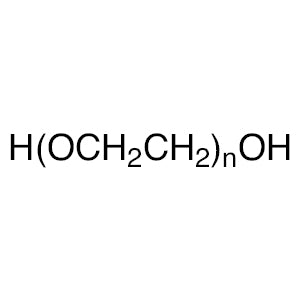
Polyethylene Glycol 20000 (PEG 20000) is a polyethylene glycol with a nominal average molecular weight of about 20,000. It is one of the most widely used high-molecular-weight PEG grades. TCI supplies it under product code P2830 in its Chemical Biology range, in the PEGylation category. The polymer is made of repeating ethylene oxide units with hydroxyl groups at the chain ends. In the laboratory, PEG 20000 is used to concentrate dialysates, precipitate biomolecules and create molecular crowding. It is also a starting material for long-chain PEG conjugates in drug delivery research.
Its very long chains give PEG 20000 strong osmotic and excluded-volume effects. Because the molecule is large, it does not pass easily through many dialysis membranes. This means it can be placed outside a dialysis bag to draw water out and gently concentrate protein samples. In PEGylation, the long chain increases the hydrodynamic size of the conjugated molecule, a strategy widely studied for extending the circulation time of therapeutic compounds. The solid dissolves well in water, though its solutions become fairly viscous at high concentrations.
In Indonesia, PEG 20000 is useful for biochemistry laboratories, protein research groups and university research teams working on biomolecule purification and characterization. It also serves pharmaceutical and drug delivery research laboratories that study polymer conjugates and long-chain PEG systems. Researchers in molecular biology and structural studies use it for crowding experiments and sample concentration. Its role in PEGylation makes it relevant for academic and industrial groups developing biomaterials and polymer-based formulations.
TCI brochures (PDF)
- Biomaterials Research Reagents 2025-02-19 · p. 6
- Dialysate concentration: PEG 20000 does not pass easily through many dialysis membranes, so it can be placed outside the dialysis bag to draw water out and gently concentrate protein samples.
- Biomolecule precipitation: its strong excluded-volume effect makes PEG 20000 a useful precipitant for proteins and other biomolecules during purification and sample preparation.
- Macromolecular crowding studies: the long polymer chains mimic crowded cellular conditions, letting researchers study how crowding affects protein folding, binding and enzyme behavior in vitro.
- PEGylation and conjugate synthesis: PEG 20000 is a starting material for long-chain PEG conjugates, which increase the hydrodynamic size of attached molecules in drug delivery research.
- Drug delivery research: long-chain PEGylation is widely studied as a way to extend the circulation time of therapeutic compounds, which makes PEG 20000 relevant to formulation and pharmaceutical studies.
| Brand | TCI (product code P2830) |
|---|---|
| CAS number | 25322-68-3 |
| Molecular formula | approximately 20,000 |
| Purity | — |
| Category | Chemistry > Chemical Biology > PEGylation |
| Pack sizes | see the product listing for available pack sizes, and follow the supplier's label and Safety Data Sheet for storage conditions |
| Physical form | Solid, readily soluble in water |
| Storage | — |
Keep PEG 20000 in a tightly closed original container in a cool, dry, well-ventilated place, away from moisture and direct sunlight. Close the container firmly after each use so the solid does not absorb moisture from the air. Use clean, dry spatulas and glassware or compatible plastic containers when weighing and preparing solutions. Because concentrated solutions can be viscous, allow enough time for the solid to dissolve fully. Follow standard laboratory practice: wear gloves, safety glasses and a lab coat, avoid creating dust, and don't eat or drink in the work area. Always check the Safety Data Sheet for full handling and disposal guidance.
—
Product Categories
- Polymer/Macromolecule ReagentsPolymersSynthetic Polymers
- Biomaterials/Biocompatible Materials Research ReagentsMonomers and Macromonomers [Biomaterials/Biocompatible Materials Research Reagents]Diol Monomers [Biomaterials/Biocompatible Materials Research Reagents]
- Biomaterials/Biocompatible Materials Research ReagentsPolymers [Biomaterials/Biocompatible Materials Research Reagents]PEGs, PEGylation Reagents [Biomaterials/Biocompatible Materials Research Reagents]
- Biomaterials/Biocompatible Materials Research ReagentsPolymers [Biomaterials/Biocompatible Materials Research Reagents]Synthetic Polymers
Produk Terkait
-
PolyethyleneGlycol11000 TCI P2829
Regular price Rp 477.750,00Regular priceRp 333.900,00Sale price Rp 477.750,00 -
PolyethyleneGlycol1000 TCI P2828
Regular price From Rp 477.750,00Regular priceRp 333.900,00Sale price From Rp 477.750,00 -
PolyethyleneGlycol2000 TCI P2034
Regular price From Rp 505.050,00Regular priceRp 352.800,00Sale price From Rp 505.050,00 -
PolyethyleneGlycol600 TCI P1187
Regular price From Rp 477.750,00Regular priceRp 333.900,00Sale price From Rp 477.750,00 -
PolyethyleneGlycol6000 TCI P0903
Regular price From Rp 477.750,00Regular priceRp 333.900,00Sale price From Rp 477.750,00 -
PolyethyleneGlycol4000 TCI P0885
Regular price From Rp 477.750,00Regular priceRp 333.900,00Sale price From Rp 477.750,00 -
PolyethyleneGlycol200 TCI P0840
Regular price From Rp 477.750,00Regular priceRp 333.900,00Sale price From Rp 477.750,00 -
PolyethyleneGlycol400 TCI N0443
Regular price From Rp 477.750,00Regular priceRp 333.900,00Sale price From Rp 477.750,00