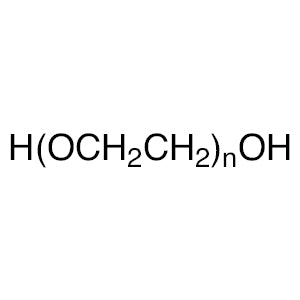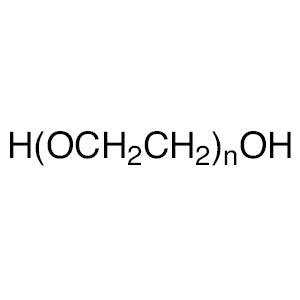
Polyethylene Glycol 2000 from TCI is a polyethylene glycol (PEG) polymer with an average molecular weight of about 2000. It is built from repeating ethylene oxide units and has a hydroxyl group at each end of the chain. PEG is one of the most widely used polymers in chemistry, biochemistry and pharmaceutical laboratories. This material is used for PEGylation, biomolecule precipitation and formulation work, and as a starting material for making functional PEG derivatives. It belongs in TCI's Chemical Biology range under the PEGylation category.
PEG 2000 is popular because it dissolves very well in water and in many polar organic solvents, so it fits into both aqueous and organic procedures. The polymer is also fairly inert chemically and is generally considered biocompatible, which matters for work involving biological systems. A chain length of around 2000 is often seen as a good balance. It is long enough to hydrate and sterically shield the surface of particles or molecules, yet still easy to handle and modify. The hydroxyl groups at both ends can be activated into tosylates, amines, carboxyls or other reactive groups for conjugation.
In Indonesia, PEG is widely used in pharmaceutical technology, nanotechnology, biochemistry and chemical engineering laboratories. Typical examples include preparing nanoparticles, solid dispersions, hydrogels and drug delivery systems. University research groups, pharmaceutical formulation labs and materials science teams use PEG 2000 both as a working excipient and as a building block for custom PEG derivatives. The 25g pack suits research-scale experiments, method development and student projects.
TCI brochures (PDF)
- Drug Delivery System (DDS) Research Reagents 2025-01-29 · p. 2
- Biomaterials Research Reagents 2025-02-19 · p. 6
- Monomers 2025-05-28 · p. 26
- PEGylation of molecules and surfaces: the chain length of about 2000 hydrates and sterically shields proteins, peptides and particle surfaces while staying easy to handle and modify.
- Synthesis of functional PEG derivatives: both terminal hydroxyl groups can be activated into tosylates, amines, carboxyls or other reactive groups, making it a flexible starting material for conjugation chemistry.
- Nanoparticle preparation: its water solubility, biocompatibility and steric shielding make it a common choice for coating and stabilizing nanoparticles in nanotechnology and drug delivery research.
- Solid dispersions and pharmaceutical formulation: high water solubility and relative chemical inertness make PEG 2000 a useful carrier polymer in pharmaceutical technology labs.
- Hydrogels and biomolecule precipitation: its hydrophilic, biocompatible backbone suits hydrogel preparation, and its behavior in aqueous solution supports precipitation of biomolecules in biochemistry workflows.
| Brand | TCI (product code P2034) |
|---|---|
| CAS number | 25322-68-3 |
| Molecular formula | about 2000 |
| Purity | — |
| Category | Chemistry > Chemical Biology > PEGylation |
| Pack sizes | 25g |
| Physical form | — |
| Storage | keep tightly closed in a cool, dry place |
Store Polyethylene Glycol 2000 in its original, tightly sealed container in a cool, dry, well-ventilated place, away from direct sunlight, heat sources and strong oxidizing agents. PEG can absorb moisture from the air, so close the container promptly after each use and do not leave it open for long periods. If you transfer portions, use clean, dry, clearly labeled glass or compatible plastic containers. Follow standard laboratory practice when handling it: wear gloves, safety glasses and a lab coat, avoid creating dust, and avoid contact with eyes and skin. Before use, check the Safety Data Sheet (SDS) provided by the manufacturer for detailed hazard, first-aid and disposal information.
—
Product Categories
- Polymer/Macromolecule ReagentsPolymersSynthetic Polymers
- Biomaterials/Biocompatible Materials Research ReagentsMonomers and Macromonomers [Biomaterials/Biocompatible Materials Research Reagents]Diol Monomers [Biomaterials/Biocompatible Materials Research Reagents]
- Biomaterials/Biocompatible Materials Research ReagentsPolymers [Biomaterials/Biocompatible Materials Research Reagents]PEGs, PEGylation Reagents [Biomaterials/Biocompatible Materials Research Reagents]
- Biomaterials/Biocompatible Materials Research ReagentsPolymers [Biomaterials/Biocompatible Materials Research Reagents]Synthetic Polymers
Produk Terkait
-
PolyethyleneGlycol20000 TCI P2830
Regular price From Rp 477.750,00Regular priceRp 333.900,00Sale price From Rp 477.750,00 -
PolyethyleneGlycol11000 TCI P2829
Regular price Rp 477.750,00Regular priceRp 333.900,00Sale price Rp 477.750,00 -
PolyethyleneGlycol1000 TCI P2828
Regular price From Rp 477.750,00Regular priceRp 333.900,00Sale price From Rp 477.750,00 -
PolyethyleneGlycol600 TCI P1187
Regular price From Rp 477.750,00Regular priceRp 333.900,00Sale price From Rp 477.750,00 -
PolyethyleneGlycol6000 TCI P0903
Regular price From Rp 477.750,00Regular priceRp 333.900,00Sale price From Rp 477.750,00 -
PolyethyleneGlycol4000 TCI P0885
Regular price From Rp 477.750,00Regular priceRp 333.900,00Sale price From Rp 477.750,00 -
PolyethyleneGlycol200 TCI P0840
Regular price From Rp 477.750,00Regular priceRp 333.900,00Sale price From Rp 477.750,00 -
PolyethyleneGlycol400 TCI N0443
Regular price From Rp 477.750,00Regular priceRp 333.900,00Sale price From Rp 477.750,00