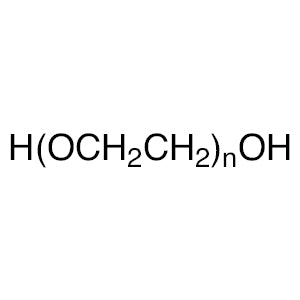
Polyethylene Glycol 1000 (PEG 1000) is a polymer of ethylene oxide with a nominal average molecular weight of around 1000, as the number in its name indicates. TCI supplies it under product code P2828 (CAS 25322-68-3) in the Chemical Biology range, within the PEGylation category. PEG is one of the most versatile polymers in the laboratory. It serves as a formulation base, a carrier solvent, and a starting material for making functional PEG derivatives. This makes PEG 1000 a useful everyday reagent for both synthetic and formulation work.
Several properties make PEG 1000 a common choice. It dissolves in water and in many organic solvents, it is relatively inert, and it is well known for its biocompatibility. At this molecular weight, PEG is usually a soft, waxy solid at room temperature that melts easily with gentle heating, so it is easy to blend with other materials. Hydroxyl groups at both ends of the chain can be converted into a range of reactive groups for PEGylation. Because the chain is relatively short, its solutions are less viscous than those of high molecular weight PEG, which makes it easier to handle. Its hydrophilic, flexible chain also makes it an effective solubility modifier.
In Indonesian laboratories, PEG 1000 is used in university research groups, pharmaceutical and cosmetic formulation labs, and chemical biology research facilities. Researchers use it as a starting material for synthesising PEG linkers and as a model polymer for teaching polymer chemistry. Formulation scientists use it as a base or carrier when preparing test formulations. Its predictable behaviour and ease of handling suit both routine work and more specialised research projects that need a dependable mid-range PEG grade.
TCI brochures (PDF)
- Biomaterials Research Reagents 2025-02-19 · p. 6
- PEGylation research: the terminal hydroxyl groups can be modified into reactive groups, so PEG 1000 is a practical starting point for preparing PEG conjugates and functional derivatives.
- Synthesis of functional PEG linkers: the relatively short chain and good solubility make it easy to handle during derivatisation steps and the purification that follows in organic synthesis.
- Formulation base and carrier: it melts readily with gentle heating and mixes well with other ingredients, so it works well as a base or carrier in experimental formulations.
- Solubility modification: its hydrophilic, flexible chain helps improve the solubility of less soluble compounds in aqueous systems and supports studies on solubility enhancement.
- Polymer chemistry education and model studies: as a well-characterised, relatively inert, low-to-mid molecular weight polymer, it is a convenient model material for teaching and comparative studies.
| Brand | TCI (product code P2828) |
|---|---|
| CAS number | 25322-68-3 |
| Molecular formula | — |
| Purity | — |
| Category | Chemistry > Chemical Biology > PEGylation |
| Pack sizes | available in TCI standard pack sizes; please confirm availability when ordering |
| Physical form | usually a soft, waxy solid at room temperature that melts with gentle heating |
| Storage | keep in a tightly closed container in a cool, dry place |
Store PEG 1000 in its original, tightly sealed container in a cool, dry, well-ventilated area, away from direct sunlight, heat sources, and strong oxidising agents. PEG can absorb moisture from the air, so close containers promptly after use. If you need to melt the material, use gentle, controlled heating rather than direct flame. Follow good laboratory practice: wear safety glasses, gloves, and a lab coat, avoid creating dust or splashes, and clean up spills promptly, since molten or spilled PEG can make surfaces slippery. Always read the supplier's Safety Data Sheet before use, and dispose of waste according to local regulations.
—
Product Categories
- Polymer/Macromolecule ReagentsPolymersSynthetic Polymers
- Biomaterials/Biocompatible Materials Research ReagentsMonomers and Macromonomers [Biomaterials/Biocompatible Materials Research Reagents]Diol Monomers [Biomaterials/Biocompatible Materials Research Reagents]
- Biomaterials/Biocompatible Materials Research ReagentsPolymers [Biomaterials/Biocompatible Materials Research Reagents]PEGs, PEGylation Reagents [Biomaterials/Biocompatible Materials Research Reagents]
- Biomaterials/Biocompatible Materials Research ReagentsPolymers [Biomaterials/Biocompatible Materials Research Reagents]Synthetic Polymers
Produk Terkait
-
PolyethyleneGlycol20000 TCI P2830
Regular price From Rp 477.750,00Regular priceRp 333.900,00Sale price From Rp 477.750,00 -
PolyethyleneGlycol11000 TCI P2829
Regular price Rp 477.750,00Regular priceRp 333.900,00Sale price Rp 477.750,00 -
PolyethyleneGlycol2000 TCI P2034
Regular price From Rp 505.050,00Regular priceRp 352.800,00Sale price From Rp 505.050,00 -
PolyethyleneGlycol600 TCI P1187
Regular price From Rp 477.750,00Regular priceRp 333.900,00Sale price From Rp 477.750,00 -
PolyethyleneGlycol6000 TCI P0903
Regular price From Rp 477.750,00Regular priceRp 333.900,00Sale price From Rp 477.750,00 -
PolyethyleneGlycol4000 TCI P0885
Regular price From Rp 477.750,00Regular priceRp 333.900,00Sale price From Rp 477.750,00 -
PolyethyleneGlycol200 TCI P0840
Regular price From Rp 477.750,00Regular priceRp 333.900,00Sale price From Rp 477.750,00 -
PolyethyleneGlycol400 TCI N0443
Regular price From Rp 477.750,00Regular priceRp 333.900,00Sale price From Rp 477.750,00