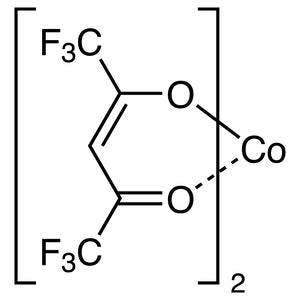
TCI H0553 Bis(hexafluoroacetylacetonato)cobalt(II) is a cobalt(II) coordination complex in which two hexafluoroacetylacetonate ligands bind the central metal in a bidentate fashion through their oxygen atoms. Replacing the methyl groups of ordinary acetylacetonate with trifluoromethyl groups produces a markedly more electron-withdrawing ligand, so the resulting complex behaves quite differently from Co(acac)₂. In the laboratory, the compound serves as a cobalt source that dissolves readily in organic solvents, as a catalyst or precatalyst in C–H bond activation and radical reactions, and as a metal precursor for thin-film growth.
The properties that make hexafluoroacetylacetonate complexes a preferred choice are the increased Lewis acidity of the metal centre, good solubility in organic and supercritical solvents, and relatively high volatility for a metal compound of this size. The fluorinated ligands shield the metal centre both sterically and electronically, so the complex resists thermal decomposition more effectively, yet the ligands can still dissociate when a substrate coordinates. This combination yields a catalyst that is active at reasonable temperatures while remaining convenient to handle as a solid.
In Indonesian laboratories, this reagent is typically used in university and institutional research groups working on synthetic methodology, homogeneous catalysis, and materials chemistry. It is normally weighed out in small quantities for screening catalytic conditions, dissolved in an organic solvent, and applied in bench-scale reactions under an inert atmosphere. Groups engaged in thin-film and surface studies also employ it as a volatile metal precursor within deposition equipment, where its solubility and stability simplify handling.
TCI brochures (PDF)
- C-H Bond Activation Reaction 2025-06-20 · p. 6
- Transition Metal Catalysts 2026-04-10 · p. 10
Related TCI products
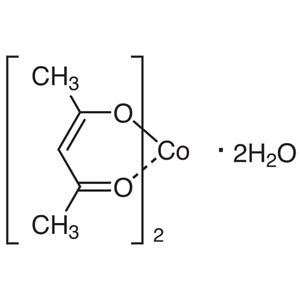
- TCI B2681 14024-48-7 Bis(2,4-pentanedionato)cobalt(II)
- TCI T0746 16092-38-9 Bis(trifluoro-2,4-pentanedionato)cobalt(II)
- TCI C0373 123334-29-2 Bis(2,4-pentanedionato)cobalt(II) Dihydrate
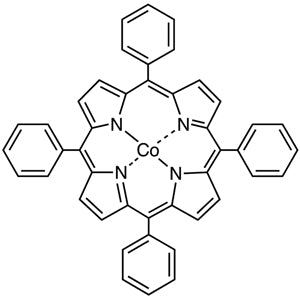
- TCI C3579 14172-90-8 Cobalt(II) Tetraphenylporphyrin
- TCI D5924 23638-66-6 Dichloro(dimethylglyoxime)(dimethylglyoximato)cobalt(III)
- TCI C3752 10026-17-2 Cobalt(II) Fluoride
- C–H bond activation catalysis: the electron-poor cobalt centre acts as a catalyst or precatalyst, and the fluorinated ligands dissociate readily once a substrate coordinates to the metal.
- Radical reaction chemistry: the cobalt(II) complex provides an accessible one-electron metal centre while its fluorinated ligand framework keeps the compound stable enough for routine bench use.
- Thin-film deposition precursor: the relatively high volatility of the hexafluoroacetylacetonate complex makes it suitable as a cobalt source for growing cobalt-containing thin layers.
- Homogeneous catalysis method development: excellent solubility in organic solvents allows the compound to be introduced as a clean, well-defined cobalt source for reaction screening work.
- Supercritical fluid chemistry: solubility in supercritical solvents lets researchers deliver cobalt into media where conventional inorganic cobalt salts would remain insoluble.
| Brand | TCI |
|---|---|
| CAS number | 19648-83-0 |
| Molecular formula | — |
| Purity | — |
| Category | Chemistry > Catalysis and Inorganic Chemistry > C-H Activation [Catalysis] |
| Pack sizes | available in standard TCI catalogue pack sizes; please confirm the current listed size when ordering. |
| Physical form | solid metal complex, handled by weighing and dissolution in organic solvent. |
| Storage | keep in a tightly closed container, protected from moisture. |
Store the container tightly closed in a cool, dry place away from moisture, since metal β-diketonate complexes are sensitive to humidity during prolonged storage. Original supplier bottles or tightly sealed glass containers with chemically resistant caps are appropriate; for the most demanding work, keep the material under an inert atmosphere or in a desiccator. Weigh and transfer the solid in a fume hood using clean, dry spatulas, and wear safety glasses, gloves, and a laboratory coat. Avoid generating dust, keep the compound away from heat sources, and consult the supplier safety data sheet before first use.
—
Product Categories
Produk Terkait
-
Bis(2,4-pentanedionato)cobalt(II) TCI B2681
Regular price Rp 1.696.800,00Regular price -
Bis(trifluoro-2,4-pentanedionato)cobalt(II) TCI T0746
Regular price From Rp 2.545.200,00Regular price -
Bis(2,4-pentanedionato)cobalt(II)Dihydrate TCI C0373
Regular price From Rp 2.041.200,00Regular price -
Cobalt(II)Tetraphenylporphyrin TCI C3579
Regular price Rp 2.650.200,00Regular price -
Dichloro(dimethylglyoxime)(dimethylglyoximato)cobalt(III) TCI D5924
Regular price From Rp 1.829.100,00Regular price -
Cobalt(II)Fluoride TCI C3752
Regular price From Rp 2.041.200,00Regular price -
Tris(hexafluoroacetylacetonato)iron(III) TCI H0555
Regular price Rp 6.360.900,00Regular price -
Bis(hexafluoroacetylacetonato)copper(II) TCI H0554
Regular price From Rp 1.167.600,00Regular price