


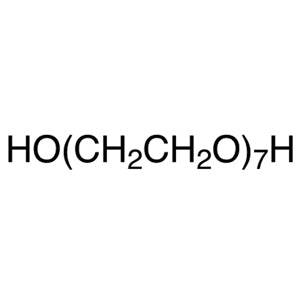
Heptaethylene glycol (HEG) is a versatile chemical compound widely used in laboratory experiments and molecular synthesis. As a fundamental building block in chemistry, HEG offers a simple yet flexible molecular structure, enabling its application in various chemical reactions. Its role in the laboratory is critical, serving as an essential reagent for the synthesis of complex compounds and the regulation of specific chemical processes. HEG is commonly employed in the development of polymers, solvents, and industrial chemical products, making it an indispensable tool for researchers and chemists.
HEG is preferred due to its stable chemical properties and excellent solubility in organic solvents. It exhibits a high boiling point, making it suitable for applications requiring elevated temperatures. The repeating molecular structure of HEG also imparts hydrophilic characteristics, allowing it to interact effectively with a wide range of chemical substances. These properties make it an ideal choice for experiments that require both reactivity and solubility. Its reliability and consistency in performance further enhance its appeal in both academic and industrial research settings.
In Indonesian laboratories, HEG is frequently used in chemical research and industrial applications. Educational institutions and research companies rely on HEG for synthesis experiments, particularly in polymer science and organic chemistry. Its availability and performance make it a standard component in many laboratory workflows, supporting the development of new materials and chemical processes. The compound’s adaptability and effectiveness in various experimental conditions ensure its continued relevance in the scientific community.
TCI brochures (PDF)
- Biomaterials Research Reagents 2025-02-19 · p. 20
- Polymer synthesis where HEG is used to create high molecular weight polymers due to its repeating ethylene glycol units.
- Organic chemistry experiments requiring a stable and versatile solvent with good solubility properties.
- Industrial chemical production where HEG serves as a base for manufacturing solvents and specialty chemicals.
- Research in material science for developing hydrophilic materials and coatings that require molecular flexibility.
- Chemical process optimization where HEG is utilized to regulate reaction temperatures and improve reaction efficiency.
| Brand | TCI |
|---|---|
| CAS number | 5617-32-3 |
| Molecular formula | — |
| Purity | — |
| Category | Chemistry > Building Blocks > Non-Heterocyclic Building Blocks |
| Pack sizes | Available in various sizes as per standard chemical supply practices |
| Physical form | Liquid |
| Storage | Store in a cool, dry place away from direct sunlight and incompatible materials |
Heptaethylene glycol should be stored in a cool, dry environment, away from direct sunlight and sources of heat. It is recommended to keep the compound in a tightly sealed container to prevent evaporation and contamination. Due to its liquid form, it should be stored in appropriate chemical-resistant containers to ensure safety and maintain its integrity. Avoid exposure to incompatible substances such as strong oxidizers or acids. In laboratory settings, always handle HEG with proper personal protective equipment, including gloves and safety goggles, to minimize risk. Regular monitoring of storage conditions is essential to ensure the stability and usability of the compound over time.
—
Product Categories
Produk Terkait
-
TriethyleneGlycol TCI T0428
Regular price Rp 530.250,00Regular priceRp 386.400,00Sale price Rp 530.250,00 -
TetraethyleneGlycol TCI T0099
Regular price From Rp 557.550,00Regular priceRp 405.300,00Sale price From Rp 557.550,00 -
PentaethyleneGlycol TCI P1154
Regular price From Rp 1.618.050,00Regular priceRp 1.146.600,00Sale price From Rp 1.618.050,00 -
NonaethyleneGlycol TCI N0698
Regular price Rp 11.791.500,00Regular priceRp 8.261.400,00Sale price Rp 11.791.500,00 -
DecaethyleneGlycol TCI D2900
Regular price Rp 11.288.550,00Regular priceRp 7.909.650,00Sale price Rp 11.288.550,00 -
HeptaethyleneGlycolMonomethylEther TCI H1046
Regular price From Rp 5.432.700,00Regular priceRp 3.814.650,00Sale price From Rp 5.432.700,00 -
TetraethyleneGlycolMonomethylEther TCI T1372
Regular price From Rp 1.881.600,00Regular priceRp 1.331.400,00Sale price From Rp 1.881.600,00 -
PentaethyleneGlycolMonomethylEther TCI P1159
Regular price From Rp 4.796.400,00Regular priceRp 3.369.450,00Sale price From Rp 4.796.400,00


