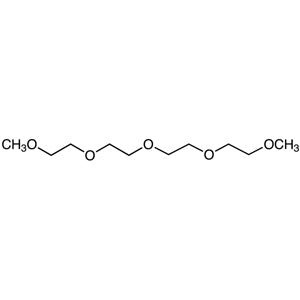
Tetraethylene Glycol from TCI (product code T0099) is an ethylene glycol oligomer made of four oxyethylene units, with a hydroxyl group at each end. You can think of it as a "short PEG" with a defined chain length. It does two jobs in the laboratory. First, it is a building block for making linkers, crown ethers and other oligoethylene glycol derivatives. Second, it is a polar, high-boiling solvent used in many reactions and materials processes. It is listed in the Non-Heterocyclic Building Blocks category.
Chemists choose this material because every molecule has the same chain length. Polymeric polyethylene glycol always contains a spread of molecular weights, but tetraethylene glycol gives a linker with an exact, predictable spacing. That precision matters in molecular design and bioconjugation. The ether backbone makes the molecule soluble in water and polar solvents, keeps it flexible, and lets it coordinate cations. The two terminal hydroxyl groups can be functionalised one after the other. As a solvent, its low volatility and its ability to dissolve metal salts make it a common choice for the polyol method of nanoparticle synthesis.
In Indonesia, organic and medicinal chemistry laboratories use Tetraethylene Glycol to build oligoethylene glycol linkers and spacers for target molecules and conjugates. Materials science and nanotechnology groups at universities and research institutes use it as a high-boiling polyol solvent to prepare metal and metal oxide nanoparticles. Supramolecular chemistry researchers use it as a starting material for crown ethers and related host molecules. Teaching laboratories also find it useful for showing how chain length and ether functionality affect solubility and coordination.
TCI brochures (PDF)
- Biomaterials Research Reagents 2025-02-19 · p. 20
- Linker and spacer synthesis: the fixed four-unit chain gives an exact distance between connected groups, and the two hydroxyl ends can be modified one at a time.
- Bioconjugation research: the defined oligoethylene glycol chain improves water solubility and flexibility, and it avoids the molecular weight spread found in polymeric PEG reagents.
- Crown ether and host molecule preparation: the ether oxygens along the chain can coordinate cations, so it is a logical precursor for macrocyclic and supramolecular structures.
- Polyol-method nanoparticle synthesis: low volatility, a high boiling point and good solubility for metal salts make it a suitable reaction medium for preparing nanoparticles.
- Oligoethylene glycol derivative synthesis: stepwise functionalisation of the terminal hydroxyl groups makes it possible to build tailored derivatives for molecular design and materials work.
| Brand | TCI (product code T0099) |
|---|---|
| CAS number | 112-60-7 |
| Molecular formula | — |
| Purity | — |
| Category | Chemistry > Building Blocks > Non-Heterocyclic Building Blocks |
| Pack sizes | as listed on the product page; please ask our team about available options |
| Physical form | liquid |
| Storage | keep tightly closed in a cool, dry, well-ventilated place |
Store Tetraethylene Glycol in its original, tightly sealed container in a cool, dry, well-ventilated area, away from direct sunlight, heat sources and strong oxidising agents. Glycols can absorb moisture from the air, so close the container promptly after each use to protect the material's quality. Use clean, dry glass or compatible chemical-resistant containers when transferring it. Follow standard laboratory practice: wear safety glasses, gloves and a lab coat, avoid contact with skin and eyes, and work in a well-ventilated area or fume hood. Always read the supplier's Safety Data Sheet before use and dispose of waste according to local regulations.
—
Product Categories
Produk Terkait
-
TetraethyleneGlycolMonomethylEther TCI T1372
Regular price From Rp 1.881.600,00Regular priceRp 1.331.400,00Sale price From Rp 1.881.600,00 -
TriethyleneGlycol TCI T0428
Regular price Rp 530.250,00Regular priceRp 386.400,00Sale price Rp 530.250,00 -
PentaethyleneGlycol TCI P1154
Regular price From Rp 1.618.050,00Regular priceRp 1.146.600,00Sale price From Rp 1.618.050,00 -
NonaethyleneGlycol TCI N0698
Regular price Rp 11.791.500,00Regular priceRp 8.261.400,00Sale price Rp 11.791.500,00 -
HeptaethyleneGlycol TCI H1045
Regular price Rp 4.399.500,00Regular priceRp 3.092.250,00Sale price Rp 4.399.500,00 -
DecaethyleneGlycol TCI D2900
Regular price Rp 11.288.550,00Regular priceRp 7.909.650,00Sale price Rp 11.288.550,00 -
TetraethyleneGlycolMonobenzylEther TCI T1997
Regular price From Rp 3.365.250,00Regular priceRp 2.368.800,00Sale price From Rp 3.365.250,00 -
TetraethyleneGlycolDimethylEther TCI B0497
Regular price From Rp 530.250,00Regular priceRp 386.400,00Sale price From Rp 530.250,00