


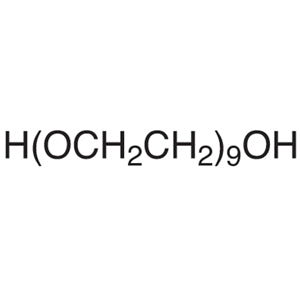
Nonaethylene Glycol from TCI (product code N0698) is an ethylene glycol oligomer made of exactly nine ethylene oxide units, with a hydroxyl group at each end of the chain. Commercial polyethylene glycol (PEG) is a mixture of chains of different lengths. This compound is monodisperse instead, so every molecule has the same chain length. In the laboratory it serves as a building block for hydrophilic linkers, as a starting material for well-defined PEG derivatives, and as a reference standard in oligomer analysis.
The main reason chemists choose this material is that it is monodisperse. Because the linker length is exact, reaction products are easier to characterize by NMR spectroscopy and mass spectrometry, and results in structure-activity relationship studies are easier to reproduce. The ethylene oxide chain improves water solubility and gives the molecule flexibility. The two terminal hydroxyl groups can be functionalized either symmetrically or asymmetrically. For example, they can be converted into tosylates, azides, amines, carboxylic acids, or activated esters, depending on what the conjugation strategy needs.
In Indonesia, this material is relevant to medicinal chemistry, biotechnology, and materials science laboratories that develop conjugates, linkers, and functional molecules that need a defined spacer length. University research groups, pharmaceutical research and development teams, and institutional laboratories can use it when they need precise, repeatable molecular design instead of the variable chain lengths found in polydisperse PEG. Its role as a defined building block makes it useful both for synthesis and for building reliable analytical reference methods.
TCI brochures (PDF)
- Biomaterials Research Reagents 2025-02-19 · p. 20
- Hydrophilic linker synthesis: the exact nine-unit ethylene oxide chain gives a spacer of consistent, known length that improves water solubility and flexibility in the final molecule.
- Preparation of defined PEG derivatives: both terminal hydroxyl groups can be converted into tosylates, azides, amines, carboxylic acids, or activated esters for specific downstream reactions.
- Bioconjugation research: the monodisperse chain gives uniform conjugates, which makes products easier to characterize by NMR and mass spectrometry than conjugates made with mixed-length PEG.
- Structure-activity relationship studies: a fixed linker length lets researchers compare compounds reproducibly and attribute activity changes to deliberate structural modifications rather than chain-length variation.
- Oligomer analysis standard: because every molecule has the same chain length, the compound works well as a reference material when analyzing and identifying ethylene glycol oligomers.
| Brand | TCI (product code N0698) |
|---|---|
| CAS number | 3386-18-3 |
| Molecular formula | — |
| Purity | — |
| Category | Chemistry > Building Blocks > Non-Heterocyclic Building Blocks |
| Pack sizes | available in the pack sizes listed on the product page |
| Physical form | — |
| Storage | follow the storage conditions stated on the TCI label and Safety Data Sheet |
- Structure: monodisperse ethylene glycol oligomer with nine ethylene oxide units and two terminal hydroxyl groups
Store Nonaethylene Glycol in its original, tightly closed container in a cool, dry, well-ventilated area away from direct sunlight, heat sources, and incompatible materials such as strong oxidizing agents. Keeping the container sealed limits moisture uptake and contamination, which helps preserve the material's defined composition for sensitive synthesis and analytical work. If you transfer the material, use clean, dry, clearly labeled glass or chemically compatible containers. Handle it according to good laboratory practice: wear safety glasses, gloves, and a lab coat, and avoid contact with skin and eyes. Read the TCI Safety Data Sheet before use for specific hazard, storage, and disposal guidance.
—
Product Categories
Produk Terkait
-
NonaethyleneGlycolMonomethylEther TCI N0699
Regular price From Rp 4.266.150,00Regular priceRp 2.998.800,00Sale price From Rp 4.266.150,00 -
TriethyleneGlycol TCI T0428
Regular price Rp 530.250,00Regular priceRp 386.400,00Sale price Rp 530.250,00 -
TetraethyleneGlycol TCI T0099
Regular price From Rp 557.550,00Regular priceRp 405.300,00Sale price From Rp 557.550,00 -
PentaethyleneGlycol TCI P1154
Regular price From Rp 1.618.050,00Regular priceRp 1.146.600,00Sale price From Rp 1.618.050,00 -
HeptaethyleneGlycol TCI H1045
Regular price Rp 4.399.500,00Regular priceRp 3.092.250,00Sale price Rp 4.399.500,00 -
DecaethyleneGlycol TCI D2900
Regular price Rp 11.288.550,00Regular priceRp 7.909.650,00Sale price Rp 11.288.550,00 -
TetraethyleneGlycolMonomethylEther TCI T1372
Regular price From Rp 1.881.600,00Regular priceRp 1.331.400,00Sale price From Rp 1.881.600,00 -
PentaethyleneGlycolMonomethylEther TCI P1159
Regular price From Rp 4.796.400,00Regular priceRp 3.369.450,00Sale price From Rp 4.796.400,00


