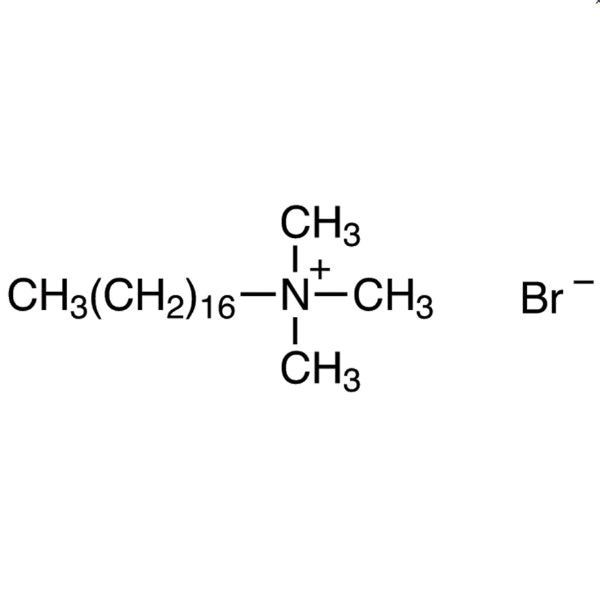
TCI H1307 Heptadecyltrimethylammonium Bromide is a quaternary ammonium cationic surfactant built around a seventeen-carbon alkyl chain attached to a positively charged trimethylammonium head group. The compound serves as a shape-directing agent and surface ligand in nanomaterial synthesis, particularly in the preparation of colloidal quantum dots and metal nanoparticles. In the laboratory, surfactants of this type adsorb onto the surfaces of growing crystals, control the rate of growth along specific crystallographic directions, and keep particles dispersed so that they do not aggregate during or after the synthesis process.
The property that makes this material a preferred choice is its odd-numbered C17 chain length, which sits between the standard even-carbon surfactants such as hexadecyl- and octadecyltrimethylammonium bromide. This single-carbon difference shifts the critical micelle concentration, the packing density of the chains on the particle surface, and the strength of the hydrophobic interactions, allowing researchers to finely tune nanoparticle morphology and size. Its quaternary ammonium group carries a fixed charge across the entire pH range, providing stable electrostatic repulsion in aqueous colloidal dispersions, while the accompanying bromide counter-ion participates in surface coordination chemistry at the growing crystal face.
In Indonesian laboratories, this surfactant is typically used in university and government research groups working on nanomaterials, electronic materials, and colloidal quantum dot development. It is generally handled in small quantities on the bench, weighed out for solution preparation, and dissolved in aqueous or alcoholic media before being introduced into a synthesis vessel. Researchers comparing chain-length effects across a homologous surfactant series commonly keep it alongside the more familiar even-carbon analogues so that systematic morphology studies can be run under otherwise identical conditions.
- Colloidal quantum dot synthesis — the surfactant adsorbs to the growing nanocrystal surface, controls directional growth, and keeps the resulting dots dispersed without aggregation.
- Metal nanoparticle shape control — directional adsorption on specific crystallographic faces lets researchers steer particle morphology toward rods, plates, or other anisotropic geometries.
- Colloidal dispersion stabilization — the permanently charged quaternary ammonium head supplies electrostatic repulsion that keeps aqueous particle suspensions stable across the full pH range.
- Surface ligand chemistry studies — the C17 chain provides an odd-carbon reference point for examining how ligand packing density on a particle surface governs growth behaviour.
- Homologous series comparison studies — positioned between hexadecyl and octadecyl analogues, it fills a chain-length gap when mapping critical micelle concentration and hydrophobic interaction trends.
| Brand | TCI |
|---|---|
| CAS number | 21424-24-8 |
| Molecular formula | — |
| Purity | — |
| Category | Materials Science > Electronic Materials > Colloidal Quantum Dot (QD) Research Reagents |
| Pack sizes | please refer to the packaging options listed for this catalogue item |
| Physical form | — |
| Storage | store according to the manufacturer's stated conditions on the product label |
- Product code: H1307
Store the container tightly closed in a cool, dry, well-ventilated area, away from moisture, since quaternary ammonium surfactants are generally hygroscopic and can cake or clump if exposed to humid air. Keep the material in its original supplier packaging or in a clean, tightly sealed glass or chemically compatible plastic container, clearly labelled with the product name and CAS number. Handle the solid in a fume hood or a well-ventilated weighing area to avoid generating or inhaling dust, and wear standard laboratory personal protective equipment including gloves, safety glasses, and a laboratory coat. Avoid contact with skin and eyes, wash hands thoroughly after handling, and consult the manufacturer's safety data sheet before use and before disposal.
—
Produk Terkait
-
TCI B5774 5,10-Bis(4,4,5,5-tetramethyl-1,3,2-dioxaborolan-2-yl)naphtho[1,2-c:5,6-c']bis([1,2,5]oxadiazole)
Regular price Rp 10.255.350,00Regular price -
Dihydroiodide TCI B6569
Regular price From Rp 1.936.200,00Regular price -
Trifluoromethanesulfonate TCI B7003
Regular price From Rp 1.936.200,00Regular price
![5,10-Bis(4,4,5,5-tetramethyl-1,3,2-dioxaborolan-2-yl)naphtho[1,2-c:5,6-c']bis([1,2,5]oxadiazole) - TCI B5774 - AMI Scientific](http://amiscientific.com/cdn/shop/files/TCI2510B5774.jpg?v=1769180228&width=533)