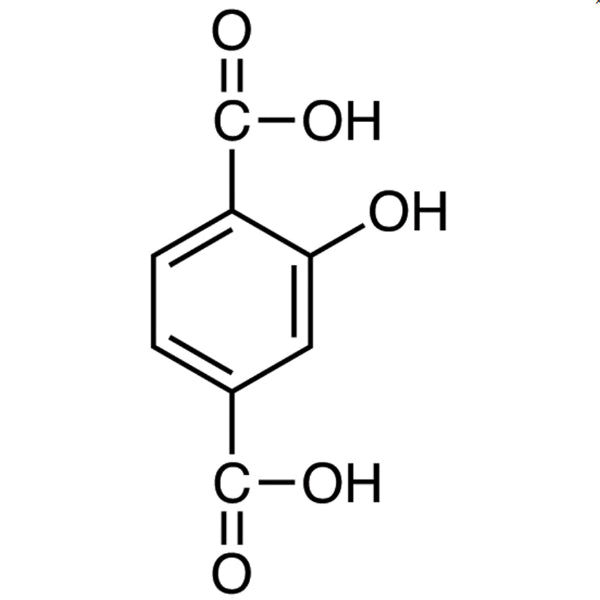
TCI H1385 2-Hydroxyterephthalic Acid is an aromatic dicarboxylic acid derived from terephthalic acid, carrying an additional hydroxyl group on the benzene ring. In materials science laboratories, this compound serves as a bridging ligand, or linker, in the preparation of metal organic frameworks, commonly abbreviated as MOF. The two carboxylate groups sit at opposing positions on the ring and are able to bind metal centres at both ends, producing an ordered porous network, while the hydroxyl group adds functional character to the resulting pore walls.
The characteristics that make this compound a frequent choice begin with the rigid, linear geometry of the terephthalate skeleton, which yields porous crystalline structures with a high degree of order. Combined with this is the hydroxyl group, which provides the ability to interact through hydrogen bonding and opens the possibility of post-synthetic modification. Beyond its use as a linker, the compound is also widely recognised in analytical chemistry, because it is the fluorescent hydroxylation product of terephthalic acid. That property makes it a useful marker in studies of hydroxyl radical formation, allowing researchers to employ it as a comparison material.
In Indonesian laboratories, this material is typically encountered in university and institutional research settings where porous materials are synthesised and characterised. It is handled as a research chemical on the laboratory bench, weighed out for framework synthesis work, and kept as a reference standard in analytical work involving hydroxyl radical detection. Its role is that of a starting material and reference compound rather than a routine bulk consumable, so quantities used per experiment are generally modest.
TCI brochures (PDF)
- Organic Linker Molecules for Metal Organic Frameworks (MOFs) 2026-05-11 · p. 3
- Metal organic framework synthesis: the two opposing carboxylate groups coordinate metal centres at both ends of the molecule, building ordered porous networks with predictable, repeating architecture.
- Functionalised pore wall design: the hydroxyl group decorates the interior surfaces of the framework, adding polar functional character that plain terephthalate linkers cannot provide on their own.
- Post-synthetic modification studies: the pendant hydroxyl group offers a reactive handle on an assembled framework, allowing chemists to alter pore chemistry after the crystalline structure has already formed.
- Hydroxyl radical detection work: as the fluorescent hydroxylation product of terephthalic acid, it acts as the reference marker against which radical generation in a test system is judged.
- Analytical comparison standard: researchers use authentic material of this compound to confirm the identity of species formed during terephthalic acid probe experiments and related fluorescence measurements.
| Brand | TCI |
|---|---|
| CAS number | 636-94-2 |
| Molecular formula | — |
| Purity | — |
| Category | Materials Science > Organic-Inorganic Hybrid Materials > Metal Organic Frameworks (MOF) and Their Raw Materials |
| Pack sizes | available in standard TCI research pack sizes; please confirm the packing option required |
| Physical form | — |
| Storage | keep in a cool, dry place in the tightly closed original container |
- Product code: H1385
Store the container in a cool, dry, well ventilated area away from direct sunlight, moisture and sources of heat or ignition. Keep the material in its original tightly closed container, or in a clean, chemically compatible and clearly labelled vessel, to prevent moisture uptake and contamination of the solid. Handle the compound in a fume hood or a well ventilated workspace and avoid generating dust during weighing and transfer. Wear a laboratory coat, safety glasses and chemically resistant gloves throughout, and avoid contact with skin and eyes as well as inhalation of any airborne particles. Wash hands thoroughly after handling, keep the material separated from incompatible substances, and consult the manufacturer safety data sheet before beginning any work.
—
Product Categories
- Organic-Inorganic Hybrid MaterialsMetal Organic Frameworks (MOF) and Their Raw MaterialsOrganic Linker Molecules [Metal Organic Frameworks (MOFs) Precursors]
- Polymer/Macromolecule ReagentsMetal Organic Frameworks (MOF) and Their Raw MaterialsOrganic Linker Molecules [Metal Organic Frameworks (MOFs) Precursors]
Produk Terkait
-
TerephthalicAcid TCI T0166
Regular price From Rp 452.550,00Regular priceRp 316.050,00Sale price From Rp 452.550,00 -
2,5-DihydroxyterephthalicAcid TCI D3899
Regular price From Rp 2.384.550,00Regular priceRp 1.683.150,00Sale price From Rp 2.384.550,00 -
BromoterephthalicAcid TCI B1321
Regular price From Rp 2.306.850,00Regular priceRp 1.612.800,00Sale price From Rp 2.306.850,00 -
2-AminoterephthalicAcid TCI A1291
Regular price From Rp 980.700,00Regular priceRp 1.686.300,00Sale price From Rp 980.700,00Sale -
NitroterephthalicAcid TCI N0272
Regular price From Rp 1.590.750,00Regular priceRp 1.111.950,00Sale price From Rp 1.590.750,00 -
2-MethylterephthalicAcid TCI M3640
Regular price Rp 3.419.850,00Regular priceRp 2.390.850,00Sale price Rp 3.419.850,00 -
2,5-Bis(trifluoromethyl)terephthalicAcid TCI B6503
Regular price From Rp 3.155.250,00Regular priceRp 2.206.050,00Sale price From Rp 3.155.250,00 -
TetrafluoroterephthalicAcid TCI T0930
Regular price From Rp 980.700,00Regular priceRp 685.650,00Sale price From Rp 980.700,00