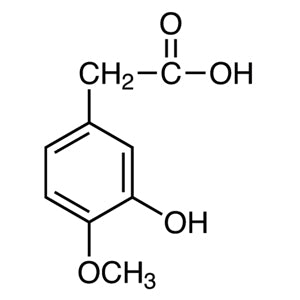
3-Hydroxy-4-methoxyphenylacetic Acid is a chemical compound widely used in organic synthesis reactions. It serves as a fundamental building block in the creation of complex molecules that require aromatic structures with hydroxyl and methoxy substituents. In laboratory settings, this compound plays a crucial role in the development of substances with specific biological or chemical properties. Its simple yet versatile structure makes it a preferred choice for various chemical experiments, enabling researchers to explore different reaction pathways and functional group modifications.
The compound’s chemical stability under certain conditions, combined with its reactivity towards acids, bases, and organic reagents, makes it highly adaptable for a range of synthetic applications. The presence of both hydroxyl and methoxy groups provides opportunities for substitution, esterification, and reduction reactions. These characteristics make it particularly suitable for the synthesis of pharmaceutical compounds, industrial chemicals, and materials used in scientific research. Its reliability and predictability in chemical reactions ensure consistent results in laboratory experiments.
In Indonesian laboratories, 3-Hydroxy-4-methoxyphenylacetic Acid is commonly used in organic chemistry research, especially in fields such as pharmacology, food chemistry, and industrial chemical development. It is frequently employed in academic and research institutions for experiments that require the synthesis of complex molecules with specific functional groups. Its availability and chemical properties make it a valuable resource for both educational and applied research purposes.
Related TCI products
- TCI H0339 306-08-1 4-Hydroxy-3-methoxyphenylacetic Acid
- TCI V0052 776-99-8 3,4-Dimethoxyphenylacetone
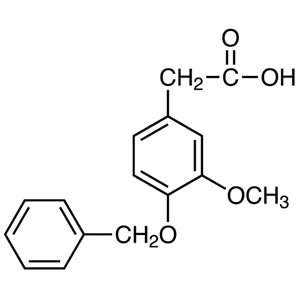
- TCI B4800 29973-91-9 4-Benzyloxy-3-methoxyphenylacetic Acid
- TCI B4742 4547-57-3 4-Butoxyphenylacetic Acid
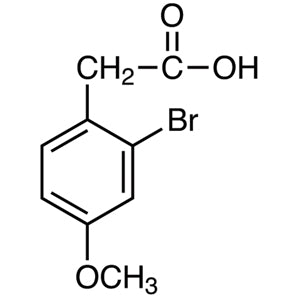
- TCI B4737 66916-99-2 2-Bromo-4-methoxyphenylacetic Acid
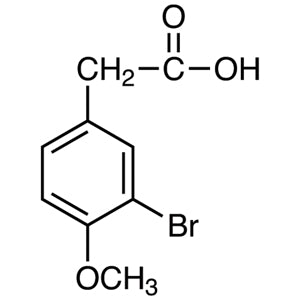
- TCI B4677 774-81-2 3-Bromo-4-methoxyphenylacetic Acid
- Organic synthesis in pharmaceutical research due to its ability to form complex molecular structures with hydroxyl and methoxy groups.
- Development of food additives and flavor compounds through esterification and substitution reactions.
- Industrial chemical production where stable and reactive building blocks are required for functional group modification.
- Academic research in pharmacology for the synthesis of bioactive compounds with specific molecular frameworks.
- Chemical analysis and modification of aromatic compounds in material science and polymer chemistry.
| Brand | TCI |
|---|---|
| CAS number | 1131-94-8 |
| Molecular formula | — |
| Purity | — |
| Category | Chemistry > Building Blocks > Non-Heterocyclic Building Blocks |
| Pack sizes | Available in various quantities as per standard laboratory supply |
| Physical form | Solid (crystalline or powder, depending on supplier) |
| Storage | Store in a cool, dry place away from light and moisture |
This compound should be stored in a cool, dry environment, away from direct light and moisture to maintain its chemical stability. It is recommended to use airtight containers to prevent exposure to air and humidity, which could affect its reactivity. In laboratory settings, it should be handled with appropriate personal protective equipment, such as gloves and safety goggles, to ensure safe handling. Due to its reactivity with acids and bases, it should be stored separately from incompatible substances. Proper labeling and storage conditions are essential to maintain its integrity and ensure safe use in chemical experiments.
—
Produk Terkait
-
4-Hydroxy-3-methoxyphenylaceticAcid TCI H0339
Regular price From Rp 955.500,00Regular price -
3,4-Dimethoxyphenylacetone TCI V0052
Regular price From Rp 1.193.850,00Regular price -
4-Benzyloxy-3-methoxyphenylaceticAcid TCI B4800
Regular price Rp 2.518.950,00Regular price -
4-ButoxyphenylaceticAcid TCI B4742
Regular price From Rp 1.060.500,00Regular price -
2-Bromo-4-methoxyphenylaceticAcid TCI B4737
Regular price From Rp 848.400,00Regular price -
3-Bromo-4-methoxyphenylaceticAcid TCI B4677
Regular price From Rp 689.850,00Regular price -
3-BenzyloxyphenylaceticAcid TCI B4674
Regular price Rp 1.618.050,00Regular price -
4-BenzyloxyphenylaceticAcid TCI B1779
Regular price Rp 2.969.400,00Regular price