

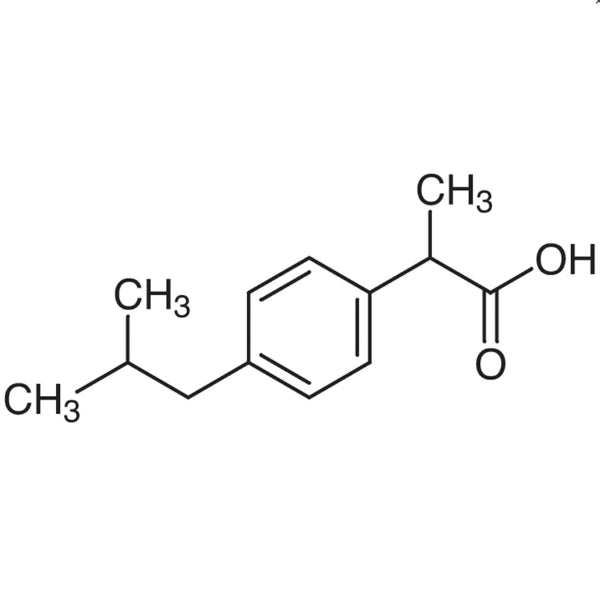
Ibuprofen, with the CAS number 15687-27-1, is a widely used chemical compound in scientific research and laboratory settings. As a non-steroidal anti-inflammatory drug (NSAID), it is known for its ability to inhibit the enzyme cyclooxygenase, which plays a key role in the production of inflammatory mediators. In the laboratory, ibuprofen serves as a versatile reagent for various biochemical studies and pharmaceutical applications. Its chemical stability and solubility make it a reliable choice for researchers working in diverse fields.
One of the key properties that make ibuprofen a preferred choice is its solubility in both organic solvents and water. This dual solubility allows it to be easily incorporated into a wide range of chemical reactions and synthesis processes. Additionally, its chemical stability ensures that it remains effective under various experimental conditions. These characteristics make it suitable for use in both qualitative and quantitative analyses, enhancing its applicability in different research scenarios.
In Indonesian laboratories, ibuprofen is commonly used in pharmacological, biochemical, and health science research. It is frequently employed in drug development, toxicity testing, and studies on drug mechanisms. Its availability and reliability make it a staple in academic and industrial research settings, supporting the advancement of scientific knowledge and innovation.
Advantages (TCI brochure)
- Often used as positive control for drug binding site II
TCI brochures (PDF)
- Fluorescent Probes for the Characterization of Two Specific Drug Binding Sites on HSA 2025-04-01 · p. 4
- Lipid Mediator Research Reagents 2026-04-10 · p. 1
- Immune System, Inflammation, Allergy Research Reagents 2025-05-26 · p. 3
- Immunology Research Reagents 2026-06-03 · p. 6
- Pharmaceutical Ingredients for Research and Experimental Use 2026-03-09 · p. 33
- Pharmacological research utilizes ibuprofen to study the mechanisms of anti-inflammatory and analgesic effects in drug development.
- Biochemical studies often incorporate ibuprofen to investigate enzyme inhibition and its impact on inflammatory pathways.
- Toxicity testing frequently employs ibuprofen as a model compound to assess the safety and side effects of pharmaceutical substances.
- Drug metabolism research benefits from ibuprofen’s solubility and stability, allowing for accurate analysis of drug interactions and metabolic processes.
- Health science experiments use ibuprofen to explore its role in various physiological and pathological conditions, supporting clinical and translational research.
From the TCI brochure
- Positive control in HSA site II assay
| Brand | TCI |
|---|---|
| CAS number | 15687-27-1 |
| Molecular formula | — |
| Purity | — |
| Category | Life Science > Biochemicals and Reagents > Enzymes, Enzyme Inhibitors, Enzyme Substrates |
| Pack sizes | Available in various quantities as per standard laboratory requirements |
| Physical form | Solid, typically in powder form |
| Storage | Store in a cool, dry place away from direct sunlight |
Ibuprofen should be stored in a cool, dry environment to maintain its chemical stability and prevent degradation. It is recommended to keep it in a sealed container to minimize exposure to moisture and air, which could affect its solubility and purity. Due to its solubility in both organic and aqueous solvents, it is important to handle it with care to avoid contamination. In laboratory settings, it should be stored in a designated chemical storage area that is accessible only to authorized personnel. Proper labeling of containers is essential for safety and traceability. Always use appropriate personal protective equipment when handling ibuprofen to ensure safe laboratory practices.
References cited in the TCI brochure
- Jamie Ghuman. Structural Basis of the Drug-binding Specificity of Human Serum Albumin Journal of Molecular Biology, 2005. doi:10.1016/j.jmb.2005.07.075
- Masaki OTAGIRI. Study on Binding of Drug to Serum Protein YAKUGAKU ZASSHI, 2009. doi:10.1248/yakushi.129.413
Product Categories
- Biochemicals and ReagentsEnzymes, Enzyme Inhibitors, Enzyme SubstratesEnzymes [by Application]
- Biochemicals and ReagentsEnzymes, Enzyme Inhibitors, Enzyme SubstratesEnzyme Inhibitors [Biochemicals and Reagents]
- Biochemicals and ReagentsPharmaceutical Research Reagents (for Experimental Use)Anti-inflammatory Ingredients (for Research and Experimental Use)
- Biochemicals and ReagentsPharmaceutical Research Reagents (for Experimental Use)Anti-rheumatoid Arthritis Ingredients (for Research and Experimental Use)
- Biochemicals and Reagents
- Cell BiologyImmune System, Inflammation, Allergy ResearchCyclooxygenase (COX) Inhibitors
- Pharmaceutical Development and Drug Discovery ResearchPharmaceutical Research Reagents (for Experimental Use)Anti-inflammatory Ingredients (for Research and Experimental Use)
- Pharmaceutical Development and Drug Discovery ResearchPharmaceutical Research Reagents (for Experimental Use)Anti-rheumatoid Arthritis Ingredients (for Research and Experimental Use)
Produk Terkait
-
Piroxicam TCI P1905
Regular price Rp 5.935.650,00Regular priceRp 4.166.400,00Sale price Rp 5.935.650,00 -
Oxaprozin TCI O0377
Regular price From Rp 1.643.250,00Regular priceRp 1.164.450,00Sale price From Rp 1.643.250,00 -
Meloxicam TCI M1959
Regular price From Rp 928.200,00Regular priceRp 664.650,00Sale price From Rp 928.200,00 -
(S)-(+)-2-(6-Methoxy-2-naphthyl)propionicAcid TCI M1021
Regular price From Rp 2.227.050,00Regular priceRp 1.572.900,00Sale price From Rp 2.227.050,00 -
KetorolacTromethamine TCI K0053
Regular price From Rp 1.431.150,00Regular priceRp 1.016.400,00Sale price From Rp 1.431.150,00 -
Ketoprofen TCI K0038
Regular price Rp 2.942.100,00Regular priceRp 2.072.700,00Sale price Rp 2.942.100,00 -
Indomethacin TCI I0655
Regular price From Rp 1.590.750,00Regular priceRp 1.127.700,00Sale price From Rp 1.590.750,00 -
Flurbiprofen TCI F0371
Regular price From Rp 3.260.250,00Regular priceRp 2.295.300,00Sale price From Rp 3.260.250,00


