


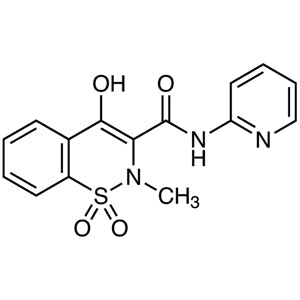
Piroxicam is a chemical compound widely used in laboratory experiments, particularly in the fields of bio-pharmaceuticals and biochemical research. As an enzyme inhibitor, it plays a crucial role in studying enzyme mechanisms and the inhibition of specific chemical reactions. Its ability to modulate enzymatic activity makes it a valuable tool for researchers investigating biological processes. In laboratory settings, piroxicam is often used as a reagent or a control material in various biochemical assays. Its versatility allows it to be applied in multiple experimental contexts, contributing to the understanding of complex biological systems.
One of the key properties that make piroxicam a preferred choice is its chemical stability and controlled reactivity. These characteristics ensure consistent performance across different experimental conditions, making it reliable for reproducible results. Additionally, piroxicam exhibits good solubility in organic solvents such as ethyl acetate and acetone, which enhances its applicability in diverse experimental setups. Its stability over time also means that it remains effective for extended periods, reducing the need for frequent replenishment.
In Indonesian laboratories, piroxicam is commonly used in pharmacological, biochemical, and pharmaceutical compound analysis research. It is a preferred material due to its availability and the reliability of experimental outcomes. Its role in inflammation and antioxidant studies further solidifies its importance in both academic and industrial research environments. Researchers in Indonesia rely on piroxicam for its consistent performance and broad range of applications.
TCI brochures (PDF)
- Anti-Rheumatoid Arthritis Ingredients 2025-01-29 · p. 1
- Lipid Mediator Research Reagents 2026-04-10 · p. 1
- Immune System, Inflammation, Allergy Research Reagents 2025-05-26 · p. 3
- Antimicrobials and Antitumor Agents for Research and Experimental Use 2025-04-24 · p. 19
- Pharmaceutical Ingredients for Research and Experimental Use 2026-03-09 · p. 19
- Reagents for Biological Research 2025-03-11 · p. 35
- In pharmacological research, piroxicam is used to study the effects of anti-inflammatory agents and their mechanisms of action.
- For biochemical assays, it serves as a control compound to evaluate enzyme inhibition and reaction kinetics.
- In pharmaceutical compound analysis, piroxicam is employed to assess the stability and reactivity of drug molecules.
- During antioxidant studies, it helps in understanding the interaction between reactive oxygen species and biological systems.
- In enzyme inhibition experiments, piroxicam is utilized to investigate the specificity and effectiveness of enzyme inhibitors.
| Brand | TCI |
|---|---|
| CAS number | 36322-90-4 |
| Molecular formula | — |
| Purity | — |
| Category | Life Science > Biochemicals and Reagents > Enzymes, Enzyme Inhibitors, Enzyme Substrates |
| Pack sizes | Available in various quantities as per standard laboratory supply |
| Physical form | Solid |
| Storage | Store in a cool, dry place away from direct sunlight |
Piroxicam should be stored in a cool, dry environment to maintain its chemical stability and prevent degradation. It is recommended to keep it in a sealed container to minimize exposure to moisture and air. Suitable containers for storage include glass or high-density polyethylene bottles, which provide protection against chemical interactions. In laboratory settings, it is important to handle piroxicam with appropriate personal protective equipment, such as gloves and safety goggles, to ensure safe handling. While it is not highly toxic, proper disposal procedures should be followed to comply with laboratory safety standards. Regular monitoring of storage conditions helps maintain the integrity of the material and ensures its effectiveness in experimental applications.
—
Product Categories
- Biochemicals and ReagentsEnzymes, Enzyme Inhibitors, Enzyme SubstratesEnzymes [by Application]
- Biochemicals and ReagentsEnzymes, Enzyme Inhibitors, Enzyme SubstratesEnzyme Inhibitors [Biochemicals and Reagents]
- Biochemicals and ReagentsPharmaceutical Research Reagents (for Experimental Use)Antitumor Research Reagents (for Experimental Use)
- Biochemicals and ReagentsPharmaceutical Research Reagents (for Experimental Use)Anti-inflammatory Ingredients (for Research and Experimental Use)
- Biochemicals and ReagentsPharmaceutical Research Reagents (for Experimental Use)Anti-rheumatoid Arthritis Ingredients (for Research and Experimental Use)
- Biochemicals and Reagents
- Cell BiologyApoptosisApoptosis Inducers
- Cell BiologyImmune System, Inflammation, Allergy ResearchCyclooxygenase (COX) Inhibitors
- Pharmaceutical Development and Drug Discovery ResearchPharmaceutical Research Reagents (for Experimental Use)Antitumor Research Reagents (for Experimental Use)
- Pharmaceutical Development and Drug Discovery ResearchPharmaceutical Research Reagents (for Experimental Use)Anti-inflammatory Ingredients (for Research and Experimental Use)
- Pharmaceutical Development and Drug Discovery ResearchPharmaceutical Research Reagents (for Experimental Use)Anti-rheumatoid Arthritis Ingredients (for Research and Experimental Use)
Produk Terkait
-
Oxaprozin TCI O0377
Regular price From Rp 1.643.250,00Regular priceRp 1.164.450,00Sale price From Rp 1.643.250,00 -
Meloxicam TCI M1959
Regular price From Rp 928.200,00Regular priceRp 664.650,00Sale price From Rp 928.200,00 -
(S)-(+)-2-(6-Methoxy-2-naphthyl)propionicAcid TCI M1021
Regular price From Rp 2.227.050,00Regular priceRp 1.572.900,00Sale price From Rp 2.227.050,00 -
KetorolacTromethamine TCI K0053
Regular price From Rp 1.431.150,00Regular priceRp 1.016.400,00Sale price From Rp 1.431.150,00 -
Ketoprofen TCI K0038
Regular price Rp 2.942.100,00Regular priceRp 2.072.700,00Sale price Rp 2.942.100,00 -
Indomethacin TCI I0655
Regular price From Rp 1.590.750,00Regular priceRp 1.127.700,00Sale price From Rp 1.590.750,00 -
Ibuprofen TCI I0415
Regular price From Rp 2.677.500,00Regular priceRp 1.887.900,00Sale price From Rp 2.677.500,00 -
Flurbiprofen TCI F0371
Regular price From Rp 3.260.250,00Regular priceRp 2.295.300,00Sale price From Rp 3.260.250,00


