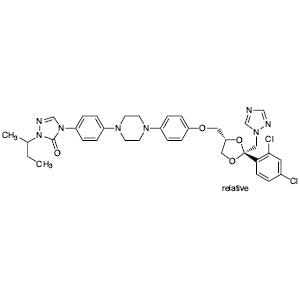
Itraconazole is a chemical compound widely used in the life sciences as an antifungal antibiotic. It plays a crucial role in microbiological research, particularly in testing antimicrobial activity and drug development. As a member of the azole class, it inhibits fungal cholesterol synthesis, thereby preventing the growth and reproduction of pathogenic organisms. This compound is essential for isolating and identifying pathogenic fungi in laboratory settings. Its chemical stability and solubility in organic solvents such as ethyl acetate and acetone make it a versatile reagent for various chemical reactions and laboratory tests.
Itraconazole is preferred due to its chemical stability and solubility characteristics. It remains effective under a range of environmental conditions, which simplifies storage and long-term use. The compound’s consistent performance ensures reliable results in experimental procedures, making it a trusted choice for researchers. Its ability to dissolve in organic solvents enhances its applicability in diverse laboratory applications, from biochemical assays to microbial sensitivity testing. These properties contribute to its reliability and effectiveness in scientific research.
In Indonesian laboratories, Itraconazole is commonly used as a raw material in public health, pharmaceutical, and microbiological research. It supports studies on fungal infections, drug efficacy, and microbial resistance. Its role in both basic and applied research underscores its importance in advancing scientific understanding and developing new therapeutic solutions.
TCI brochures (PDF)
- Antimicrobials and Antitumor Agents for Research and Experimental Use 2025-04-24 · p. 9
- Pharmaceutical Ingredients for Research and Experimental Use 2026-03-09 · p. 9
- Microbial Sensitivity Testing: Itraconazole is ideal for assessing the effectiveness of antifungal agents against various fungal strains.
- Fungal Isolation and Identification: It aids in the cultivation and differentiation of pathogenic fungi in microbiological studies.
- Drug Development Research: It is used to evaluate the pharmacological properties of new antifungal compounds in preclinical studies.
- Biochemical Assays: Its solubility and chemical stability make it suitable for use in enzyme inhibition and metabolic pathway studies.
- Public Health Research: Itraconazole supports investigations into fungal infections and their impact on community health in Indonesia.
| Brand | TCI |
|---|---|
| CAS number | 84625-61-6 |
| Molecular formula | — |
| Purity | — |
| Category | Life Science > Biochemicals and Reagents > Antibiotics |
| Pack sizes | Available in various quantities as per standard laboratory requirements |
| Physical form | Solid powder |
| Storage | Store in a cool, dry place away from direct sunlight |
Itraconazole should be stored in a cool, dry environment to maintain its chemical stability and effectiveness. It is recommended to keep it in a sealed container to prevent moisture absorption and contamination. The compound is best stored in airtight containers made of glass or high-density polyethylene to ensure long-term integrity. Laboratory personnel should handle it with care, using appropriate personal protective equipment such as gloves and safety goggles. Proper labeling of containers is essential for safe handling and to prevent accidental exposure. Regular monitoring of storage conditions ensures that the material remains suitable for use in research applications.
—
Product Categories
- Biochemicals and ReagentsAntibioticsAntibiotics (by Application)
- Biochemicals and ReagentsPharmaceutical Research Reagents (for Experimental Use)Antifungal Ingredients (for Research and Experimental Use)
- Biochemicals and Reagents
- Cell BiologyCancer ResearchAntitumor Agents for Research
- Cell BiologyCancer ResearchChemopreventive Agents [Cancer Research]
- Cell BiologyCancer Research
- MicrobiologyAntibioticsAntibiotics (by Application)
- Pharmaceutical Development and Drug Discovery ResearchPharmaceutical Research Reagents (for Experimental Use)Antifungal Ingredients (for Research and Experimental Use)
- Pharmaceutical Development and Drug Discovery ResearchAntibioticsAntibiotics (by Application)
Produk Terkait
-
Ketoconazole TCI K0045
Regular price Rp 1.881.600,00Regular priceRp 1.331.400,00Sale price Rp 1.881.600,00 -
Fluconazole TCI F0677
Regular price Rp 1.326.150,00Regular priceRp 942.900,00Sale price Rp 1.326.150,00 -
MiconazoleNitrate TCI M1769
Regular price Rp 1.246.350,00Regular priceRp 887.250,00Sale price Rp 1.246.350,00 -
Ritonavir TCI R0116
Regular price Rp 2.121.000,00Regular priceRp 1.498.350,00Sale price Rp 2.121.000,00 -
EconazoleNitrate TCI E0957
Regular price Rp 1.326.150,00Regular priceRp 942.900,00Sale price Rp 1.326.150,00 -
Terbinafine TCI T3677
Regular price Rp 2.173.500,00Regular priceRp 1.535.100,00Sale price Rp 2.173.500,00 -
Posaconazole TCI P2477
Regular price Rp 2.809.800,00Regular priceRp 1.980.300,00Sale price Rp 2.809.800,00 -
Erythromycin TCI E0751
Regular price Rp 1.696.800,00Regular priceRp 1.202.250,00Sale price Rp 1.696.800,00