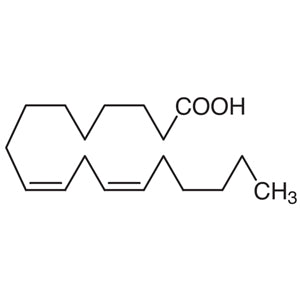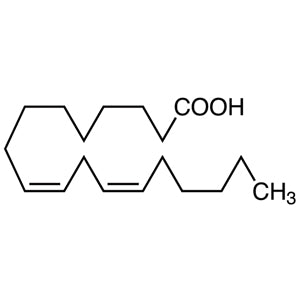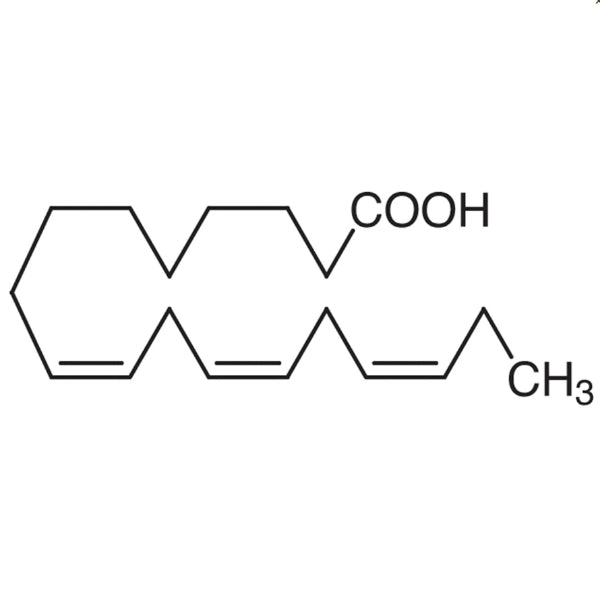
TCI L0050 Linolenic Acid is a long-chain polyunsaturated fatty acid carrying three double bonds along its hydrocarbon chain. Within this catalogue the compound is classified as a colloidal quantum dot research reagent, because long-chain fatty acids play a key role as surface ligands in nanocrystal synthesis. In the laboratory the material is used to control particle growth, stabilise colloidal dispersions, and tune the interfacial properties of nanomaterials, alongside its established use as a standard in lipid analysis.
The advantage of linolenic acid as a reagent lies in its amphiphilic structure. The carboxylate group at one end binds strongly to the metal surface of the nanocrystal core, while the long unsaturated hydrocarbon chain extends outward into the solvent and prevents the particles from aggregating. The three double bonds in the cis configuration give the chain a pronounced kink, so the ligand layer that forms is looser and more flexible than that produced by a saturated fatty acid. This influences ligand packing density as well as the solubility of the nanoparticles in non-polar solvents. Its liquid state at room temperature also makes handling and dosing straightforward.
In Indonesian laboratories, this reagent is typically found in materials science and nanomaterials groups working on colloidal quantum dot synthesis, as well as in analytical laboratories that require a defined long-chain fatty acid for lipid work. It is normally used in small, carefully measured portions within solvent systems, where consistent ligand quality matters more than volume, making a single well-handled bottle suitable for extended research programmes.
TCI brochures (PDF)
- Regenerative Medicine Research Reagents 2016-03-18 · p. 2
- Colloidal Quantum Dot (QD) Research Reagents 2026-05-21 · p. 4
- Lipids 2025-12-17 · p. 5
- Reagents for Biological Research 2025-03-11 · p. 38
- Colloidal quantum dot synthesis: acts as a surface ligand that binds the nanocrystal core through its carboxylate group and controls particle growth during the reaction.
- Colloidal dispersion stabilisation: the long unsaturated chain projects into the solvent and keeps nanoparticles physically separated, preventing aggregation over the course of the experiment.
- Nanomaterial interfacial engineering: the amphiphilic structure allows researchers to tune surface chemistry and adjust nanoparticle solubility in non-polar solvent systems.
- Ligand packing studies: the kinked cis double-bond geometry produces a looser, more flexible ligand shell, useful for comparative work against saturated fatty acid ligands.
- Lipid analysis reference material: serves as a defined long-chain polyunsaturated fatty acid standard for analytical work requiring consistent identity and behaviour.
| Brand | TCI |
|---|---|
| CAS number | 463-40-1 |
| Molecular formula | — |
| Purity | — |
| Category | Materials Science > Electronic Materials > Colloidal Quantum Dot (QD) Research Reagents |
| Pack sizes | available in standard TCI catalogue pack sizes; please confirm the required size when ordering |
| Physical form | liquid at room temperature |
| Storage | store according to the manufacturer's stated conditions on the product label |
Store the container tightly closed in a cool, dark place, following the storage conditions stated on the manufacturer's label. Amber glass or the original supplier bottle is preferred, since unsaturated fatty acids are sensitive to air and light; blanketing the headspace with inert gas after each use helps preserve reagent quality. Handle in a well-ventilated area or fume hood, wear gloves, safety glasses, and a laboratory coat, and dispense with clean, dry glassware to avoid contamination. Allow refrigerated material to reach room temperature before opening to prevent moisture condensation, and consult the supplier safety data sheet before first use.
—
Product Categories
Produk Terkait
-
gamma-LinolenicAcid TCI L0152
Regular price Rp 1.988.700,00Regular priceRp 1.405.950,00Sale price Rp 1.988.700,00 -
ArachidonicAcid TCI A0781
Regular price Rp 2.384.550,00Regular priceRp 1.683.150,00Sale price Rp 2.384.550,00 -
LinoleicAcid TCI L0124
Regular price Rp 1.881.600,00Regular priceRp 1.331.400,00Sale price Rp 1.881.600,00 -
LinoleicAcid TCI L0053
Regular price Rp 1.538.250,00Regular priceRp 1.090.950,00Sale price Rp 1.538.250,00 -
allcis-5,8,11,14,17-EicosapentaenoicAcid TCI E0441
Regular price Rp 4.559.100,00Regular priceRp 3.203.550,00Sale price Rp 4.559.100,00 -
cis-4,7,10,13,16,19-DocosahexaenoicAcid TCI D2226
Regular price Rp 6.386.100,00Regular priceRp 4.481.400,00Sale price Rp 6.386.100,00 -
cis-15-TetracosenoicAcid TCI T1642
Regular price Rp 6.784.050,00Regular priceRp 4.759.650,00Sale price Rp 6.784.050,00 -
BehenicAcid TCI B1747
Regular price Rp 4.028.850,00Regular priceRp 2.832.900,00Sale price Rp 4.028.850,00