

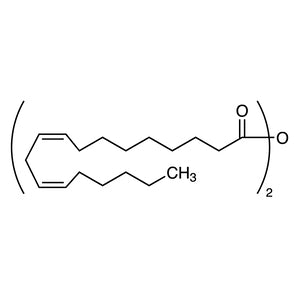
Linoleic Anhydride is an acid anhydride formed from two molecules of linoleic acid, which means it combines the reactivity of the anhydride group with the long, polyunsaturated fatty acid chains carried on either side. In the laboratory it functions as an acylating reagent, meaning a compound that transfers a linoleoyl group onto alcohols, amines, or other nucleophilic functional groups. That role makes it an important tool for researchers who need to attach an unsaturated lipid chain to a target molecule, for example in the preparation of synthetic lipids, biochemical probes, or other fatty acid derived materials.
The property that makes this reagent a preferred choice is the higher reactivity of the anhydride group compared with an ordinary ester, while still remaining more controllable than an acid chloride and without releasing acidic gas during the reaction. The reaction yields linoleic acid as the by-product, which is comparatively straightforward to separate, so purification of the desired product tends to be simple. On the other hand, the anhydride group is highly sensitive to water and readily hydrolyses, while the multiple double bonds in the chains are vulnerable to oxidation. The combination of these two sensitivities means the material must be handled under dry conditions and, as far as possible, under an inert gas.
In Indonesian laboratories this reagent is used in work that calls for controlled introduction of a polyunsaturated fatty acid chain, typically within organic synthesis and lipid chemistry groups at universities and research institutes. Because it is supplied by TCI and listed under Chemistry > Building Blocks > Non-Heterocyclic Building Blocks, it is most often ordered as a building block for multi-step preparative work rather than for routine analysis, and it is commonly reserved for planned experimental campaigns where the receiving laboratory is equipped for moisture-sensitive handling.
- Synthetic lipid preparation — the reagent transfers a linoleoyl group onto alcohol-bearing backbones, allowing researchers to build defined lipid structures carrying a polyunsaturated chain in a controlled acylation step.
- Biochemical probe synthesis — attaching the linoleoyl chain to a molecular scaffold gives probes that carry authentic fatty acid character, which is useful where the lipid portion itself is part of the experimental question.
- Acylation of amines to form amides — the anhydride reacts with nucleophilic amine groups to install the fatty acid chain without generating acidic gas, making the transformation easier to run than with an acid chloride.
- Preparation of fatty acid derived materials — researchers use this reagent to introduce long unsaturated chains into target molecules when building derivative materials based on fatty acid chemistry.
- General organic synthesis as a non-heterocyclic building block — the reagent serves as a lipid-chain source in multi-step routes where the linoleoyl fragment must be introduced at a defined stage of the synthesis.
| Brand | TCI |
|---|---|
| CAS number | 24909-68-0 |
| Molecular formula | — |
| Purity | — |
| Category | Chemistry > Building Blocks > Non-Heterocyclic Building Blocks |
| Pack sizes | available in the pack sizes listed for this catalogue item; please refer to the product listing for the options offered |
| Physical form | — |
| Storage | keep dry and protected from moisture and air; storage under inert gas is recommended |
- Product code: L0145
Store the reagent in a tightly closed container that protects it from moisture and air, since the anhydride group hydrolyses readily on contact with water and the polyunsaturated chains are susceptible to oxidation. Where possible, keep and dispense the material under an inert gas, and use dry glassware and dry solvents when setting up reactions. Handle it in a fume hood using standard laboratory personal protective equipment, including gloves, safety glasses, and a laboratory coat. Return the container promptly after dispensing and reseal it to limit exposure to atmospheric moisture, and follow the storage conditions given by the manufacturer on the product label and safety data sheet.
—
Produk Terkait
-
LinoleicAcid TCI L0124
Regular price From Rp 1.829.100,00Regular price -
LinoleicAcid TCI L0053
Regular price From Rp 1.485.750,00Regular price -
ValericAnhydride TCI V0006
Regular price From Rp 875.700,00Regular price -
3-BromophthalicAnhydride TCI B4061
Regular price From Rp 1.246.350,00Regular price -
Bicyclo[2.2.2]oct-5-ene-2,3-dicarboxylicAnhydride TCI B3038
Regular price Rp 3.605.700,00Regular price -
ButylsuccinicAnhydride TCI B2742
Regular price From Rp 5.274.150,00Regular price -
4-BromophthalicAnhydride TCI B1693
Regular price From Rp 2.386.650,00Regular price -
2-Buten-1-ylsuccinicAnhydride TCI B1613
Regular price From Rp 2.439.150,00Regular price


![6708-37-8 Bicyclo[2.2.2]oct-5-ene-2,3-dicarboxylic Anhydride - AMI Scientific](http://amiscientific.com/cdn/shop/files/TCI2510B3038.jpg?v=1767089273&width=533)


