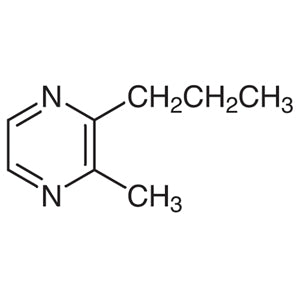
2-Methyl-3-propylpyrazine is a heterocyclic compound built on a pyrazine ring that carries a methyl group at position 2 and a propyl chain at position 3. Unlike its alkoxypyrazine relatives, this compound belongs to the purely alkylated pyrazine class, meaning both of its substituents are hydrocarbon chains. In the laboratory, the material serves as a heterocyclic building block for organic synthesis and at the same time as a reference compound in the analysis of volatile components in food materials. This TCI product, catalogue code M0841, is supplied as a liquid in 5 mL and 25 mL pack options that are practical for research work and analytical method development.
The property that makes this compound a preferred choice is its more pronounced hydrophobic character arising from the propyl chain, so that its behaviour in extraction and chromatography differs clearly from pyrazines bearing shorter substituents. The electron-poor diazine ring still provides aromatic stability while offering opportunities for directed transformation, and the alkyl groups supply benzylic positions that can be oxidised or further functionalised. Because the material is a liquid, it is easy to pipette and to dilute in series for the preparation of standard solutions at very low concentrations.
Alkylpyrazines of this type occupy a familiar place in Indonesian laboratory practice, particularly in groups working on food chemistry, flavour and aroma studies, and synthetic organic chemistry. The 5 mL and 25 mL formats suit university research groups, government analytical laboratories, and industrial quality laboratories that need modest working quantities rather than bulk volumes, allowing a single pack to support repeated method development runs and calibration work over an extended period.
Related TCI products
- TCI P1833 18138-03-9 2-Propylpyrazine
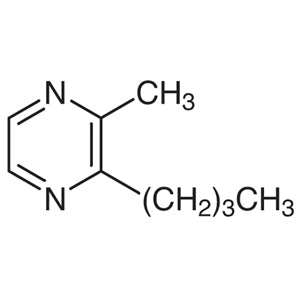
- TCI B1173 15987-00-5 2-Butyl-3-methylpyrazine
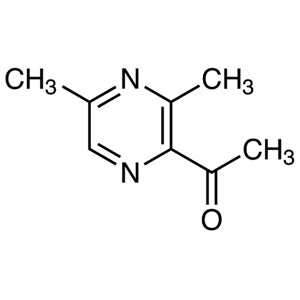
- TCI A3326 54300-08-2 2-Acetyl-3,5-dimethylpyrazine (contains 2-Acetyl-3,6-dimethylpyrazine)
- TCI A2992 5521-56-2 2-Amino-6-methylpyrazine
- TCI A2003 32974-92-8 2-Acetyl-3-ethylpyrazine
- TCI A1978 23787-80-6 2-Acetyl-3-methylpyrazine
- Heterocyclic building block for organic synthesis — the electron-poor pyrazine core is aromatically stable yet open to directed transformation, giving synthetic chemists a dependable scaffold to elaborate further.
- Reference compound in volatile food component analysis — the material provides an identified alkylpyrazine standard against which aroma-active peaks in food samples can be matched with confidence.
- Preparation of serial standard solutions — its liquid form makes accurate pipetting and stepwise dilution straightforward when calibration standards at very low concentration levels are required.
- Chromatographic method development — the pronounced hydrophobicity from the propyl chain gives retention behaviour clearly distinct from short-substituted pyrazines, which is useful when separating closely related analytes.
- Extraction behaviour studies — the same hydrophobic character allows researchers to examine partitioning and recovery of alkylpyrazines across different extraction systems and solvent conditions.
| Brand | TCI, catalogue code M0841 |
|---|---|
| CAS number | 15986-80-8 |
| Molecular formula | — |
| Purity | — |
| Category | Chemistry > Building Blocks > Heterocyclic Building Blocks |
| Pack sizes | 5 mL and 25 mL |
| Physical form | liquid |
| Storage | keep tightly closed in the original container under the conditions stated on the manufacturer's label |
Store the container tightly closed in a cool, dry, well-ventilated area away from heat sources and direct sunlight, following the conditions indicated on the manufacturer's label. Keep the material in its original container or in a chemically compatible sealed glass vessel, since volatile alkylpyrazines are readily lost through poorly fitting closures. Handle and transfer the liquid inside a fume hood, and wear a laboratory coat, safety glasses, and suitable chemical-resistant gloves. Use clean, dry pipettes for each transfer to avoid contaminating the stock, reseal immediately after use, and label all prepared dilutions clearly with identity and date.
—
Produk Terkait
-
2-Propylpyrazine TCI P1833
Regular price Rp 1.908.900,00Regular price -
2-Butyl-3-methylpyrazine TCI B1173
Regular price Rp 3.232.950,00Regular price -
2-Acetyl-3,5-dimethylpyrazine(contains2-Acetyl-3,6-dimethylpyrazine) TCI A3326
Regular price From Rp 1.326.150,00Regular price -
2-Amino-6-methylpyrazine TCI A2992
Regular price From Rp 903.000,00Regular price -
2-Acetyl-3-ethylpyrazine TCI A2003
Regular price From Rp 1.035.300,00Regular price -
2-Acetyl-3-methylpyrazine TCI A1978
Regular price Rp 1.035.300,00Regular price -
2,3,5-Trimethylpyrazine TCI T0942
Regular price From Rp 875.700,00Regular price -
5-Methylpyrazin-2-amine TCI M3006
Regular price From Rp 4.293.450,00Regular price