![TCI M0900 2444-46-4 N-Vanillylnonanamide [=Capsaicin (Synthetic)] — struktur kimia](http://amiscientific.com/cdn/shop/files/TCI2510M0900-struktur.jpg?v=1791525106&width=1946)
![TCI M0900 2444-46-4 N-Vanillylnonanamide [=Capsaicin (Synthetic)] — struktur kimia](http://amiscientific.com/cdn/shop/files/TCI2510M0900-struktur.jpg?v=1791525106&width=1445)
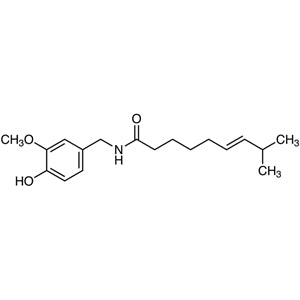
N-Vanillylnonanamide, with CAS number 2444-46-4, is a synthetic compound widely used in biochemical and pharmacological research. This compound serves as an analog of capsaicin, making it a valuable tool for studying the molecular mechanisms of pain perception and receptor activity. Its role in laboratories is critical for investigating the function of TRPV1 receptors, which are central to understanding inflammatory and pain-related responses in biological systems. The compound's chemical structure is designed to mimic the biological activity of capsaicin, enabling researchers to explore its potential in drug development and therapeutic applications.
N-Vanillylnonanamide is preferred due to its high purity and chemical stability under various experimental conditions. It exhibits reactivity that allows it to participate in diverse synthetic and analytical processes, making it a versatile reagent. Its solid form facilitates easy handling and storage, which is essential for maintaining consistency in research protocols. The compound's ability to interact with multiple substrates enhances its utility in both qualitative and quantitative studies. These properties make it a reliable and essential component in advanced biochemical investigations.
In Indonesian laboratories, N-Vanillylnonanamide is commonly used in pharmacological and biochemical studies. Researchers in Indonesia utilize this compound to explore the mechanisms of pain and inflammation, as well as to develop new therapeutic agents. Its availability and chemical properties support a wide range of experimental applications, contributing to the advancement of scientific research in the region.
TCI brochures (PDF)
- Reagents for Preparing Animal Disease Models 2024-09-13 · p. 1
- Alkaloids 2025-10-10 · p. 8
- Immunology Research Reagents 2026-06-03 · p. 8
- Reagents for Biological Research 2025-03-11 · p. 49
- Pharmacological research involving TRPV1 receptor activation and pain signaling pathways utilizes N-Vanillylnonanamide to study the molecular basis of pain perception and inflammatory responses.
- Biochemical studies on alkaloid derivatives benefit from this compound's structural similarity to capsaicin, enabling comparative analysis of biological activity and receptor interactions.
- Drug development programs in Indonesian laboratories use N-Vanillylnonanamide as a model compound to test the efficacy and safety of new analgesic and anti-inflammatory agents.
- Analytical chemistry applications leverage its reactivity and stability for use in synthetic reactions and chromatographic analysis of complex biological samples.
- Toxicology research employs this compound to assess the biological effects of synthetic alkaloids on cellular and tissue responses in controlled experimental settings.
| Brand | TCI |
|---|---|
| CAS number | 2444-46-4 |
| Molecular formula | — |
| Purity | — |
| Category | Life Science > Biochemicals and Reagents > Alkaloids |
| Pack sizes | Available in standard laboratory quantities |
| Physical form | Solid |
| Storage | Store in a cool, dry place away from light and moisture |
N-Vanillylnonanamide should be stored in a cool, dry environment, away from direct light and moisture to maintain its chemical stability. It is recommended to use airtight containers to prevent exposure to air and humidity, which could affect its purity and reactivity. In laboratory settings, it should be handled with care to avoid contamination and ensure safe usage. Proper labeling of containers is essential for identifying the compound and preventing mix-ups. Due to its chemical nature, it should be stored separately from incompatible substances to prevent unintended reactions. Regular monitoring of storage conditions helps ensure the compound remains suitable for research applications.
—
Produk Terkait
-
Capsaicin(Natural) TCI M1149
Regular price Rp 1.670.550,00Regular price -
Capsaicinbeta-D-Glucopyranoside TCI C2548
Regular price Rp 3.605.700,00Regular price -
HistamineDiphosphate TCI H0147
Regular price Rp 1.008.000,00Regular price -
HistamineDihydrochloride TCI H0146
Regular price From Rp 505.050,00Regular price -
AceticAcid TCI A2035
Regular price Rp 477.750,00Regular price -
SerotoninHydrochloride TCI S0370
Regular price Rp 9.248.400,00Regular price -
2,4-Dinitrofluorobenzene TCI D0835
Regular price From Rp 1.087.800,00Regular price -
Indigo(synthetic) TCI I0212
Regular price Rp 1.590.750,00Regular price