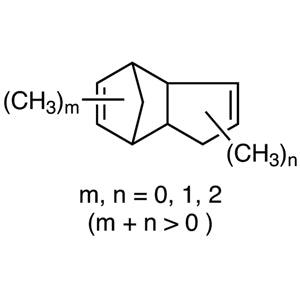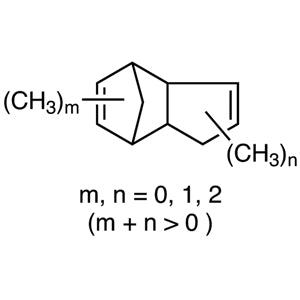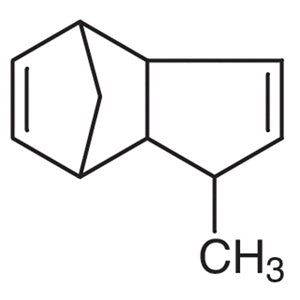
1-Methyldicyclopentadiene is a chemical compound widely used as a foundational material in various chemical reactions. It plays a crucial role in the synthesis of both heterocyclic and non-heterocyclic compounds, making it an essential component in organic chemistry research. This compound is valued for its ability to participate in multiple reaction pathways, enabling the construction of complex molecular structures. In laboratory settings, it serves as a key reagent in the development of new chemical entities and the exploration of reaction mechanisms. Its versatility makes it a go-to choice for researchers aiming to expand their synthetic capabilities.
The compound is known for its chemical stability and moderate reactivity, which allows for efficient and controlled chemical reactions. It exhibits good solubility in organic solvents, enhancing its usability in a wide range of experimental conditions. These properties make it a preferred choice for chemists looking to achieve consistent results in their experiments. Its compatibility with various reaction conditions and its ability to maintain structural integrity during synthesis further solidify its position as a reliable building block in chemical research.
In Indonesian laboratories, 1-Methyldicyclopentadiene is commonly used in organic chemistry research and the synthesis of new compounds. It is particularly relevant for academic institutions and research centers that require high-quality chemical reagents. Its availability and reliability support scientific investigations across multiple disciplines, contributing to the advancement of chemical knowledge and innovation.
Related TCI products
- TCI P1841 504-60-9 1,3-Pentadiene (cis- and trans- mixture) (stabilized with TBC)
- TCI P0650 1574-41-0 cis-1,3-Pentadiene (stabilized with TBC)
- TCI P0647 2004-70-8 trans-1,3-Pentadiene (stabilized with TBC)
- TCI P0038 591-93-5 1,4-Pentadiene
- TCI M0616 763-30-4 2-Methyl-1,4-pentadiene
- TCI D0443 77-73-6 Dicyclopentadiene (stabilized with BHT) [precursor to Cyclopentadiene]
- Organic synthesis applications benefit from 1-Methyldicyclopentadiene due to its reactivity and structural versatility, enabling the creation of complex molecules.
- It is ideal for heterocyclic compound synthesis, where its molecular structure facilitates the formation of ring systems essential in pharmaceutical and material science research.
- In polymer chemistry, this compound is used as a building block for creating specialized polymers with unique mechanical and thermal properties.
- It supports the development of new chemical entities in drug discovery, where its reactivity allows for the formation of diverse molecular scaffolds.
- For academic research, it is a valuable tool in teaching and experimental studies, providing students with hands-on experience in synthetic chemistry.
| Brand | TCI |
|---|---|
| CAS number | 16327-42-7 |
| Molecular formula | — |
| Purity | — |
| Category | Chemistry > Building Blocks > Non-Heterocyclic Building Blocks |
| Pack sizes | Available in various quantities as per standard chemical supply specifications |
| Physical form | Liquid |
| Storage | Store in a cool, dry place away from direct sunlight and incompatible materials |
1-Methyldicyclopentadiene should be stored in a cool, dry environment to maintain its chemical stability and prevent degradation. It is recommended to use airtight containers made of materials compatible with organic solvents to avoid contamination and evaporation. The compound should be kept away from heat sources and incompatible substances such as strong oxidizing agents. In laboratory settings, it is important to handle the material with appropriate personal protective equipment, including gloves and safety goggles, to ensure safe handling. Proper ventilation should be maintained in the workspace to minimize exposure to vapors. Regular inspection of storage conditions ensures the compound remains in optimal condition for use in research applications.
—
Produk Terkait
-
1,3-Pentadiene(cis-andtrans-mixture)(stabilizedwithTBC) TCI P1841
Regular price Rp 10.229.100,00Regular price -
cis-1,3-Pentadiene(stabilizedwithTBC) TCI P0650
Regular price From Rp 5.962.950,00Regular price -
trans-1,3-Pentadiene(stabilizedwithTBC) TCI P0647
Regular price From Rp 1.829.100,00Regular price -
1,4-Pentadiene TCI P0038
Regular price From Rp 5.327.700,00Regular price -
2-Methyl-1,4-pentadiene TCI M0616
Regular price From Rp 1.856.400,00Regular price -
Dicyclopentadiene(stabilizedwithBHT)[precursortoCyclopentadiene] TCI D0443
Regular price From Rp 477.750,00Regular price -
MethylcyclopentadieneDimer(socalled)(stabilizedwithBHT) TCI M2705
Regular price From Rp 689.850,00Regular price -
MethylcyclopentadieneDimer(socalled)(stabilizedwithTBC) TCI M0920
Regular price Rp 769.650,00Regular price


![Dicyclopentadiene (stabilized with BHT) [precursor to Cyclopentadiene] (CAS 77-73-6) - TCI D0443 - AMI Scientific](http://amiscientific.com/cdn/shop/files/TCI2510D0443.jpg?v=1767101304&width=533)