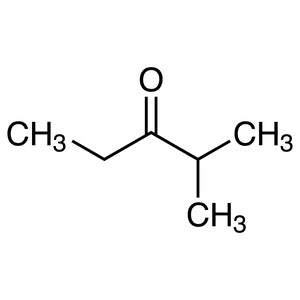
2-Methyl-3-pentanone, with CAS number 565-69-5, is an organic compound widely used in various chemical reactions within laboratory settings. As a member of the ketone group, it possesses a carbonyl group that makes it highly reactive, enabling it to serve as a versatile building block in the synthesis of complex organic molecules. Its chemical structure allows it to participate in a range of reactions, including substitution, reduction, and oxidation processes, making it a valuable resource for chemists. This compound is commonly found in research laboratories where the development of new compounds and materials is a priority.
The reactivity of 2-Methyl-3-pentanone is complemented by its physical properties, which make it a preferred choice for laboratory use. It has a relatively high boiling point, facilitating evaporation and separation processes in analytical and preparative techniques. Additionally, its colorless and odorless nature ensures it does not interfere with experimental results or introduce unwanted variables. These characteristics make it ideal for use in both qualitative and quantitative chemical analyses. Its stability under controlled conditions further enhances its reliability in laboratory environments.
In Indonesian laboratories, 2-Methyl-3-pentanone is frequently utilized in organic chemistry research, particularly in academic institutions and research centers focused on the synthesis of new compounds. It is commonly used in the preparation of intermediates for pharmaceutical and industrial applications. Its availability and reliability make it a staple in the chemical supply chain for laboratories across Indonesia, supporting both educational and industrial research activities.
- Organic synthesis is a primary application where 2-Methyl-3-pentanone serves as a key reagent due to its reactivity and ability to participate in various reaction mechanisms.
- Intermediate compound production benefits from its role in the synthesis of aromatic and ester-based compounds, which are essential in pharmaceutical and industrial chemistry.
- Analytical chemistry experiments often use this compound for its stable properties and lack of interfering characteristics, ensuring accurate and reproducible results.
- Teaching laboratories utilize it to demonstrate fundamental chemical reactions and mechanisms, providing students with hands-on experience in organic chemistry.
- Industrial research applications rely on its versatility in creating complex molecules, supporting innovation in chemical manufacturing processes.
| Brand | TCI |
|---|---|
| CAS number | 565-69-5 |
| Molecular formula | — |
| Purity | — |
| Category | Chemistry > Building Blocks > Non-Heterocyclic Building Blocks |
| Pack sizes | Available in various quantities as per supplier specifications |
| Physical form | Liquid |
| Storage | Store in a cool, dry place away from direct sunlight and incompatible materials |
2-Methyl-3-pentanone should be stored in a cool, dry location, away from direct sunlight and sources of heat. It is recommended to use airtight, sealed containers made of materials compatible with organic solvents, such as glass or high-density polyethylene. Proper labeling of containers is essential to ensure safe handling and prevent accidental exposure. In laboratory settings, it should be kept in a well-ventilated area to minimize inhalation risks. While it is not highly toxic, standard safety protocols should be followed when handling and disposing of this compound. Always ensure that personal protective equipment, such as gloves and safety goggles, is worn when working with this material.
—
Produk Terkait
-
2-Bromo-3-pentanone TCI B4648
Regular price From Rp 4.213.650,00Regular price -
3-Pentanone TCI P0061
Regular price From Rp 505.050,00Regular price -
2-Pentanone TCI P0060
Regular price From Rp 477.750,00Regular price -
4-Methoxy-4-methyl-2-pentanone TCI M0652
Regular price From Rp 557.550,00Regular price -
4-Methyl-2-pentanone TCI M0389
Regular price From Rp 477.750,00Regular price -
3-Methyl-2-pentanone TCI M0388
Regular price From Rp 2.016.000,00Regular price -
5-Hydroxy-2-pentanone(mixtureofmonomeranddimer) TCI H0511
Regular price From Rp 2.227.050,00Regular price -
2,4-Dimethyl-3-pentanone TCI D0770
Regular price From Rp 637.350,00Regular price