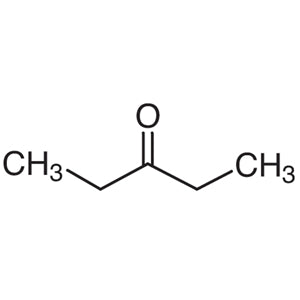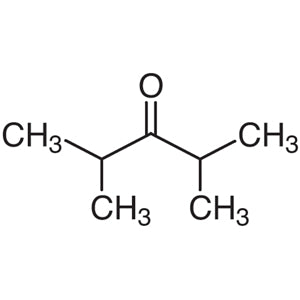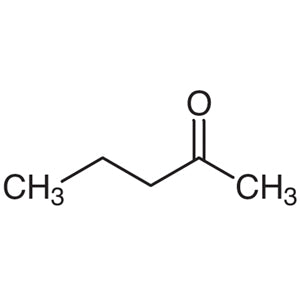
2-Pentanone, also called methyl propyl ketone, is a simple aliphatic ketone. Its carbonyl group sits at the second position of a five-carbon chain. TCI supplies it as a non-heterocyclic building block. In the laboratory it serves three main roles: an organic solvent of moderate polarity, a model substrate for methyl ketone reactions, and an analytical standard for volatile organic compounds. It also occurs naturally as an aroma component in many foods, which makes it relevant to flavor research as well as general synthetic chemistry.
Chemists choose 2-pentanone because it is an unsymmetrical methyl ketone. The methyl side and the propyl side carry different α-hydrogens. This makes the compound a good model for studying regioselectivity in enolate formation, the haloform reaction and aldol condensation. As a solvent, it dissolves many resins and organic compounds and evaporates easily after use, so removing it after a procedure is simple. Its structure is simple and its spectra are easy to recognise, so it also works well for teaching and for calibration.
In Indonesia, 2-pentanone is useful to university organic chemistry laboratories, where it supports practical classes and research into reaction mechanisms. Environmental analysis laboratories can use it as a reference compound when they work on volatile organic compounds. Food and flavor research groups may also find it relevant because it occurs naturally as an aroma component. Because it is a single, well-defined compound from TCI, teaching, research and analytical laboratories can use it as one consistent reference material across their work.
- Enolate regioselectivity studies: the methyl and propyl sides carry different α-hydrogens, so researchers can compare which side forms the enolate under different conditions.
- Haloform reaction demonstrations: as a methyl ketone, 2-pentanone is a suitable substrate for showing and studying the haloform reaction in teaching and research laboratories.
- Aldol condensation experiments: its unsymmetrical structure makes it a useful model for examining how reaction conditions affect selectivity in aldol-type carbon–carbon bond formation.
- Moderate-polarity organic solvent: it dissolves many resins and organic compounds and evaporates easily afterwards, which suits routine dissolution and workup steps in the laboratory.
- Analytical standard for volatile organic compounds: its simple structure and easily recognised spectra make it practical for calibration, method checks and teaching in instrumental analysis.
| Brand | TCI (product code P0060) |
|---|---|
| CAS number | 107-87-9 |
| Molecular formula | — |
| Purity | — |
| Category | Chemistry > Building Blocks > Non-Heterocyclic Building Blocks |
| Pack sizes | as listed on the product page |
| Physical form | liquid |
| Storage | keep tightly closed in a cool, well-ventilated place away from ignition sources |
Store 2-pentanone in its original, tightly sealed container in a cool, dry and well-ventilated area. Keep it away from heat, sparks, open flames and other ignition sources, because it is a volatile organic solvent. Keep it separate from strong oxidising agents. Handle it in a fume hood or another well-ventilated space, and wear chemical-resistant gloves, safety glasses and a laboratory coat. Avoid breathing the vapours and avoid contact with skin and eyes. Close containers promptly after use to limit evaporation. Always read the supplier's Safety Data Sheet before use, and dispose of waste according to institutional and local regulations.
—
Produk Terkait
-
3-Pentanone TCI P0061
Regular price From Rp 505.050,00Regular price -
4-Methyl-2-pentanone TCI M0389
Regular price From Rp 477.750,00Regular price -
2-Bromo-3-pentanone TCI B4648
Regular price From Rp 4.213.650,00Regular price -
2-Methyl-3-pentanone TCI M1249
Regular price From Rp 823.200,00Regular price -
4-Methoxy-4-methyl-2-pentanone TCI M0652
Regular price From Rp 557.550,00Regular price -
3-Methyl-2-pentanone TCI M0388
Regular price From Rp 2.016.000,00Regular price -
5-Hydroxy-2-pentanone(mixtureofmonomeranddimer) TCI H0511
Regular price From Rp 2.227.050,00Regular price -
2,4-Dimethyl-3-pentanone TCI D0770
Regular price From Rp 637.350,00Regular price