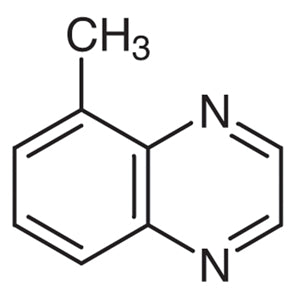
TCI M1371, CAS 13708-12-8, is 5-Methylquinoxaline, an aromatic heterocyclic compound containing two nitrogen atoms, formed by the fusion of a benzene ring with a pyrazine ring and bearing a methyl group as a substituent. The quinoxaline framework is an important structural motif that appears across a wide range of bioactive compounds, dyes, and organic electronic materials. In the laboratory, this compound serves as a heterocyclic building block for further synthesis, as an electron-withdrawing unit in the design of optoelectronic materials, and as a potential bidentate ligand in coordination chemistry studies and transition metal catalysis.
The property that makes this compound particularly attractive is its electron-poor electronic character, a direct consequence of the two nitrogen atoms present in the pyrazine ring. This characteristic establishes quinoxaline as a highly useful acceptor unit for constructing donor-acceptor systems in organic semiconductor materials, while at the same time making it readily susceptible to nucleophilic aromatic substitution reactions under appropriate conditions. The methyl group at the five position provides an additional point of functionalization that can be oxidized to an aldehyde or a carboxylic acid, or deprotonated for condensation reactions, giving synthetic chemists multiple handles on a single scaffold.
In Indonesian laboratories, 5-Methylquinoxaline is typically encountered in university and institutional research groups working on synthetic organic chemistry, medicinal chemistry scaffold development, and organic electronic materials. It is generally ordered in research-scale quantities for multi-step synthesis routes, ligand preparation, and exploratory work on donor-acceptor conjugated systems. Researchers commonly incorporate it into method development, thesis and dissertation projects, and collaborative studies where a well-defined heterocyclic intermediate is required as a starting point.
- Heterocyclic building block synthesis — the quinoxaline core provides a preformed bicyclic nitrogen scaffold that saves several synthetic steps compared with constructing the ring system from simpler precursors.
- Organic optoelectronic material design — the electron-deficient pyrazine ring makes this compound an effective acceptor unit for building donor-acceptor architectures in organic semiconductor systems.
- Coordination chemistry investigations — the two ring nitrogen atoms allow the molecule to act as a potential bidentate ligand, making it suitable for preparing and studying transition metal complexes.
- Transition metal catalysis studies — as a nitrogen-donor ligand candidate, it supports research into metal-ligand interactions and the tuning of catalytic behaviour in coordination systems.
- Functional group transformation work — the methyl substituent at position five can be oxidized to an aldehyde or carboxylic acid, or deprotonated for condensation, enabling diverse derivatization routes.
| Brand | TCI |
|---|---|
| CAS number | 13708-12-8 |
| Molecular formula | — |
| Purity | — |
| Category | Chemistry > Building Blocks > Heterocyclic Building Blocks |
| Pack sizes | available in standard research-scale laboratory pack sizes; please confirm the currently available packaging option when ordering |
| Physical form | — |
| Storage | store in a tightly closed container in a cool, dry, and well-ventilated place |
- Chemical name: 5-Methylquinoxaline
- Product code: M1371
Store 5-Methylquinoxaline in its original tightly closed container, kept in a cool, dry, and well-ventilated area away from direct sunlight, heat sources, and incompatible materials such as strong oxidizing agents. Chemically resistant glass containers with secure closures are appropriate, and containers should be clearly labelled and kept sealed when not in use to limit exposure to moisture and air. Handle the compound inside a functioning fume hood and wear standard personal protective equipment, including safety glasses, chemically resistant gloves, and a laboratory coat. Avoid inhalation of vapours and direct contact with skin and eyes. Use clean, dry spatulas and glassware during transfer to prevent contamination of the bulk material, and dispose of residues and contaminated consumables in accordance with applicable laboratory chemical waste procedures. Always consult the manufacturer's safety data sheet before first use.
—
Produk Terkait
-
2-Methylquinoxaline TCI M0580
Regular price From Rp 848.400,00Regular price -
Benzo[g]quinoxaline TCI B4540
Regular price Rp 2.016.000,00Regular price -
Quinoxaline1,4-Dioxide TCI Q0110
Regular price From Rp 2.359.350,00Regular price -
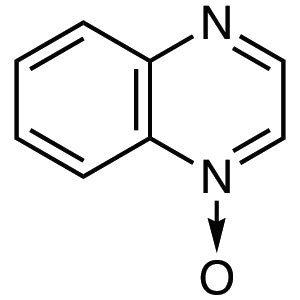
Quinoxaline1-Oxide TCI Q0108
Regular price From Rp 1.618.050,00Regular price -
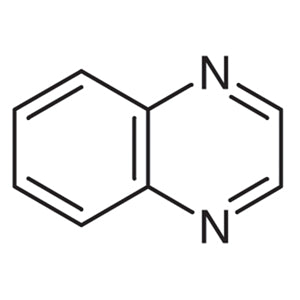
Quinoxaline TCI Q0020
Regular price Rp 1.538.250,00Regular price -
6H-Indolo[2,3-b]quinoxaline TCI I1098
Regular price Rp 1.803.900,00Regular price -
2,3-Dimethylquinoxaline TCI D0795
Regular price From Rp 795.900,00Regular price -
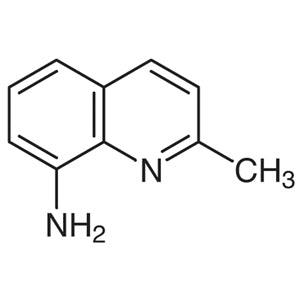
8-Amino-2-methylquinoline TCI A0416
Regular price From Rp 1.273.650,00Regular price

![260-50-4 Benzo[g]quinoxaline - AMI Scientific](http://amiscientific.com/cdn/shop/files/TCI2510B4540.jpg?v=1767091332&width=533)

![243-59-4 6H-Indolo[2,3-b]quinoxaline - AMI Scientific](http://amiscientific.com/cdn/shop/files/TCI2510I1098.jpg?v=1767120775&width=533)