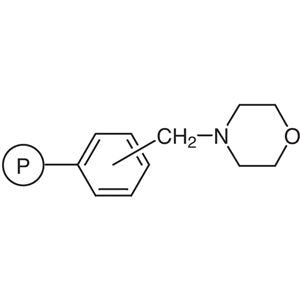
TCI M1857 Morpholinomethyl Polystyrene Resin is a solid-supported reagent: polystyrene polymer beads cross-linked with one percent divinylbenzene whose surface and pores have been functionalised with morpholinomethyl groups. In other words, a tertiary amine base is covalently bound to an insoluble polymer backbone. Its role in the laboratory is to supply the chemical reactivity of an organic base in a form that can be removed by simple filtration, so the purification stages that normally consume the most time are cut back sharply, particularly in parallel synthesis and combinatorial chemistry.
The characteristics that lead chemists to select this resin are the combination of high functional group loading, low cross-linking, and uniform bead size. One percent divinylbenzene cross-linking produces beads that swell readily in organic solvents such as dichloromethane and tetrahydrofuran, so the morpholine sites in the interior of the bead remain accessible to reagents rather than only those at the surface. The fifty to one hundred mesh size range gives a good balance between diffusion rate and ease of filtration without clogging the funnel. The stated loading of 2.9 to 3.5 mmol per gram means a modest mass of resin delivers a substantial quantity of base.
In Indonesian laboratories this resin is used where a base must be introduced and then removed cleanly without an aqueous work-up. It suits university and institutional organic synthesis groups, pharmaceutical and fine chemical research units, and any laboratory preparing compound series in parallel. Because the spent resin is separated by filtration alone, the material fits workflows that prioritise a clean product stream, reduced solvent handling, and shorter turnaround between synthetic steps.
Related TCI products
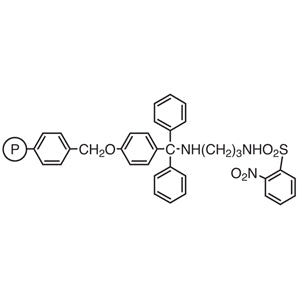
- TCI B2372 N-(4-Benzyloxytrityl)-N'-(2-nitrobenzenesulfonyl)-1,4-diaminobutane Resin cross-linked with 1% DVB (200-400mesh) (0.9-1.1mmol/g)
- TCI B2371 N-(4-Benzyloxytrityl)-N'-(2-nitrobenzenesulfonyl)-1,3-diaminopropane Resin cross-linked with 1% DVB (200-400mesh) (0.9-1.1mmol/g)
- TCI B2370 N-(4-Benzyloxytrityl)-N'-(2-nitrobenzenesulfonyl)-1,2-diaminoethane Resin cross-linked with 1% DVB (200-400mesh) (0.9-1.1mmol/g)
- TCI H0987 4-(Hydroxymethyl)phenoxymethyl Polystyrene Resin cross-linked with 1% DVB (200-400mesh) (1.0-2.0mmol/g)
- TCI H0986 4-(Hydroxymethyl)phenoxymethyl Polystyrene Resin cross-linked with 1% DVB (200-400mesh) (0.5-1.0mmol/g)
- TCI P1432 9003-70-7 Polystyrene Resin cross-linked with 1% DVB (100-200mesh)
- Acid scavenging in acylation and sulfonylation reactions, where the immobilised tertiary amine binds the hydrogen halide released and is then filtered away rather than washed out with aqueous acid.
- Parallel synthesis of compound libraries, in which many small reactions are run side by side and the solid-supported base allows each vessel to be worked up by simple filtration instead of individual extraction.
- Combinatorial chemistry campaigns, where the high loading of 2.9 to 3.5 mmol per gram lets a small measured mass of resin service a large number of reaction wells reliably.
- General base-mediated organic transformations in dichloromethane or tetrahydrofuran, since the one percent divinylbenzene cross-linking lets beads swell fully so interior morpholine sites stay reactive.
- Solution-phase synthesis requiring clean product isolation, because removing the base as a filterable solid avoids emulsions and losses that often accompany conventional aqueous work-up procedures.
| Brand | TCI |
|---|---|
| CAS number | — |
| Molecular formula | — |
| Purity | — |
| Category | Chemistry > Specialty Synthesis > Solid Supported Synthesis |
| Pack sizes | please refer to the packaging options listed for this item |
| Physical form | polystyrene resin beads, cross-linked with 1% DVB, 50-100 mesh particle size |
| Storage | keep in a tightly closed container in a cool, dry place |
- Catalogue number: M1857
- Functional group loading: 2.9-3.5 mmol/g
Store the resin in its original tightly closed container in a cool, dry area away from moisture, direct sunlight, and sources of heat. Keep it separated from strong acids and other incompatible reagents, since the morpholine sites are basic and will react with them. Use clean, dry spatulas when weighing to avoid contaminating the bulk material, and reseal the container promptly after each use. Handle in a well-ventilated area or fume hood with safety glasses, laboratory gloves, and a laboratory coat, and avoid generating or inhaling dust from the dry beads. Consult the manufacturer's safety data sheet before use and follow institutional procedures for disposal of the spent resin.
—
Produk Terkait
-
N-(4-Benzyloxytrityl)-N'-(2-nitrobenzenesulfonyl)-1,4-diaminobutaneResincross-linkedwith1%DVB(200-400mesh)(0.9-1.1mmol/g) TCI B2372
Regular price Rp 7.287.000,00Regular price -
N-(4-Benzyloxytrityl)-N'-(2-nitrobenzenesulfonyl)-1,3-diaminopropaneResincross-linkedwith1%DVB(200-400mesh)(0.9-1.1mmol/g) TCI B2371
Regular price Rp 6.599.250,00Regular price -
N-(4-Benzyloxytrityl)-N'-(2-nitrobenzenesulfonyl)-1,2-diaminoethaneResincross-linkedwith1%DVB(200-400mesh)(0.9-1.1mmol/g) TCI B2370
Regular price Rp 6.599.250,00Regular price -
PolystyreneResincross-linkedwith1%DVB(200-400mesh)(1.0-2.0mmol/g) TCI H0987
Regular price Rp 3.525.900,00Regular price -
PolystyreneResincross-linkedwith1%DVB(200-400mesh)(0.5-1.0mmol/g) TCI H0986
Regular price Rp 3.525.900,00Regular price -
PolystyreneResincross-linkedwith1%DVB(100-200mesh) TCI P1432
Regular price From Rp 2.359.350,00Regular price -
ChloromethylPolystyreneResincross-linkedwith2%DVB(100-200mesh)(0.8-1.2mmol/g) TCI C1751
Regular price From Rp 689.850,00Regular price -
ChloromethylPolystyreneResincross-linkedwith1%DVB(100-200mesh)(2.0-3.0mmol/g) TCI C1750
Regular price From Rp 1.193.850,00Regular price