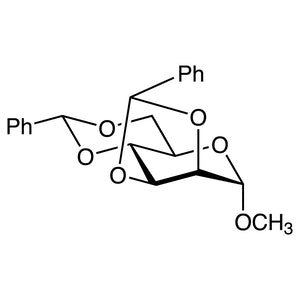
TCI M2061 4148-71-4 Methyl 2,3:4,6-Di-O-benzylidene-alpha-D-mannopyranoside is a chemical compound widely used in laboratory research across the fields of chemical biology and glycoscience. This compound is a derivative of mannose, featuring a complex molecular structure that makes it a valuable reagent in the synthesis of glycosidic compounds. Its role in the laboratory is critical for studies involving molecular structure analysis, glycan modification, and the development of new pharmaceuticals. Due to its chemical stability and reactivity, it is frequently employed in various biochemical and pharmacological investigations.
The compound's unique molecular structure and chemical properties make it a preferred choice for researchers requiring high precision in molecular synthesis. Its ability to participate in specific chemical reactions, such as coupling or deprotonation, enhances its utility in complex synthetic pathways. The specificity of its molecular framework allows for accurate and reproducible results, which is essential in advanced research. This makes it particularly relevant in disciplines such as pharmacology, biochemistry, and bioinformatics, where precise molecular manipulation is required.
In Indonesian laboratories, this compound is commonly used in drug development, molecular biology modifications, and studies on glycan-protein interactions. It serves as a foundational material for various research projects, especially those focused on understanding biological mechanisms and developing innovative therapeutic approaches. Its application is widespread among research institutions and universities in Indonesia, supporting both academic and industrial research initiatives.
- Glycosylation Studies - This compound is ideal for investigating glycosylation processes due to its complex sugar structure, enabling researchers to study how glycan modifications affect protein function and cellular processes.
- Drug Development - Its use in synthesizing glycosidic compounds makes it a key reagent in the development of pharmaceuticals targeting glycan-related diseases and biological pathways.
- Structural Analysis - The compound’s stable chemical properties allow for accurate molecular structure analysis, supporting research in chemical biology and molecular modeling.
- Glycan-Protein Interaction Research - Its molecular specificity enables detailed studies on how glycan structures interact with proteins, aiding in understanding biological mechanisms and disease progression.
- Synthetic Chemistry - The compound’s reactivity and structural complexity make it a valuable tool in synthetic pathways for creating complex organic molecules with specific functional groups.
| Brand | — |
|---|---|
| CAS number | — |
| Molecular formula | — |
| Purity | — |
| Category | — |
| Pack sizes | — |
| Physical form | — |
| Storage | — |
- Brand - TCI
- CAS Number - 4148-71-4
- Category - Chemistry > Chemical Biology > Glycoscience
- Pack Sizes - Available in standard laboratory quantities as per supplier specifications
- Physical Form - Solid powder
- Storage Note - Store in a cool, dry place away from direct sunlight and moisture
This compound should be stored in a cool, dry environment, away from direct sunlight and moisture to maintain its chemical stability. It is recommended to use airtight containers to prevent exposure to humidity and potential degradation. Due to its chemical nature, it should be handled with appropriate personal protective equipment, including gloves and safety goggles, to ensure laboratory safety. Avoid contact with incompatible substances to prevent unwanted chemical reactions. Proper labeling of storage containers is essential for safe handling and to prevent accidental exposure. Regular monitoring of storage conditions ensures the compound remains viable for research applications.
—
Produk Terkait
-
4-Nitrophenylalpha-D-Mannopyranoside[Substrateforalpha-Mannosidase] TCI N0619
Regular price Rp 4.902.450,00Regular price -
Methylalpha-D-Mannopyranoside TCI M0368
Regular price From Rp 1.326.150,00Regular price -
Methyl2,3,4,6-Tetra-O-pivaloyl-D-mannopyranoside TCI M2102
Regular price Rp 5.300.400,00Regular price -
1,3,4,6-Tetra-O-acetyl-2-O-(trifluoromethanesulfonyl)-beta-D-mannopyranose TCI T2307
Regular price Rp 1.326.150,00Regular price -
1,2,3,4,6-Penta-O-pivaloyl-D-mannopyranose TCI P1803
Regular price Rp 7.500.150,00Regular price -
1,2,3,4,6-Penta-O-acetyl-D-mannopyranose TCI P1514
Regular price Rp 1.803.900,00Regular price -
1,6:2,3-Dianhydro-beta-D-mannopyranose TCI D4372
Regular price Rp 4.771.200,00Regular price -
Fluoride TCI T2568
Regular price Rp 5.724.600,00Regular price
![10357-27-4 4-Nitrophenyl alpha-D-Mannopyranoside [Substrate for alpha-Mannosidase] - AMI Scientific](http://amiscientific.com/cdn/shop/files/TCI2510N0619.jpg?v=1767130142&width=533)