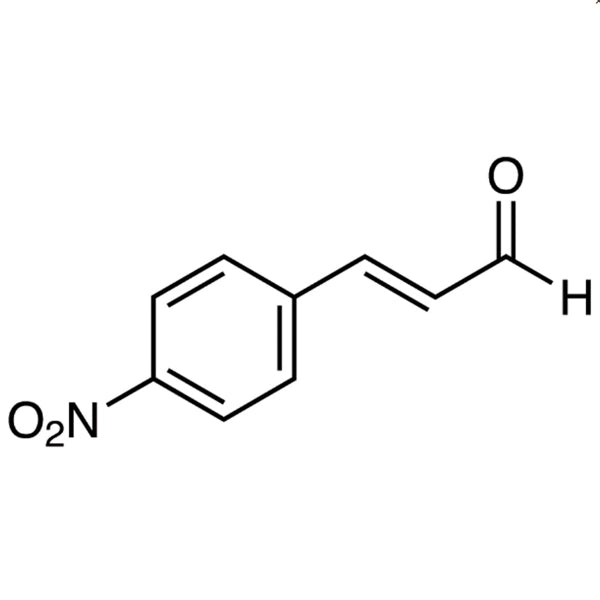
(E)-4-Nitrocinnamaldehyde is a chemical compound widely used in laboratory settings for the synthesis of complex molecules. As a building block in organic chemistry, it plays a crucial role in the development of aromatic and heterocyclic compounds. This compound is frequently employed in chemical reactions that require high reactivity and stability, making it a versatile tool for researchers. Its presence in laboratories is essential for advancing chemical research, particularly in the fields of pharmaceutical and material sciences.
The compound’s molecular structure is stable, and its reactivity allows it to participate in various types of chemical reactions, such as nucleophilic and electrophilic reactions. These properties make it a preferred choice for chemists seeking reliable and effective reagents. Additionally, its resistance to degradation under certain conditions ensures long-term stability and consistency in experimental results. This reliability is vital for maintaining the accuracy and reproducibility of scientific experiments.
In Indonesian laboratories, (E)-4-Nitrocinnamaldehyde is commonly used in organic chemistry research, especially in the development of new compounds with potential medical or industrial applications. Many research institutions and universities rely on this compound for their experiments, contributing to the advancement of scientific knowledge. Its availability locally supports ongoing research efforts and facilitates access for scientists working in the field.
- Organic synthesis applications benefit from this compound’s reactivity and stability, making it ideal for creating complex aromatic and heterocyclic structures.
- Pharmaceutical research utilizes it as a precursor in the development of new drug compounds, supporting the synthesis of bioactive molecules.
- Material science experiments leverage its chemical properties for the production of advanced polymers and functional materials.
- Analytical chemistry uses it as a standard reference for identifying and quantifying similar compounds in complex mixtures.
- Environmental studies incorporate it to investigate the behavior and degradation of organic compounds in different conditions.
| Brand | TCI |
|---|---|
| CAS number | 49678-08-2 |
| Molecular formula | — |
| Purity | — |
| Category | Chemistry > Building Blocks > Non-Heterocyclic Building Blocks |
| Pack sizes | Available in various quantities as per standard laboratory requirements |
| Physical form | Liquid |
| Storage | Store in a cool, dry place away from light and incompatible substances |
This compound should be stored in a cool, dry place, away from direct light and incompatible materials such as strong oxidizing agents. It is recommended to use airtight containers made of glass or polyethylene to prevent contamination and maintain its chemical integrity. Due to its reactivity, it should be handled with care, using appropriate personal protective equipment such as gloves and safety goggles. Proper ventilation is essential when working with this compound to minimize exposure. Regular inspection of storage conditions ensures the compound remains stable and suitable for use in laboratory experiments.
—
Produk Terkait
-
2-Nitrocinnamaldehyde TCI N0611
Regular price Rp 1.246.350,00Regular price -
trans-Cinnamaldehyde TCI C0352
Regular price From Rp 477.750,00Regular price -
trans-4-Bromocinnamaldehyde TCI B4337
Regular price From Rp 1.060.500,00Regular price -
alpha-Bromocinnamaldehyde TCI B1253
Regular price Rp 980.700,00Regular price -
(E)-4-Methoxycinnamaldehyde TCI M1012
Regular price From Rp 823.200,00Regular price -
2-Hydroxycinnamaldehyde TCI H0952
Regular price Rp 12.694.500,00Regular price -
alpha-Hexylcinnamaldehyde TCI H0685
Regular price From Rp 530.250,00Regular price -
4-NitrocinnamylAlcohol TCI N0690
Regular price From Rp 1.618.050,00Regular price