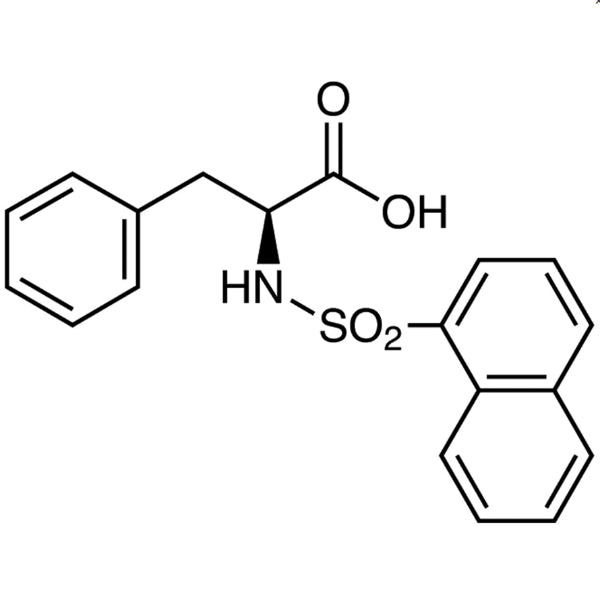
N-(1-Naphthalenesulfonyl)-L-phenylalanine is a chemical compound widely used in chemical and biochemical applications, particularly in peptide synthesis. This compound plays a crucial role in laboratory settings where researchers are engaged in the development of complex molecular structures. Its unique molecular structure enables specific chemical reactions with various substrates, making it an essential tool in biochemical research. The compound is often employed as a building block in peptide chemistry, allowing scientists to create molecules with tailored properties for diverse scientific investigations.
One of the key attributes that make this compound a preferred choice is its ability to form covalent bonds with amino groups. This property is vital for conjugation and modification reactions, which are fundamental in molecular biology and drug development. Additionally, its chemical stability ensures that it remains effective under a variety of reaction conditions without significant degradation. The compound's solubility in organic solvents further enhances its utility, as it facilitates easy handling and manipulation in laboratory procedures.
In Indonesian laboratories, N-(1-Naphthalenesulfonyl)-L-phenylalanine is commonly used in research related to biochemistry, pharmacology, and organic synthesis. It is a valuable resource for academic and research institutions working on projects that require precise molecular modifications. Its versatility and reliability make it a staple in the chemical inventory of many Indonesian research facilities.
Related TCI products
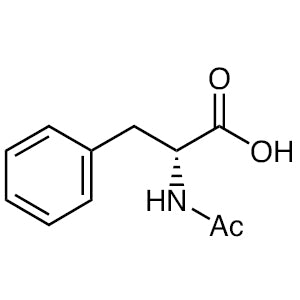
- TCI A0105 10172-89-1 N-Acetyl-D-phenylalanine
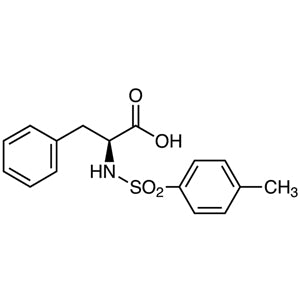
- TCI T1443 13505-32-3 N-(p-Toluenesulfonyl)-L-phenylalanine
- TCI B5350 68856-96-2 N-(tert-Butoxycarbonyl)-4-methoxy-D-phenylalanine
- TCI B5011 85466-66-6 N-(tert-Butoxycarbonyl)-N-methyl-D-phenylalanine
- TCI B4877 131724-45-3 N-(tert-Butoxycarbonyl)-4-cyano-L-phenylalanine
- TCI B4369 114873-07-3 N-(tert-Butoxycarbonyl)-4-trifluoromethyl-L-phenylalanine
- Peptide Synthesis: This compound is ideal for peptide synthesis due to its ability to form stable bonds with amino groups, enabling the creation of complex peptide structures.
- Bioconjugation Reactions: Its reactivity with amino groups makes it suitable for bioconjugation, allowing the attachment of functional groups to biomolecules.
- Molecular Modification Studies: Researchers use it to modify molecular structures, facilitating the study of molecular interactions and functional properties.
- Drug Development Research: It plays a role in developing new therapeutic agents by enabling the synthesis of targeted molecular compounds.
- Organic Chemistry Experiments: Its solubility in organic solvents makes it a useful reagent in various organic chemistry experiments and reactions.
| Brand | TCI |
|---|---|
| CAS number | 90291-46-6 |
| Molecular formula | — |
| Purity | — |
| Category | Chemistry > Chemical Biology > Peptide Chemistry |
| Pack sizes | Available in various quantities as per supplier specifications |
| Physical form | Solid powder |
| Storage | Store in a cool, dry place away from moisture and direct sunlight |
This compound should be stored in a cool, dry environment to maintain its chemical stability and prevent degradation. It is recommended to keep it in airtight containers to minimize exposure to moisture and air, which can affect its integrity. Due to its chemical nature, it should be handled with appropriate personal protective equipment, such as gloves and safety goggles, to ensure laboratory safety. Avoid direct contact with skin or inhalation of vapors. The compound is best stored in a well-ventilated area, away from incompatible substances. Regular monitoring of storage conditions is advised to ensure optimal performance and safety in laboratory settings.
—
Product Categories
Produk Terkait
-
N-Acetyl-D-phenylalanine TCI A0105
Regular price From Rp 1.087.800,00Regular price -
N-(p-Toluenesulfonyl)-L-phenylalanine TCI T1443
Regular price From Rp 848.400,00Regular price -
N-(tert-Butoxycarbonyl)-4-methoxy-D-phenylalanine TCI B5350
Regular price From Rp 1.670.550,00Regular price -
N-(tert-Butoxycarbonyl)-N-methyl-D-phenylalanine TCI B5011
Regular price From Rp 1.590.750,00Regular price -
N-(tert-Butoxycarbonyl)-4-cyano-L-phenylalanine TCI B4877
Regular price From Rp 2.466.450,00Regular price -
N-(tert-Butoxycarbonyl)-4-trifluoromethyl-L-phenylalanine TCI B4369
Regular price Rp 6.253.800,00Regular price -
N-(tert-Butoxycarbonyl)-4-phenyl-L-phenylalanine TCI B4289
Regular price Rp 2.571.450,00Regular price -
N-(tert-Butoxycarbonyl)-L-phenylalanineMethylEster TCI B4259
Regular price From Rp 875.700,00Regular price