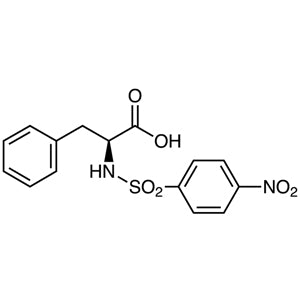
N-(4-Nitrophenylsulfonyl)-L-phenylalanine is a chemical compound widely used in laboratory research, particularly in chemical biology and peptide chemistry. It serves as a key reagent in various biochemical and synthetic processes, playing a crucial role in enzyme inhibition studies and molecular modification experiments. This compound is commonly employed in the development of new pharmaceuticals and the investigation of protein interactions, making it an essential tool for researchers in both academic and industrial settings. Its versatility and chemical stability make it a reliable choice for a wide range of experimental applications.
The compound’s unique chemical properties, including its solubility in organic solvents and its reactive nature, contribute to its popularity among scientists. These characteristics allow for efficient synthesis and purification processes, which are critical in laboratory workflows. Additionally, its molecular structure enables it to interact effectively with enzymes and proteins, making it ideal for studying biological activity and molecular mechanisms. The controlled physical and chemical properties of this compound ensure consistent results, which are vital for scientific accuracy and reproducibility.
In Indonesian laboratories, N-(4-Nitrophenylsulfonyl)-L-phenylalanine is frequently used in biochemical, pharmacological, and organic chemistry research. Researchers in universities and research institutions rely on this compound to develop new synthetic methods and test the biological effects of various substances. Its application in enzyme inhibition studies and molecular modification experiments highlights its importance in advancing scientific knowledge in Indonesia.
Related TCI products
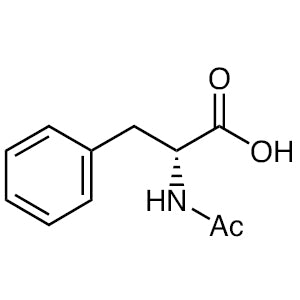
- TCI A0105 10172-89-1 N-Acetyl-D-phenylalanine
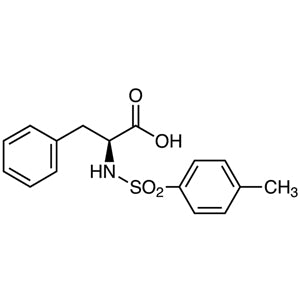
- TCI T1443 13505-32-3 N-(p-Toluenesulfonyl)-L-phenylalanine
- TCI B5350 68856-96-2 N-(tert-Butoxycarbonyl)-4-methoxy-D-phenylalanine
- TCI B5011 85466-66-6 N-(tert-Butoxycarbonyl)-N-methyl-D-phenylalanine
- TCI B4877 131724-45-3 N-(tert-Butoxycarbonyl)-4-cyano-L-phenylalanine
- TCI B4369 114873-07-3 N-(tert-Butoxycarbonyl)-4-trifluoromethyl-L-phenylalanine
- Enzyme Inhibition Studies: This compound is used to evaluate the inhibitory effects on specific enzymes, aiding in drug discovery and biochemical research.
- Peptide Synthesis: Its reactivity makes it suitable for peptide chemistry applications, enabling the synthesis of complex molecular structures.
- Molecular Modification Experiments: It is employed to modify molecular structures, facilitating the study of protein interactions and biological activity.
- Biochemical Research: Its role as a substrate or reagent supports various biochemical processes, contributing to the understanding of cellular mechanisms.
- Drug Development: It is used in the development of pharmaceutical compounds, helping to identify potential therapeutic agents through targeted experiments.
| Brand | TCI |
|---|---|
| CAS number | 64501-87-7 |
| Molecular formula | — |
| Purity | — |
| Category | Chemistry > Chemical Biology > Peptide Chemistry |
| Pack sizes | Available in standard laboratory quantities |
| Physical form | Solid |
| Storage | Store in a cool, dry place away from light |
This compound should be stored in a cool, dry environment, away from direct sunlight and sources of heat. It is recommended to keep it in a tightly sealed container to prevent moisture absorption and contamination. Due to its chemical reactivity, it should be handled with care, using appropriate personal protective equipment such as gloves and safety goggles. Storage in a well-ventilated area is advised to minimize exposure to vapors. Proper labeling of containers is essential to ensure safe handling and prevent accidental use. Regular inspection of storage conditions is necessary to maintain the integrity and stability of the compound.
—
Product Categories
Produk Terkait
-
N-Acetyl-D-phenylalanine TCI A0105
Regular price From Rp 1.087.800,00Regular price -
N-(p-Toluenesulfonyl)-L-phenylalanine TCI T1443
Regular price From Rp 848.400,00Regular price -
N-(tert-Butoxycarbonyl)-4-methoxy-D-phenylalanine TCI B5350
Regular price From Rp 1.670.550,00Regular price -
N-(tert-Butoxycarbonyl)-N-methyl-D-phenylalanine TCI B5011
Regular price From Rp 1.590.750,00Regular price -
N-(tert-Butoxycarbonyl)-4-cyano-L-phenylalanine TCI B4877
Regular price From Rp 2.466.450,00Regular price -
N-(tert-Butoxycarbonyl)-4-trifluoromethyl-L-phenylalanine TCI B4369
Regular price Rp 6.253.800,00Regular price -
N-(tert-Butoxycarbonyl)-4-phenyl-L-phenylalanine TCI B4289
Regular price Rp 2.571.450,00Regular price -
N-(tert-Butoxycarbonyl)-L-phenylalanineMethylEster TCI B4259
Regular price From Rp 875.700,00Regular price