

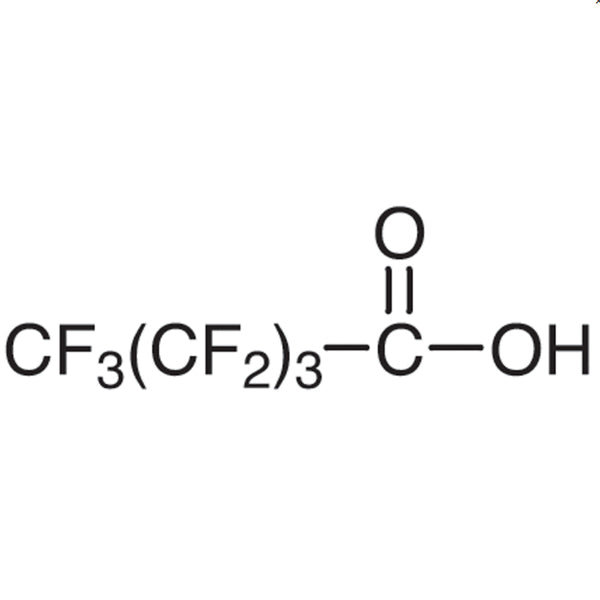
Nonafluorovaleric Acid from TCI, also known as perfluoropentanoic acid, is a carboxylic acid in which every hydrogen atom on the carbon chain has been replaced by fluorine. It belongs to the fluorous synthesis category of specialty synthesis reagents. In the laboratory, it is used as a reagent for introducing short perfluoroalkyl groups, as a starting material for fluorinated esters, amides, and salts, and as a reference compound in the environmental analysis of per- and polyfluoroalkyl substances (PFAS).
Chemists choose this material because the highly electronegative fluorine atoms make its carboxylic acid group much more acidic than an ordinary carboxylic acid. The perfluoroalkyl chain also gives it high chemical and thermal stability, along with hydrophobic and oleophobic character. Its chain is relatively short compared with long-chain PFAS, so the compound is often studied as a comparison substance in research on how PFAS behave in the environment. Consistent TCI quality matters here, especially when the material serves as an analytical standard, where batch-to-batch reliability directly affects the accuracy of results.
In Indonesia, this material is relevant to environmental and water testing laboratories that are starting to monitor PFAS, to analytical chemistry laboratories developing LC-MS methods, and to research groups working in fluorine chemistry and materials science. University laboratories studying fluorinated compounds and industrial research teams evaluating fluorinated intermediates can also use it. For all of these users, a well-characterised reagent from an established brand supports reproducible work and makes method validation easier.
TCI brochures (PDF)
- Fluorous Chemistry 2025-01-21 · p. 6
- Fluorination Reagents, Fluorinated Building Blocks 2026-03-18 · p. 53
Related TCI products
- TCI N0600 2043-47-2 1H,1H,2H,2H-Nonafluoro-1-hexanol
- TCI A5714 2706-90-3 Nonafluorovaleric Acid (ca. 0.5mol/L in Water) [Ion-Pair Reagent for LC-MS]
- TCI N1040 83310-97-8 4,4,5,5,6,6,7,7,7-Nonafluoro-1-heptanol
- TCI N1038 756-13-8 1,1,1,2,2,4,5,5,5-Nonafluoro-4-(trifluoromethyl)-3-pentanone
- TCI N0810 355-28-2 1H,1H-Nonafluoro-1-pentanol
- TCI N0692 2378-02-1 Nonafluoro-tert-butyl Alcohol
- Perfluoroalkyl group introduction: the compound supplies a short perfluoroalkyl unit, so it suits synthetic routes that need a small, stable fluorinated segment in the target molecule.
- Synthesis of fluorinated esters and amides: the carboxylic acid group is easy to derivatise, which makes it a practical starting material for preparing esters and amides that carry a perfluorinated chain.
- Preparation of fluorinated salts: because it is much more acidic than ordinary carboxylic acids, it readily forms salts, which are useful for studying fluorinated surfactant-like behaviour and ionic properties.
- PFAS reference standard in environmental analysis: as a defined short-chain PFAS, it can serve as a reference compound when identifying and quantifying perfluoroalkyl acids in water and environmental samples.
- LC-MS method development: analytical laboratories can use it to optimise separation, detection, and calibration conditions for short-chain perfluorinated carboxylic acids during method development and validation.
| Brand | TCI (product code N0605) |
|---|---|
| CAS number | 2706-90-3 |
| Molecular formula | — |
| Purity | — |
| Category | Chemistry > Specialty Synthesis > Fluorous Synthesis |
| Pack sizes | as listed on the product page and in the TCI catalogue |
| Physical form | — |
| Storage | keep tightly closed in a cool, dry, well-ventilated place and follow the TCI Safety Data Sheet |
- Synonym: Perfluoropentanoic acid
Store Nonafluorovaleric Acid in its original, tightly sealed container in a cool, dry, well-ventilated area, away from bases, oxidising agents, and sources of moisture. Use containers made of chemically resistant materials that suit strong acids, and label them clearly. Handle the material in a fume hood, wearing chemical-resistant gloves, safety goggles, and a lab coat. Avoid skin and eye contact and do not inhale vapours. Because it is a persistent fluorinated compound, collect waste separately and dispose of it according to local regulations. For analytical standard work, avoid cross-contamination from fluoropolymer labware. Always read the TCI Safety Data Sheet before use.
—
Produk Terkait
-
1H,1H,2H,2H-Nonafluoro-1-hexanol TCI N0600
Regular price From Rp 1.458.450,00Regular price -
NonafluorovalericAcid(ca.0.5mol/LinWater)[Ion-PairReagentforLC-MS] TCI A5714
Regular price Rp 2.174.550,00Regular price -
4,4,5,5,6,6,7,7,7-Nonafluoro-1-heptanol TCI N1040
Regular price From Rp 3.021.900,00Regular price -
1,1,1,2,2,4,5,5,5-Nonafluoro-4-(trifluoromethyl)-3-pentanone TCI N1038
Regular price From Rp 3.232.950,00Regular price -
1H,1H-Nonafluoro-1-pentanol TCI N0810
Regular price From Rp 1.035.300,00Regular price -
Nonafluoro-tert-butylAlcohol TCI N0692
Regular price From Rp 1.458.450,00Regular price -
EthylNonafluorovalerate TCI N0689
Regular price Rp 1.115.100,00Regular price -
MethylNonafluorovalerate TCI M1912
Regular price Rp 2.094.750,00Regular price

![2706-90-3 Nonafluorovaleric Acid (ca. 0.5mol/L in Water) [Ion-Pair Reagent for LC-MS] - AMI Scientific](http://amiscientific.com/cdn/shop/files/TCI2510A5714.jpg?v=1768358993&width=533)


