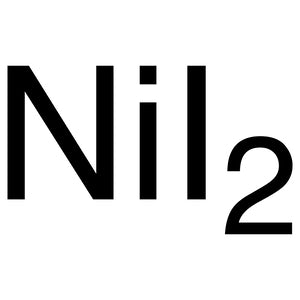
Nickel(II) Iodide (NiI₂) is a chemical compound widely utilized in various laboratory applications, particularly in catalysis and inorganic chemistry. It plays a crucial role in facilitating chemical reactions by acting as a catalyst in substitution and redox reactions. Its high reactivity and stable crystalline structure make it a valuable reagent in both organic and inorganic synthesis. This compound is commonly found in research settings where precise chemical transformations are required, supporting the development of new materials and compounds.
The properties of Nickel(II) Iodide that make it a preferred choice include its solubility in organic solvents such as ethyl acetate and ethanol, as well as its relatively low melting point. These characteristics simplify the processes of purification and separation, making it easier to handle in laboratory environments. Additionally, its chemical stability under certain conditions ensures reliable performance in a variety of experimental setups. The consistent quality and purity of Nickel(II) Iodide further enhance its reliability for scientific applications.
In Indonesian laboratories, Nickel(II) Iodide is extensively used in chemical research, especially in catalytic processes and organic synthesis. Its role in supporting complex chemical reactions and its compatibility with various experimental techniques make it a staple in both academic and industrial research settings. The compound's versatility and effectiveness contribute to its widespread use in the scientific community within Indonesia.
TCI brochures (PDF)
- Metallic Salts 2025-11-06 · p. 5
- Transition Metal Catalysts 2026-04-10 · p. 12
- Catalytic Reactions: Nickel(II) Iodide is widely used in catalytic processes due to its ability to facilitate substitution and redox reactions efficiently.
- Organic Synthesis: It serves as a key reagent in the synthesis of organic compounds, particularly in reactions involving nucleophilic substitution.
- Electroplating Processes: Its reactivity and solubility make it suitable for use in electroplating, where metal deposition is required.
- Metal Complex Formation: Nickel(II) Iodide is used to create metal complexes, which are essential in various analytical and synthetic applications.
- Redox Reactions: It plays a vital role in redox reactions, acting as an electron donor or acceptor depending on the reaction conditions.
| Brand | TCI |
|---|---|
| CAS number | 13462-90-3 |
| Molecular formula | — |
| Purity | — |
| Category | Chemistry > Catalysis and Inorganic Chemistry > Transition Elements |
| Pack sizes | Available in various quantities as per standard laboratory supply |
| Physical form | Solid |
| Storage | Store in a cool, dry place away from moisture and direct sunlight |
Nickel(II) Iodide should be stored in a cool, dry environment to maintain its chemical stability and prevent degradation. It is recommended to use airtight containers to protect it from moisture and humidity, which can affect its reactivity and purity. Due to its high reactivity, it should be handled with care, using appropriate personal protective equipment such as gloves and safety goggles. It is important to ensure proper ventilation in the laboratory when working with this compound. Avoid exposure to heat sources and keep it away from incompatible substances to ensure safe storage and usage. Regular inspection of storage conditions is advised to maintain the integrity of the material.
—
Produk Terkait
-
Nickel(III)OxideBlack TCI N1291
Regular price From Rp 2.121.000,00Regular priceRp 1.482.600,00Sale price From Rp 2.121.000,00 -
Nickel(II)Sulfate TCI N1264
Regular price From Rp 875.700,00Regular priceRp 612.150,00Sale price From Rp 875.700,00 -
Nickel(II)NitrateHexahydrate TCI N1252
Regular price From Rp 610.050,00Regular priceRp 426.300,00Sale price From Rp 610.050,00 -
Nickel(II)Fluoride TCI N1215
Regular price From Rp 1.326.150,00Regular priceRp 927.150,00Sale price From Rp 1.326.150,00 -
Nickel(II)SulfateHexahydrate TCI N1203
Regular price From Rp 477.750,00Regular priceRp 333.900,00Sale price From Rp 477.750,00 -
Nickel(II)Hydroxide TCI N1202
Regular price From Rp 664.650,00Regular priceRp 464.100,00Sale price From Rp 664.650,00 -
Nickel(II)ChlorideHexahydrate TCI N0851
Regular price From Rp 505.050,00Regular priceRp 352.800,00Sale price From Rp 505.050,00 -
Nickel(II)ChlorideAnhydrous TCI N0850
Regular price From Rp 610.050,00Regular priceRp 426.300,00Sale price From Rp 610.050,00