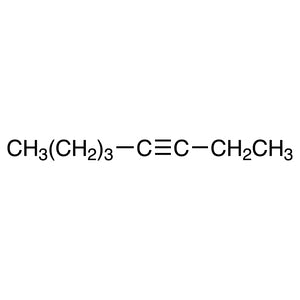
3-Octyne from TCI is an eight-carbon internal alkyne with its carbon-carbon triple bond between the third and fourth carbon atoms. It is classed as a non-heterocyclic building block, so it gives chemists an alkyne functional group that can be converted into alkenes, ketones, halogenated compounds, or cyclic frameworks. In the laboratory, 3-Octyne serves as a substrate for developing synthetic methods, testing catalysts, and studying reaction mechanisms. It also belongs to the octyne isomer series, which chemists use to compare how the position of the triple bond affects reactivity.
The triple bond sits in the middle part of the chain but not exactly at its centre, so 3-Octyne has an ethyl group on one side and a butyl group on the other. This asymmetry lets researchers measure how sensitive a catalyst or reagent is to small differences in steric hindrance, which matters in regioselectivity studies. Like other internal alkynes, 3-Octyne has no acidic acetylenic hydrogen, so its reactions centre on the triple bond itself. TCI's consistent product quality helps researchers record accurate selectivity results that they can reproduce from one batch to the next.
In Indonesia, 3-Octyne is useful for organic chemistry laboratories at universities, research institutes, and industrial R&D facilities. Research groups working on catalysis, method development, or reaction mechanisms can use it as a model internal alkyne alongside other octyne isomers. Graduate students and academic researchers studying hydrogenation, hydration, halogenation, or cyclisation can use it to compare how different catalyst systems perform on the same substrate. AMI Scientific supplies the TCI product for these laboratories, which need reliable reagents for synthesis and analytical research.
- Synthetic method development: 3-Octyne is a well-defined internal alkyne substrate, so researchers can use it to test new transformations of the triple bond without interference from an acidic terminal hydrogen.
- Catalyst screening and evaluation: The ethyl and butyl groups on either side of the triple bond let chemists test whether a catalyst tells apart two slightly different steric environments.
- Regioselectivity studies: Because the molecule is asymmetric, reactions such as hydration or hydrofunctionalisation can give two distinct products, and the ratio between them shows how selective the reagent is.
- Conversion to alkenes, ketones, and halogenated compounds: The alkyne group can be transformed into several other functional groups, which makes 3-Octyne a practical starting material for building non-heterocyclic intermediates.
- Comparative reactivity studies within the octyne isomer series: Used alongside other octyne isomers, 3-Octyne helps show systematically how the position of the triple bond affects reaction rates and outcomes.
| Brand | TCI (product code O0126) |
|---|---|
| CAS number | 15232-76-5 |
| Molecular formula | — |
| Purity | — |
| Category | Chemistry > Building Blocks > Non-Heterocyclic Building Blocks |
| Pack sizes | Available in TCI standard pack sizes; please contact AMI Scientific to confirm current options |
| Physical form | Refer to the TCI product label and Certificate of Analysis |
| Storage | Follow the storage conditions stated on the TCI label and Safety Data Sheet |
Keep 3-Octyne in its original tightly closed container in a cool, dry, well-ventilated area, away from heat, sparks, open flames, and strong oxidising agents. Put the container back on the shelf and reseal it promptly after use so the material is not exposed to air or moisture for long. Handle it in a fume hood while wearing suitable personal protective equipment, including chemical-resistant gloves, safety glasses, and a laboratory coat. Do not inhale vapours or let the material touch skin or eyes. Always read the TCI Safety Data Sheet before use, and dispose of residues and contaminated materials according to your institution's chemical waste rules and local regulations.
—
Produk Terkait
-
TCI B5774 5,10-Bis(4,4,5,5-tetramethyl-1,3,2-dioxaborolan-2-yl)naphtho[1,2-c:5,6-c']bis([1,2,5]oxadiazole)
Regular price Rp 10.255.350,00Regular price -
Dihydroiodide TCI B6569
Regular price From Rp 1.936.200,00Regular price -
Trifluoromethanesulfonate TCI B7003
Regular price From Rp 1.936.200,00Regular price
![5,10-Bis(4,4,5,5-tetramethyl-1,3,2-dioxaborolan-2-yl)naphtho[1,2-c:5,6-c']bis([1,2,5]oxadiazole) - TCI B5774 - AMI Scientific](http://amiscientific.com/cdn/shop/files/TCI2510B5774.jpg?v=1769180228&width=533)