Octaethylene Glycol Monododecyl Ether from TCI, product code O0139, is a nonionic surfactant commonly known by the abbreviation C12E8. Each molecule has a hydrophobic dodecyl tail of twelve carbon atoms attached to a hydrophilic head made of eight ethylene glycol units. This ethoxylate chain has a defined, uniform length. In the catalogue, the product is listed under polymer additives within materials science. In the laboratory it has a wide range of uses, from solubilising membrane proteins and studying micelles and interfacial physical chemistry to formulating polymer-based materials.
The main advantage of C12E8 over technical-grade ethoxylated surfactants is its homogeneous structure. Technical surfactants are usually mixtures with a broad distribution of chain lengths. This compound, by contrast, has a fixed number of ethylene oxide units. As a result, its micellisation, phase and interfacial behaviour is far more reproducible, and the physicochemical data it produces can be compared directly with published literature. Because it is nonionic, it is relatively gentle on protein structure and carries no charge that could disturb electrostatic interactions in the system under study.
In Indonesia, C12E8 is relevant to university research groups, government research institutes and industrial R&D laboratories working in biochemistry, colloid and surface science, and materials science. Researchers who handle membrane proteins, run surfactant self-assembly experiments or develop polymer formulations need a well-defined surfactant so that results can be reproduced between batches and compared with international studies. A single-component nonionic surfactant from an established brand such as TCI meets that need for consistent experimental work.
Related TCI products
- TCI T0768 3055-94-5 Triethylene Glycol Monododecyl Ether
- TCI P0671 9002-92-0 Polyethylene Glycol Monododecyl Ether (n=approx 25)
- TCI P0372 3055-95-6 Pentaethylene Glycol Monododecyl Ether
- TCI N1204 3055-99-0 Nonaethylene Glycol Monododecyl Ether [for Biochemical Research]
- TCI H0444 3055-96-7 Hexaethylene Glycol Monododecyl Ether
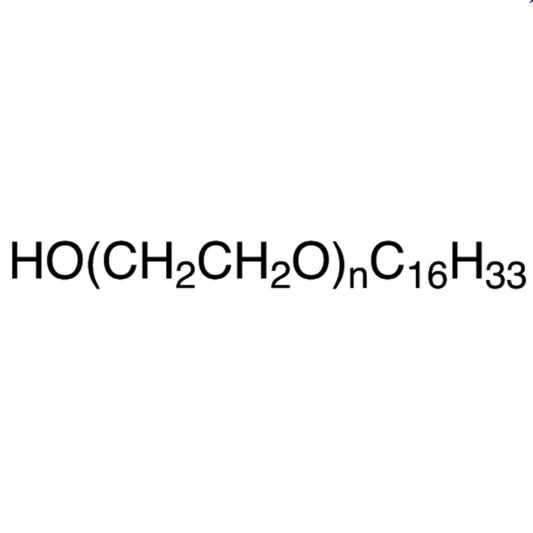
- TCI P3064 9005-00-9 Polyethylene Glycol Monostearyl Ether (n=approx. 20)
- Membrane protein solubilisation: its nonionic character is relatively gentle on protein structure, so it can extract and stabilise membrane proteins without adding charges that disturb their native interactions.
- Micelle and self-assembly studies: the fixed number of ethylene oxide units gives reproducible micellisation behaviour, making it a reliable model surfactant for studying aggregation and micelle structure.
- Interfacial physical chemistry research: its uniform molecular structure gives consistent interfacial behaviour, so surface and interface measurements can be compared meaningfully with values reported in the literature.
- Phase behaviour investigations: unlike technical ethoxylate mixtures with broad chain-length distributions, this single defined compound produces cleaner, more interpretable phase behaviour in surfactant–water and multicomponent systems.
- Polymer-based material formulation: as a polymer additive with a defined amphiphilic structure, it helps researchers control dispersion and interfacial properties when developing and testing polymer formulations.
| Brand | TCI (product code O0139) |
|---|---|
| CAS number | 3055-98-9 |
| Molecular formula | — |
| Purity | — |
| Category | Materials Science > Polymer/Macromolecule Reagents > Polymer Additives |
| Pack sizes | please contact AMI Scientific for the pack sizes currently available |
| Physical form | — |
| Storage | follow the storage conditions on the TCI label and Safety Data Sheet |
- Synonym: C12E8 (nonionic surfactant with a dodecyl tail and eight ethylene glycol units)
Keep Octaethylene Glycol Monododecyl Ether in its original, tightly closed container, and follow the storage conditions on the TCI product label and Safety Data Sheet. Store it in a cool, dry, well-ventilated place away from direct sunlight, heat sources and incompatible substances such as strong oxidising agents. Reseal the container promptly after each use to limit exposure to moisture and air. Handle the material according to good laboratory practice: wear suitable gloves, safety glasses and a lab coat, avoid contact with skin and eyes, and work in a well-ventilated area. Label any prepared solutions clearly with the concentration and date, and dispose of waste in line with local regulations and your institution's procedures.
—
Product Categories
Produk Terkait
-
TriethyleneGlycolMonododecylEther TCI T0768
Regular price Rp 18.628.050,00Regular price -
PolyethyleneGlycolMonododecylEther(n=approx25) TCI P0671
Regular price From Rp 477.750,00Regular price -
PentaethyleneGlycolMonododecylEther TCI P0372
Regular price Rp 18.550.350,00Regular price -
NonaethyleneGlycolMonododecylEther[forBiochemicalResearch] TCI N1204
Regular price From Rp 980.700,00Regular price -
HexaethyleneGlycolMonododecylEther TCI H0444
Regular price Rp 5.724.600,00Regular price -
PolyethyleneGlycolMonostearylEther(n=approx.20) TCI P3064
Regular price From Rp 505.050,00Regular price -
PolyethyleneGlycolMono-4-octylphenylEther(n=approx.10) TCI P0873
Regular price From Rp 557.550,00Regular price -
PolyethyleneGlycolMonocetylEther(n=approx.23) TCI P0841
Regular price From Rp 477.750,00Regular price


![3055-99-0 Nonaethylene Glycol Monododecyl Ether [for Biochemical Research] - AMI Scientific](http://amiscientific.com/cdn/shop/files/TCI2510N1204.jpg?v=1768362176&width=533)