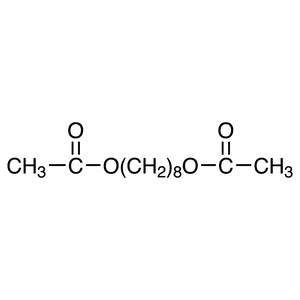
1,8-Diacetoxyoctane is a chemical compound widely used in organic reactions for the synthesis of complex molecules. It serves as a foundational building block in chemical laboratories, enabling the creation of compounds with specific structural characteristics. This versatile reagent is commonly employed in research settings where controlled chemical transformations are required. Its role in laboratory processes is critical, as it provides a stable starting point for further chemical modifications.
The compound is valued for its stable molecular structure and its ability to participate in various types of chemical reactions, including substitution, elimination, and redox reactions. These properties make it a preferred choice for organic chemists seeking reliable and predictable outcomes in their experiments. Additionally, its non-polar nature facilitates efficient separation and purification during synthesis processes. This characteristic is particularly beneficial in multi-step reactions where purity is essential.
In Indonesian laboratories, 1,8-Diacetoxyoctane is extensively used in organic chemistry research, especially in the development of pharmaceutical compounds and industrial chemicals. It is a common component in experiments requiring both reactivity and molecular stability. Many research institutions and universities rely on this compound as a fundamental reagent for their chemical synthesis projects. Its consistent performance and broad applicability make it an essential tool in the chemical research landscape of Indonesia.
- Organic synthesis of pharmaceutical compounds due to its reactivity and structural versatility.
- Industrial chemical production where stable and predictable chemical transformations are required.
- Research in molecular structure modification for the development of new chemical entities.
- Purification processes in multi-step chemical reactions due to its non-polar characteristics.
- Educational experiments in undergraduate and graduate chemistry courses for teaching chemical reactivity.
| Brand | TCI |
|---|---|
| CAS number | 3992-48-1 |
| Molecular formula | — |
| Purity | — |
| Category | Chemistry > Building Blocks > Non-Heterocyclic Building Blocks |
| Pack sizes | Available in various sizes as per standard chemical supply practices. |
| Physical form | Liquid, clear, with a characteristic odor. |
| Storage | Store in a cool, dry place away from direct sunlight. |
1,8-Diacetoxyoctane should be stored in a cool, dry environment to maintain its stability and prevent degradation. It is recommended to keep the compound in a tightly sealed container to minimize exposure to air and moisture. Suitable storage containers include glass or high-density polyethylene (HDPE) bottles, which are resistant to chemical interactions. In laboratory settings, it is important to handle the compound with appropriate personal protective equipment, such as gloves and safety goggles, to ensure safety. The compound should be stored away from incompatible materials, such as strong oxidizers or acids, to prevent any potential chemical reactions. Regular monitoring of storage conditions is advised to maintain the integrity of the compound throughout its shelf life.
—
Produk Terkait
-
1,3-Diacetoxybenzene TCI R0046
Regular price From Rp 795.900,00Regular price -
1,2-Diacetoxybenzene TCI D2044
Regular price Rp 3.605.700,00Regular price -
3,4-Diacetoxybenzaldehyde TCI D2042
Regular price From Rp 2.466.450,00Regular price -
1,4-Diacetoxybenzene TCI D1803
Regular price From Rp 1.035.300,00Regular price -
1,4-Diacetoxybutane TCI B1232
Regular price From Rp 1.035.300,00Regular price -
1,2,4-Triacetoxybenzene TCI T0976
Regular price Rp 2.571.450,00Regular price -
1,5-Diacetoxypentane TCI P1238
Regular price From Rp 848.400,00Regular price -
1,2-Diacetoxypropane TCI P0902
Regular price From Rp 477.750,00Regular price