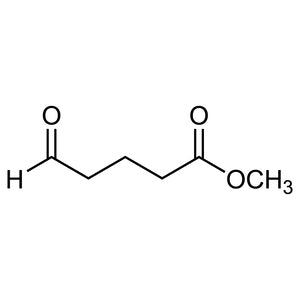
Methyl 5-oxopentanoate (TCI product code O0706, CAS 6026-86-4) is a bifunctional compound. It has an aldehyde group at one end and a methyl ester group at the other, joined by a short carbon chain. It belongs to the non-heterocyclic building blocks and is widely used in organic synthesis as an intermediate. Chemists use it to extend carbon chains, build rings, or add functional groups step by step when assembling more complex target molecules. In the laboratory it is a versatile starting material and connecting piece in multistep synthetic routes.
The main advantage of this compound is that its two functional groups react very differently. The aldehyde is much more reactive toward nucleophiles than the ester. Researchers can therefore run reactions such as Wittig olefination, reductive amination, Grignard addition, or aldol condensation at the aldehyde end while the ester stays intact for later steps. Because of this built-in selectivity, fewer protection and deprotection steps are needed, which shortens routes and saves reagents and time. The five-carbon chain is also well suited to intramolecular cyclisation reactions that form five- or six-membered rings, which makes the compound useful for building ring systems.
In Indonesian laboratories, methyl 5-oxopentanoate is relevant to research groups working on total synthesis of natural products, medicinal chemistry, and the development of new reaction methods. University chemistry departments, pharmaceutical research units, and government research institutes can use it as a dependable intermediate for synthetic projects, student theses, and exploratory studies. As a TCI-branded reagent, it gives researchers a recognised source of supply for work that needs consistent starting materials and reproducible results across repeated experiments.
- Wittig olefination: the reactive aldehyde group converts readily into an alkene, while the methyl ester remains available for later transformations in the same synthetic sequence.
- Reductive amination: the aldehyde end can be joined to amines to install nitrogen-containing chains, which is useful for preparing amine intermediates in medicinal chemistry programmes.
- Grignard and organometallic additions: nucleophiles attack the aldehyde preferentially over the ester, so chemists can extend the carbon chain selectively without first protecting the ester group.
- Aldol condensation and carbon chain extension: the aldehyde takes part in carbon–carbon bond formation, letting researchers build larger carbon frameworks step by step toward complex target molecules.
- Intramolecular cyclisation: the five-carbon chain between the two functional groups suits ring-closing strategies that produce five- or six-membered rings in natural product and methodology research.
| Brand | TCI (product code O0706) |
|---|---|
| CAS number | 6026-86-4 |
| Molecular formula | — |
| Purity | — |
| Category | Chemistry > Building Blocks > Non-Heterocyclic Building Blocks |
| Pack sizes | as offered by TCI; please check the product listing for available options |
| Physical form | please refer to the TCI product specification and Safety Data Sheet (SDS) |
| Storage | — |
- Chemical name: Methyl 5-Oxopentanoate
Store methyl 5-oxopentanoate in its original, tightly closed container, following the storage conditions on the TCI label and Safety Data Sheet. Keep it in a cool, dry, well-ventilated area away from heat, ignition sources, oxidising agents, and direct sunlight. Aldehyde-containing compounds can degrade when exposed to air and moisture, so reseal the container promptly after each use. Handle the material in a fume hood and wear suitable personal protective equipment, including chemical-resistant gloves, safety glasses, and a laboratory coat. Avoid contact with skin, eyes, and clothing, and do not inhale vapours. Dispose of waste according to local chemical waste regulations and your institution's laboratory safety procedures.
—
Produk Terkait
-
Ethyl4-Methylpentanoate TCI E1626
Regular price From Rp 1.988.700,00Regular price -
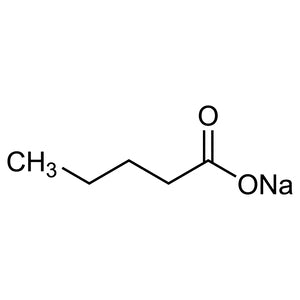
SodiumPentanoate TCI O0705
Regular price From Rp 1.431.150,00Regular price -
Methyl2-Fluoro-3-oxopentanoate TCI M3282
Regular price From Rp 769.650,00Regular price -
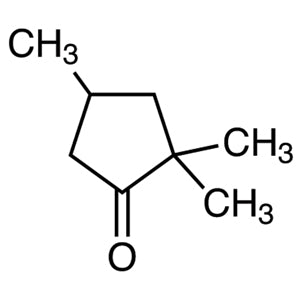
2,2,4-Trimethylcyclopentanone TCI T1719
Regular price Rp 7.261.800,00Regular price -
2-Acetylcyclopentanone TCI A0869
Regular price From Rp 980.700,00Regular price -
2-Heptylcyclopentanone TCI H0569
Regular price Rp 4.743.900,00Regular price -
2,2-Dimethylcyclopentanone TCI D5988
Regular price From Rp 1.988.700,00Regular price -
2,5-Dibenzylidenecyclopentanone TCI D3597
Regular price From Rp 1.378.650,00Regular price