

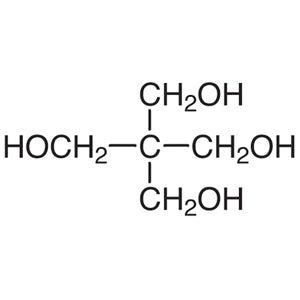
Pentaerythritol is an aliphatic polyol built around a single central carbon atom bonded to four hydroxymethyl groups. This gives the molecule four equivalent primary hydroxyl groups arranged symmetrically around its core. Chemistry laboratories and industry know it as an important tetrafunctional building block. It is used to build branched molecules, dendrimer cores and star polymers, alkyd resins, polyol esters for lubricants, and a range of crosslinking agents. Almost all of the popular tetrafunctional derivatives in materials chemistry, such as tetraacrylates and tetrathiols, are made from the pentaerythritol framework.
Chemists choose pentaerythritol mainly for its symmetry and functionality. Its four primary hydroxyl groups react in a similar way, so esterification, etherification, or substitution reactions can give tetra-substituted derivatives with well-defined structures. The central quaternary carbon has no hydrogen atoms, and this makes its derivatives, especially esters, tend to resist heat. This thermal stability is the reason pentaerythritol esters are widely used in high-performance lubricants. Because it is a stable crystalline solid, it is also easy to weigh and handle during routine laboratory work.
In Indonesian laboratories, pentaerythritol is used mostly in university research groups, polymer and materials science laboratories, and industrial research and development units. These groups work on resins, coatings, lubricants, and crosslinked networks. Synthetic chemists use it as a starting core for multi-arm molecules and dendritic structures. Formulation laboratories use it to study polyol esters and alkyd systems. AMI Scientific supplies this TCI product to support these research and development activities.
- Dendrimer and star polymer synthesis: its four equivalent primary hydroxyl groups make a symmetrical tetrafunctional core from which identical branches or polymer arms can grow in a controlled way.
- Alkyd resin research: it serves as a polyol component that adds branching points to the resin structure, so researchers can study how crosslink density affects coating and film properties.
- Polyol ester lubricant development: its quaternary carbon centre has no hydrogen atoms, which gives the resulting esters good thermal stability, a key property studied for high-performance lubricant formulations.
- Preparation of tetrafunctional monomers: it is the standard framework for making derivatives such as tetraacrylates and tetrathiols, which are widely used in materials chemistry and polymer network research.
- Crosslinking agent studies: its four reactive hydroxyl groups allow it to link several polymer chains together, which suits work on crosslinked networks, thermosets, and related functional materials.
| Brand | TCI (product code P0039) |
|---|---|
| CAS number | 115-77-5 |
| Molecular formula | — |
| Purity | — |
| Category | Chemistry > Building Blocks > Non-Heterocyclic Building Blocks |
| Pack sizes | as listed on the product page |
| Physical form | crystalline solid |
| Storage | keep in a tightly closed container in a cool, dry place |
Store pentaerythritol in its original, tightly closed container in a cool, dry, well-ventilated area, away from moisture and direct heat. Keep the container sealed between uses so the crystalline solid does not absorb humidity, which matters in Indonesia's humid climate. Store it away from strong oxidising agents. Follow standard laboratory practice when handling it: wear safety glasses, gloves, and a lab coat, avoid creating or breathing in dust, and weigh the material in a well-ventilated area. Clean up spills promptly. Always check the supplier's Safety Data Sheet for full hazard, handling, and disposal information before use.
—
Produk Terkait
-
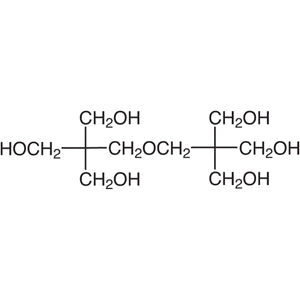
Dipentaerythritol TCI D1342
Regular price From Rp 505.050,00Regular price -
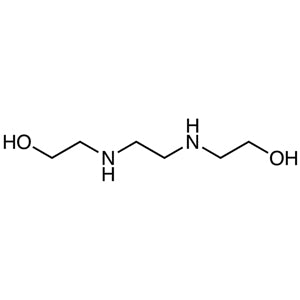
N,N'-Bis(2-hydroxyethyl)ethylenediamine TCI B3807
Regular price Rp 3.498.600,00Regular price -
trans-2-Butene-1,4-diol TCI B3384
Regular price From Rp 2.757.300,00Regular price -
2,2'-Bis(hydroxymethyl)diphenylEther TCI B1643
Regular price From Rp 3.763.200,00Regular price -
4,4'-Bicyclohexanol(mixtureofisomers) TCI B1621
Regular price From Rp 1.565.550,00Regular price -
3,9-Bis(1,1-dimethyl-2-hydroxyethyl)-2,4,8,10-tetraoxaspiro[5.5]undecane TCI B1158
Regular price From Rp 1.008.000,00Regular price -
2-Butyl-2-ethyl-1,3-propanediol TCI B0922
Regular price From Rp 477.750,00Regular price -
cis-2-Butene-1,4-diol TCI B0693
Regular price From Rp 717.150,00Regular price


![1455-42-1 3,9-Bis(1,1-dimethyl-2-hydroxyethyl)-2,4,8,10-tetraoxaspiro[5.5]undecane - AMI Scientific](http://amiscientific.com/cdn/shop/files/TCI2510B1158_609993f6-3ef5-43f1-b023-4ccd96c49dd8.jpg?v=1767231560&width=533)

