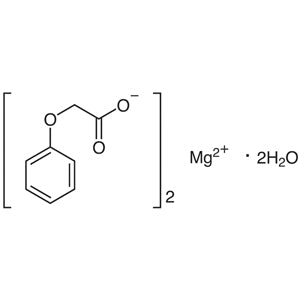
Magnesium Phenoxyacetate Dihydrate from TCI is the magnesium salt of phenoxyacetic acid, supplied as a hydrate that contains two molecules of water of crystallization. In the laboratory, the compound serves as a source of the phenoxyacetate anion in the form of a stable metal salt. Researchers can use it whenever they need the ionic form of phenoxyacetic acid without neutralizing the free acid themselves. The material belongs to the non-heterocyclic building block group and is useful for salt chemistry studies, metal coordination work and experimental formulations.
The main reason to choose this material is that it is a defined salt, complete with its water of crystallization. Researchers therefore get a material with a consistent composition, which matters for comparative work and repeated experiments. The magnesium ion gives the compound different solubility and interaction behaviour from the free acid, which is important in studies of how the cation affects physicochemical properties. Because the compound is a hydrate, storage conditions also matter: careful storage keeps its water content in line with the value stated on the label and the certificate of analysis.
For laboratories in Indonesia, magnesium phenoxyacetate dihydrate is relevant to university research groups, chemistry teaching laboratories and industrial research and development units that work with organic salts and metal carboxylates. It suits projects that compare a free acid with its metal salts and studies of how cations influence solubility and reactivity. It is also useful in exploratory formulation work, where a ready-made salt of known composition saves preparation time and improves reproducibility.
- Salt chemistry studies: as a defined magnesium salt, it lets researchers examine the behaviour of the phenoxyacetate anion in ionic form without preparing the salt from the free acid first.
- Metal coordination research: the combination of magnesium ions and phenoxyacetate ligands makes it a practical starting point for investigating how carboxylate groups interact with metal centres.
- Cation effect comparisons: researchers can compare its solubility and physicochemical behaviour with the free phenoxyacetic acid to see how the magnesium cation changes material properties.
- Experimental formulation work: its consistent composition, including the stated water of crystallization, supports reproducible formulation trials where a ready-made ionic form of phenoxyacetic acid is needed.
- Building block chemistry: as a non-heterocyclic building block, it gives synthetic chemists a convenient phenoxyacetate source in salt form for exploratory reactions and comparative synthetic studies.
| Brand | TCI (product code P0108) |
|---|---|
| CAS number | 76172-73-1 |
| Molecular formula | — |
| Purity | — |
| Category | Chemistry > Building Blocks > Non-Heterocyclic Building Blocks |
| Pack sizes | please refer to the available options on the product listing |
| Physical form | — |
| Storage | store as stated on the product label so that the water content stays consistent with the certificate of analysis |
- Form: magnesium salt of phenoxyacetic acid, dihydrate (two molecules of water of crystallization)
Keep Magnesium Phenoxyacetate Dihydrate in its original, tightly closed container, in a cool, dry, well-ventilated area away from direct sunlight and incompatible materials. Because it is a hydrate, avoid exposing it to excessive heat or very dry or very humid conditions, since these can change its water of crystallization. Close the container promptly after each use. Follow good laboratory practice: wear gloves, safety glasses and a lab coat, avoid creating dust, and do not inhale it or let it touch your skin or eyes. Always check the supplier's Safety Data Sheet and the label for specific storage and handling instructions.
—
Produk Terkait
-
SodiumPhenoxyacetate TCI S0529
Regular price Rp 3.312.750,00Regular price -
EthylPhenoxyacetate TCI P1340
Regular price Rp 2.041.200,00Regular price -
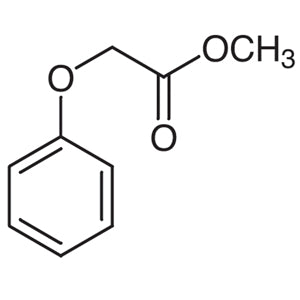
MethylPhenoxyacetate TCI P0110
Regular price From Rp 1.115.100,00Regular price -
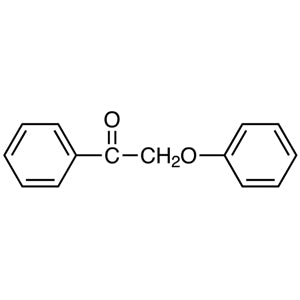
2-Phenoxyacetophenone TCI P2121
Regular price Rp 1.298.850,00Regular price -
4'-Phenoxyacetophenone TCI P1355
Regular price Rp 1.298.850,00Regular price -
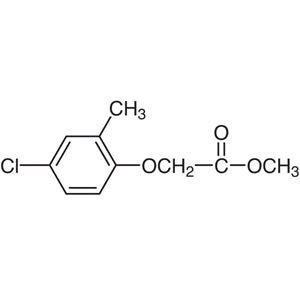
Methyl4-Chloro-2-methylphenoxyacetate TCI C0598
Regular price From Rp 477.750,00Regular price -
PhenoxyacetylChloride TCI P0113
Regular price From Rp 1.565.550,00Regular price -
Phenoxyacetone TCI P0112
Regular price From Rp 3.630.900,00Regular price