


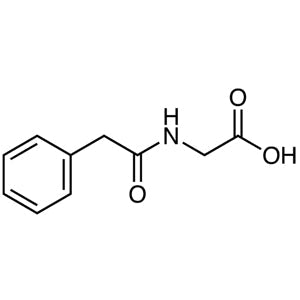
Phenaceturic Acid from TCI, also known as N-phenylacetylglycine, is an amino acid derivative. It forms when a phenylacetyl group joins glycine through an amide bond. In the laboratory it is known as one of the conjugation metabolites of phenylacetic acid in a range of organisms. It is also a simple example of an N-acylated amino acid, which makes it relevant to peptide chemistry. Researchers use it as a reference compound, as a starting material for synthesis, and as a model for studying how amide bonds form and break.
The compound is useful because it holds an amide bond and a free carboxylic acid group in one compact structure. With these two functional groups, it can be coupled further, esterified, or analysed as a standard in metabolism studies. The phenyl group acts as a chromophore that helps UV detection in liquid chromatography. Its structure is stable and easy to identify. This makes it a dependable comparison standard when validating analytical methods for metabolites based on conjugated amino acids, and a practical choice for both analytical and synthetic work.
In Indonesia, pharmacology, toxicology, clinical chemistry, and synthetic organic chemistry laboratories can use this compound in research on how aromatic compounds are metabolised and in work on amino acid conjugates. University research groups studying xenobiotic metabolism can use it as a reference standard. Teaching laboratories can use it to show amide bond chemistry and N-acylation of amino acids. Analytical laboratories building chromatographic methods for urinary or plasma metabolites can use it as a calibration and identification standard.
- Metabolism reference standard: as a known conjugation metabolite of phenylacetic acid, it lets researchers confirm the identity of this metabolite in biological samples from different organisms.
- Analytical method validation: its stable, easily recognised structure and UV-active phenyl chromophore make it a reliable comparison standard for liquid chromatography methods targeting conjugated amino acids.
- Peptide chemistry model studies: as a simple N-acylated amino acid, it is a convenient model for studying how amide bonds form, how stable they are, and how they are cleaved.
- Synthetic starting material: its free carboxylic acid group allows further coupling or esterification, so chemists can use it as a building block for larger amide or ester derivatives.
- Toxicology and pharmacology research: it supports studies of how aromatic compounds are processed and conjugated with glycine, which helps explain detoxification pathways in living systems.
| Brand | TCI (product code P0131) |
|---|---|
| CAS number | 500-98-1 |
| Molecular formula | — |
| Purity | — |
| Category | Chemistry > Chemical Biology > Peptide Chemistry |
| Pack sizes | see the TCI product listing for available pack sizes |
| Physical form | — |
| Storage | follow the conditions on the TCI label and Safety Data Sheet |
- Synonym: N-phenylacetylglycine
Store Phenaceturic Acid in its original, tightly closed container in a cool, dry, well-ventilated place, away from direct sunlight, heat, and moisture, unless the TCI label or Safety Data Sheet says otherwise. Keep it away from incompatible materials such as strong oxidising agents. Wear standard laboratory protective equipment, including gloves, safety glasses, and a lab coat. Avoid breathing in dust and avoid contact with skin and eyes. Weigh and handle the material in a well-ventilated area or under a fume hood. Label containers clearly, close them right after use to prevent contamination, and always read the Safety Data Sheet before use. Dispose of waste according to local regulations.
—
Produk Terkait
-
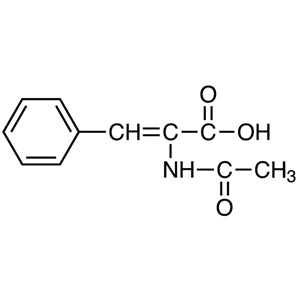
alpha-AcetamidocinnamicAcid TCI A0014
Regular price Rp 1.087.800,00Regular price -
(2R,5S)-2-Trichloromethyl-3-oxa-1-azabicyclo[3.3.0]octan-4-one TCI T2902
Regular price Rp 1.644.300,00Regular price -
N-(tert-Butoxycarbonyl)-4-methoxy-D-phenylalanine TCI B5350
Regular price From Rp 1.670.550,00Regular price -
(1R,2S)-1-[(tert-Butoxycarbonyl)amino]-2-vinylcyclopropanecarboxylicAcid TCI B5322
Regular price From Rp 637.350,00Regular price -
N-(tert-Butoxycarbonyl)-N-methyl-D-phenylalanine TCI B5011
Regular price From Rp 1.590.750,00Regular price -
N-(tert-Butoxycarbonyl)-4-cyano-L-phenylalanine TCI B4877
Regular price From Rp 2.466.450,00Regular price -
N-(tert-Butoxycarbonyl)-4-trifluoromethyl-L-phenylalanine TCI B4369
Regular price Rp 6.253.800,00Regular price -
N-(tert-Butoxycarbonyl)-L-homophenylalanine TCI B4356
Regular price Rp 664.650,00Regular price
![97538-67-5 (2R,5S)-2-Trichloromethyl-3-oxa-1-azabicyclo[3.3.0]octan-4-one - AMI Scientific](http://amiscientific.com/cdn/shop/files/TCI2510T2902.jpg?v=1767143504&width=533)

![159622-10-3 (1R,2S)-1-[(tert-Butoxycarbonyl)amino]-2-vinylcyclopropanecarboxylic Acid - AMI Scientific](http://amiscientific.com/cdn/shop/files/TCI2510B5322_7b687177-5993-48bc-b732-b8687acd11a9.jpg?v=1767861556&width=533)


