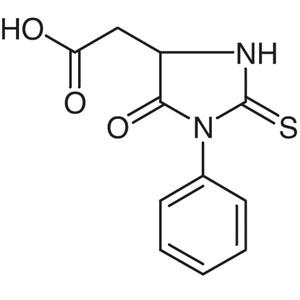
Phenylthiohydantoin-methionine is a chemical compound widely used in laboratory settings, particularly in organic chemistry and pharmaceutical research. It serves as a key building block in the synthesis of heterocyclic compounds, playing a crucial role in the development of complex molecular structures. This compound is valued for its ability to participate in various chemical reactions, including substitution and functional group transfer, making it an essential tool for chemists working on advanced synthetic pathways. Its unique chemical structure enables it to act as a versatile functional group donor, enhancing the efficiency of synthetic processes.
The compound is favored for its chemical stability and reactivity under a wide range of reaction conditions. Its molecular structure allows it to interact effectively with other molecules, facilitating the formation of new chemical bonds. This property makes it particularly useful in applications where precise control over molecular interactions is required. Additionally, its ability to maintain stability during storage and handling ensures that it remains a reliable and consistent reagent in laboratory environments.
In Indonesian laboratories, Phenylthiohydantoin-methionine is commonly used in organic chemistry research, especially in the synthesis of heterocyclic compounds. It is a preferred choice among researchers due to its versatility and effectiveness in various synthetic reactions. Its application in pharmaceutical and biochemical research further highlights its importance in the development of new compounds and drug discovery processes.
TCI brochures (PDF)
- Amino Acids and Peptide Synthesis Reagents 2025-08-14 · p. 22
Related TCI products
- TCI P0731 182153-75-9 Phenylthiohydantoin-arginine Hydrochloride
- TCI P0729 4333-21-5 Phenylthiohydantoin-proline
- TCI P0379 4333-20-4 Phenylthiohydantoin-valine
- TCI P0376 2010-15-3 Phenylthiohydantoin-glycine
- TCI P0368 4332-95-0 Phenylthiohydantoin-tyrosine
- TCI P0364 5624-13-5 Phenylthiohydantoin-aspartic Acid
- Organic synthesis of heterocyclic compounds due to its unique functional group and reactivity in substitution reactions.
- Pharmaceutical research for the development of new drug molecules through efficient synthetic pathways.
- Biochemical studies involving the modification of amino acids and their derivatives in complex molecular structures.
- Structural analysis in chemical research to understand molecular interactions and reaction mechanisms.
- Custom compound preparation for specialized applications in both academic and industrial research settings.
| Brand | TCI |
|---|---|
| CAS number | 4370-90-5 |
| Molecular formula | — |
| Purity | — |
| Category | Chemistry > Building Blocks > Heterocyclic Building Blocks |
| Pack sizes | Available in various quantities as per standard laboratory reagent packaging |
| Physical form | Solid, crystalline powder |
| Storage | Store in a cool, dry place away from moisture and direct sunlight |
Phenylthiohydantoin-methionine should be stored in a cool, dry environment to maintain its chemical stability. It is recommended to keep the compound in a sealed container to prevent exposure to moisture and air. The storage area should be free from direct sunlight and sources of heat to avoid degradation. When handling the compound, it is advisable to use appropriate personal protective equipment such as gloves and safety goggles to ensure safety. It should be stored separately from incompatible materials to prevent any potential chemical interactions. Proper labeling of storage containers is essential for safe and efficient laboratory management.
—
Product Categories
Produk Terkait
-
Phenylthiohydantoin-arginineHydrochloride TCI P0731
Regular price Rp 1.273.650,00Regular price -
Phenylthiohydantoin-proline TCI P0729
Regular price Rp 584.850,00Regular price -
Phenylthiohydantoin-valine TCI P0379
Regular price Rp 637.350,00Regular price -
Phenylthiohydantoin-glycine TCI P0376
Regular price Rp 1.115.100,00Regular price -
Phenylthiohydantoin-tyrosine TCI P0368
Regular price From Rp 505.050,00Regular price -
Phenylthiohydantoin-asparticAcid TCI P0364
Regular price From Rp 505.050,00Regular price -
Phenylthiohydantoin-norleucine TCI P0756
Regular price Rp 689.850,00Regular price -
Phenylthiohydantoin-(Nepsilon-phenylthiocarbamyl)-lysine TCI P0625
Regular price From Rp 743.400,00Regular price