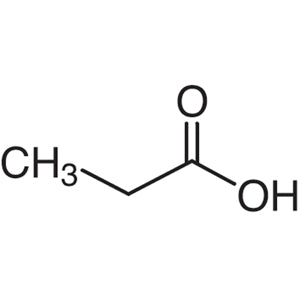
Propionic acid (TCI P0500, CAS 79-09-4) is a fundamental organic compound widely used in laboratory settings for its versatility in chemical reactions. As a key building block in organic chemistry, it serves as a precursor for various synthetic pathways, including esterification, hydrolysis, and the synthesis of more complex molecules. Its simple molecular structure allows for easy manipulation and integration into a wide range of chemical processes. This compound is essential for researchers working in both academic and industrial environments, offering a reliable and cost-effective solution for experimental needs.
Propionic acid is valued for its chemical stability and moderate reactivity, making it suitable for a variety of chemical transformations. It is a clear liquid with a distinct odor, which facilitates its identification and use in laboratory procedures. Its non-corrosive nature allows for safe handling under controlled conditions, reducing the risk of damage to equipment or exposure to personnel. These properties, combined with its availability in different packaging sizes, make it a preferred choice for both small-scale and medium-scale laboratory applications.
In Indonesian laboratories, propionic acid is commonly used in research and development activities across educational institutions and research organizations. It plays a crucial role in analytical and synthetic processes, supporting the creation of pharmaceutical compounds, food additives, and industrial chemicals. Its widespread use reflects its importance as a fundamental reagent in the chemical sciences.
- Used in pharmaceutical research for the synthesis of drug compounds due to its reactivity and compatibility with various organic reactions.
- Applied in food chemistry for the production of flavoring agents and preservatives, as it is safe for use in food-related applications.
- Utilized in analytical chemistry for qualitative and quantitative analysis, where its stability and known properties aid in accurate results.
- Employed in polymer chemistry for the modification of polymer structures through esterification and other chemical reactions.
- Incorporated in environmental testing to analyze organic compounds in soil and water samples due to its solubility and reactivity.
| Brand | TCI |
|---|---|
| CAS number | 79-09-4 |
| Molecular formula | — |
| Purity | — |
| Category | Chemistry > Building Blocks > Non-Heterocyclic Building Blocks |
| Pack sizes | Available in various sizes to suit different laboratory needs |
| Physical form | Clear liquid |
| Storage | Store in a cool, dry place away from direct sunlight |
Propionic acid should be stored in a cool, dry place, away from direct sunlight and sources of heat. It is recommended to use sealed containers made of glass or polyethylene to prevent contamination and evaporation. Due to its moderate reactivity, it should be handled with appropriate personal protective equipment, such as gloves and safety goggles, to ensure laboratory safety. Avoid contact with incompatible materials like strong oxidizing agents. Regular monitoring of storage conditions is essential to maintain the compound's integrity and ensure safe usage in laboratory settings.
—
Product Categories
Produk Terkait
-
SorbicAcid TCI S0053
Regular price From Rp 452.550,00Regular price -
PalmiticAcid TCI P1145
Regular price Rp 2.704.800,00Regular price -
PalmiticAcid TCI P0002
Regular price From Rp 505.050,00Regular price -
ValericAcid TCI V0003
Regular price From Rp 610.050,00Regular price -
10-UndecenoicAcid TCI U0007
Regular price From Rp 505.050,00Regular price -
UndecanoicAcid TCI U0004
Regular price From Rp 955.500,00Regular price -
BehenicAcid TCI B1747
Regular price Rp 3.976.350,00Regular price -
BehenicAcid TCI B1248
Regular price From Rp 795.900,00Regular price