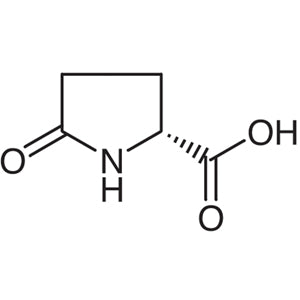
L-Pyroglutamic Acid (L-PGlu), with CAS number 98-79-3, is a chemical compound widely utilized in laboratory settings for its role in asymmetric synthesis and chiral resolution processes. This reagent plays a critical part in the separation of optical isomers, enabling the production of compounds with specific stereochemical configurations. Its application is particularly significant in the development of pharmaceuticals and organic chemicals, where precise molecular structures are essential. In Indonesian laboratories, L-Pyroglutamic Acid is a key component in research focused on creating active pharmaceutical ingredients and optimizing chemical synthesis pathways.
The chemical properties of L-Pyroglutamic Acid make it a preferred choice for researchers. It is chemically stable, water-soluble, and possesses a molecular structure that allows for effective interaction with various compounds. These characteristics enhance its reactivity and selectivity, making it suitable for complex chemical reactions that require high precision. Its ability to participate in chiral resolution processes ensures that it remains a reliable and efficient reagent in both academic and industrial research environments.
In Indonesian laboratories, L-Pyroglutamic Acid is commonly used in pharmaceutical and organic chemistry research. Its availability in different packaging options supports its use in both small-scale and larger research projects. Researchers in Indonesia rely on this compound for its consistent performance and reliability in achieving desired chemical outcomes, making it an essential tool in modern chemical synthesis.
TCI brochures (PDF)
- Chiral Auxiliaries and Optical Resolving Agents 2025-06-17 · p. 7
- Amino Acids and Peptide Synthesis Reagents 2025-08-14 · p. 5
- Reagents for Biological Research 2025-03-11 · p. 57
- Asymmetric Synthesis: L-Pyroglutamic Acid is ideal for creating enantiomerically pure compounds, essential in pharmaceutical development where stereochemistry directly affects drug efficacy.
- Chiral Resolution: It facilitates the separation of optical isomers, allowing for the production of high-purity compounds used in medicinal and industrial applications.
- Organic Chemistry Research: Its reactivity and selectivity make it a valuable reagent in the synthesis of complex organic molecules, supporting academic and industrial innovation.
- Pharmaceutical Development: It is used in the production of active pharmaceutical ingredients, ensuring the correct stereochemical configuration for therapeutic effectiveness.
- Analytical Chemistry: Its stability and solubility allow it to be used in analytical procedures requiring precise chemical interactions and consistent results.
| Brand | TCI |
|---|---|
| CAS number | 98-79-3 |
| Molecular formula | — |
| Purity | — |
| Category | Chemistry > Asymmetric Synthesis > Chiral Resolution Reagents |
| Pack sizes | Available in various sizes suitable for laboratory use |
| Physical form | Solid powder |
| Storage | Store in a cool, dry place away from moisture and direct sunlight |
L-Pyroglutamic Acid should be stored in a cool, dry environment to maintain its chemical stability and prevent degradation. It is recommended to use airtight containers to protect it from moisture and humidity, which can affect its solubility and effectiveness. Since it is water-soluble, it should be kept away from sources of water to avoid unintended reactions. In laboratory settings, it is important to handle the compound with care, using appropriate personal protective equipment such as gloves and safety goggles. Proper labeling of storage containers ensures safe handling and minimizes the risk of accidental exposure. Regular monitoring of storage conditions helps maintain the integrity of the reagent, ensuring its performance in chemical processes remains consistent.
—
Product Categories
Produk Terkait
-
D-PyroglutamicAcid TCI P1354
Regular price From Rp 928.200,00Regular price -
DL-PyroglutamicAcid TCI G0061
Regular price From Rp 664.650,00Regular price -
N-(tert-Butoxycarbonyl)-L-pyroglutamicAcid TCI B4083
Regular price Rp 1.326.150,00Regular price -
N-Carbobenzoxy-L-pyroglutamicAcid TCI C3143
Regular price Rp 795.900,00Regular price -
L-GlutamicAcid TCI G0059
Regular price From Rp 477.750,00Regular price -
D-GlutamicAcid TCI G0057
Regular price From Rp 1.829.100,00Regular price -
tert-ButylN-(tert-Butoxycarbonyl)-L-pyroglutamate TCI B5216
Regular price From Rp 1.035.300,00Regular price -
tert-ButylL-Pyroglutamate TCI B4026
Regular price From Rp 477.750,00Regular price