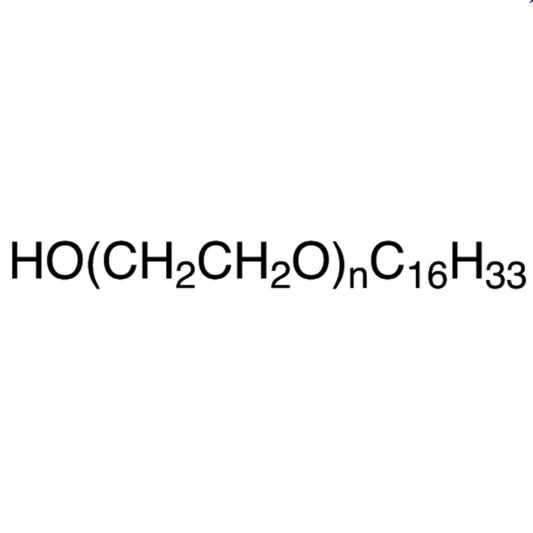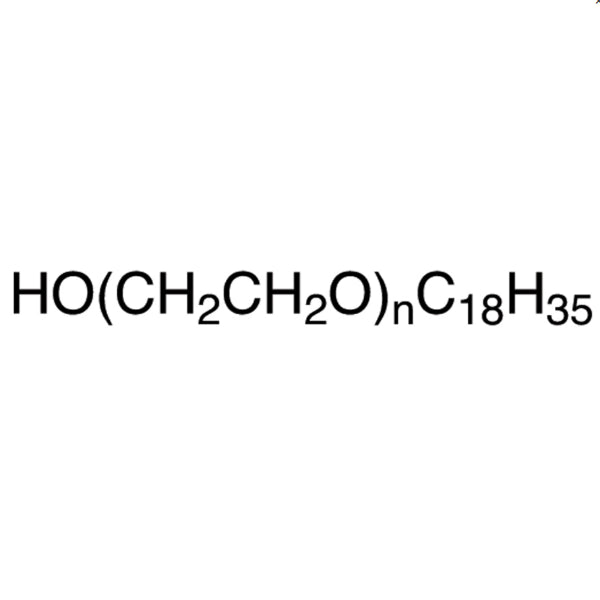
Polyethylene Glycol Monooleyl Ether (P0715), with CAS number 9004-98-2, is a versatile chemical compound widely utilized in scientific and industrial applications. As a non-ionic surfactant, it plays a crucial role in laboratories by reducing surface tension and enhancing the dispersion of substances in various media. This compound is particularly valuable in material science for its ability to stabilize emulsions and improve the solubility of hydrophobic materials. Its presence in formulations helps in achieving better compatibility between different components, making it an essential tool for researchers and chemists.
The key properties that make Polyethylene Glycol Monooleyl Ether a preferred choice include its non-ionic nature, chemical stability, and solubility in organic solvents. These characteristics enable it to function effectively across a range of experimental conditions without undergoing significant degradation. Additionally, its molecular structure, consisting of a polyethylene glycol chain attached to an oleyl group, provides both hydrophilic and hydrophobic properties. This dual functionality allows it to act as a bridge between aqueous and oily phases, making it ideal for applications that require interfacial activity.
In Indonesian laboratories, Polyethylene Glycol Monooleyl Ether is commonly used in chemical, pharmaceutical, and material research. Its role in surface property testing, formulation development, and synthesis of complex compounds makes it a staple in both academic and industrial settings. Due to its reliability and performance, it is often selected as a primary material for experiments requiring surfactant properties and emulsification capabilities.
Related TCI products
- TCI P3064 9005-00-9 Polyethylene Glycol Monostearyl Ether (n=approx. 20)
- TCI P2885 9005-08-7 Polyethylene Glycol Distearate (n=approx. 10)
- TCI P0873 9002-93-1 Polyethylene Glycol Mono-4-octylphenyl Ether (n=approx. 10)
- TCI P0872 9004-81-3 Polyethylene Glycol Monolaurate (n=approx. 10)
- TCI P0841 9004-95-9 Polyethylene Glycol Monocetyl Ether (n=approx. 23)
- TCI P0723 9004-99-3 Polyethylene Glycol Monostearate (n=approx. 55) (palmitate and stearate mixture)
- Surface tension testing and emulsification studies benefit from its surfactant properties, aiding in the creation of stable emulsions and reducing interfacial tension.
- Formulation development in cosmetics and pharmaceuticals relies on its ability to improve dispersion and compatibility between ingredients.
- Polymer synthesis and modification processes use it as a dispersing agent to enhance the uniformity of polymer structures.
- Coating and film-forming applications take advantage of its ability to modify surface properties and improve adhesion.
- Analytical testing for surface-active agents includes its use as a reference standard for determining surfactant behavior in different media.
| Brand | TCI |
|---|---|
| CAS number | 9004-98-2 |
| Molecular formula | — |
| Purity | — |
| Category | Materials Science > Polymer/Macromolecule Reagents > Polymer Additives |
| Pack sizes | Available in various quantities as per standard laboratory requirements |
| Physical form | Liquid |
| Storage | Store in a cool, dry place away from direct sunlight and incompatible materials |
Polyethylene Glycol Monooleyl Ether should be stored in a cool, dry environment, away from direct sunlight and sources of heat. It is recommended to keep the container tightly sealed to prevent contamination and evaporation. Due to its organic nature, it should be stored in appropriate chemical-resistant containers, such as glass or high-density polyethylene. In laboratory settings, it is important to handle the compound with care, using appropriate personal protective equipment when necessary. While it is generally stable under normal conditions, it should be kept away from strong oxidizing agents and incompatible substances to ensure safety and maintain its chemical integrity.
—
Product Categories
Produk Terkait
-
PolyethyleneGlycolMonostearylEther(n=approx.20) TCI P3064
Regular price From Rp 505.050,00Regular price -
PolyethyleneGlycolDistearate(n=approx.10) TCI P2885
Regular price Rp 1.220.100,00Regular price -
PolyethyleneGlycolMono-4-octylphenylEther(n=approx.10) TCI P0873
Regular price From Rp 557.550,00Regular price -
PolyethyleneGlycolMonolaurate(n=approx.10) TCI P0872
Regular price From Rp 477.750,00Regular price -
PolyethyleneGlycolMonocetylEther(n=approx.23) TCI P0841
Regular price From Rp 477.750,00Regular price -
PolyethyleneGlycolMonostearate(n=approx.55)(palmitateandstearatemixture) TCI P0723
Regular price From Rp 477.750,00Regular price -
PolyethyleneGlycolMonostearate(n=approx.45)(palmitateandstearatemixture) TCI P0722
Regular price From Rp 477.750,00Regular price -
PolyethyleneGlycolMonostearate(n=approx.40)(palmitateandstearatemixture) TCI P0721
Regular price From Rp 477.750,00Regular price