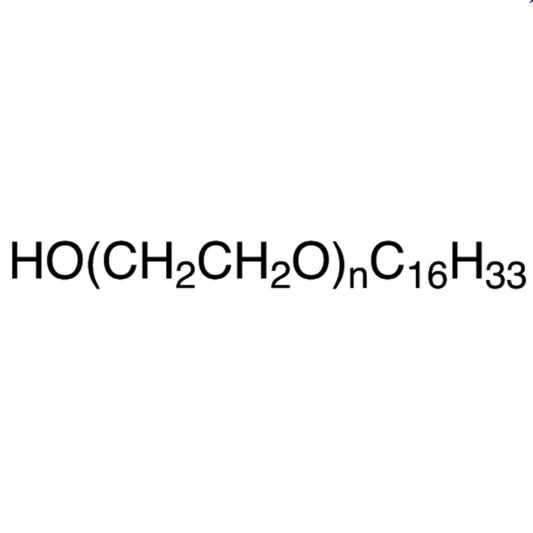
Polyethylene Glycol Monooleyl Ether (PEGO), with CAS number 9004-98-2, is a chemical compound widely used in laboratory settings for polymer and material science applications. As a non-ionic surfactant, it plays a crucial role in emulsification and solubilization processes. Its unique molecular structure combines a hydrophilic polyethylene glycol chain with a hydrophobic oleyl group, enabling it to function effectively at the interface of water and oil. This dual nature makes it an essential component in various chemical and material experiments.
The properties of PEGO that make it a preferred choice include its stability, solubility in both aqueous and organic solvents, and its ability to modify polymer characteristics. Its non-ionic nature ensures compatibility with a wide range of chemical systems, making it versatile for different experimental setups. Additionally, its low toxicity and chemical inertness contribute to its widespread use in both research and industrial applications. These attributes make it a reliable and effective reagent for laboratory use.
In Indonesian laboratories, PEGO is commonly used in material science, pharmaceutical chemistry, and cosmetic formulation research. Its availability and consistent quality make it a go-to choice for researchers and developers. It is frequently employed in experiments requiring emulsification, solubility enhancement, or viscosity reduction. Its role in improving the performance of polymer-based materials is well recognized in both academic and industrial settings.
Related TCI products
- TCI P3064 9005-00-9 Polyethylene Glycol Monostearyl Ether (n=approx. 20)
- TCI P2885 9005-08-7 Polyethylene Glycol Distearate (n=approx. 10)
- TCI P0873 9002-93-1 Polyethylene Glycol Mono-4-octylphenyl Ether (n=approx. 10)
- TCI P0872 9004-81-3 Polyethylene Glycol Monolaurate (n=approx. 10)
- TCI P0841 9004-95-9 Polyethylene Glycol Monocetyl Ether (n=approx. 23)
- TCI P0723 9004-99-3 Polyethylene Glycol Monostearate (n=approx. 55) (palmitate and stearate mixture)
- In polymer science research, PEGO is used to modify polymer properties, enhancing solubility and reducing viscosity in formulation processes.
- For pharmaceutical applications, it serves as an emulsifier and solubilizer, aiding in the development of stable drug delivery systems and topical formulations.
- In cosmetic formulation, PEGO helps create stable emulsions and improves the texture and spreadability of skincare and personal care products.
- It is utilized in material science for surface modification, enabling better adhesion and compatibility between different material components.
- In analytical chemistry, PEGO is employed as a dispersing agent to improve the homogeneity of samples and facilitate accurate testing procedures.
| Brand | TCI |
|---|---|
| CAS number | 9004-98-2 |
| Molecular formula | — |
| Purity | — |
| Category | Materials Science > Polymer/Macromolecule Reagents > Polymer Additives |
| Pack sizes | Available in various quantities as per standard laboratory supply options |
| Physical form | Liquid |
| Storage | Store in a cool, dry place away from direct sunlight and moisture |
PEGO should be stored in a cool, dry environment, away from direct sunlight and moisture to maintain its chemical integrity. It is recommended to use airtight containers made of glass or polyethylene to prevent contamination and evaporation. Due to its non-ionic nature, it is generally safe to handle, but standard laboratory safety precautions should be followed, including the use of gloves and eye protection. Avoid exposure to high temperatures and ensure proper ventilation when working with larger quantities. Regular inspection of storage conditions is advised to ensure the material remains in optimal condition for use in laboratory experiments.
—
Product Categories
Produk Terkait
-
PolyethyleneGlycolMonostearylEther(n=approx.20) TCI P3064
Regular price From Rp 505.050,00Regular price -
PolyethyleneGlycolDistearate(n=approx.10) TCI P2885
Regular price Rp 1.220.100,00Regular price -
PolyethyleneGlycolMono-4-octylphenylEther(n=approx.10) TCI P0873
Regular price From Rp 557.550,00Regular price -
PolyethyleneGlycolMonolaurate(n=approx.10) TCI P0872
Regular price From Rp 477.750,00Regular price -
PolyethyleneGlycolMonocetylEther(n=approx.23) TCI P0841
Regular price From Rp 477.750,00Regular price -
PolyethyleneGlycolMonostearate(n=approx.55)(palmitateandstearatemixture) TCI P0723
Regular price From Rp 477.750,00Regular price -
PolyethyleneGlycolMonostearate(n=approx.45)(palmitateandstearatemixture) TCI P0722
Regular price From Rp 477.750,00Regular price -
PolyethyleneGlycolMonostearate(n=approx.40)(palmitateandstearatemixture) TCI P0721
Regular price From Rp 477.750,00Regular price