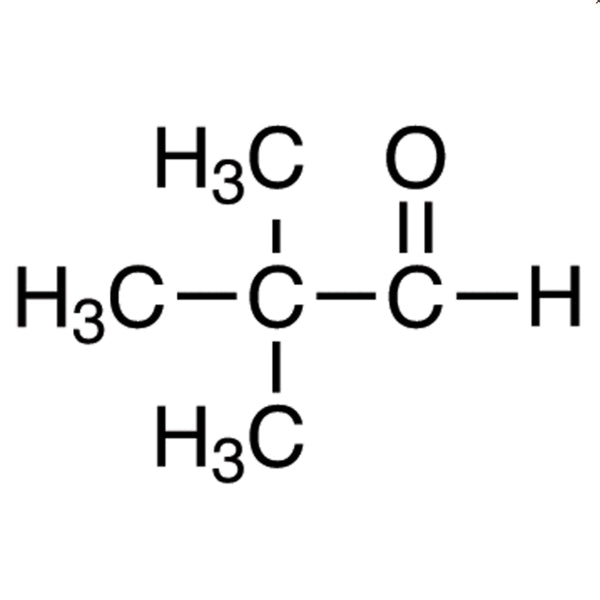
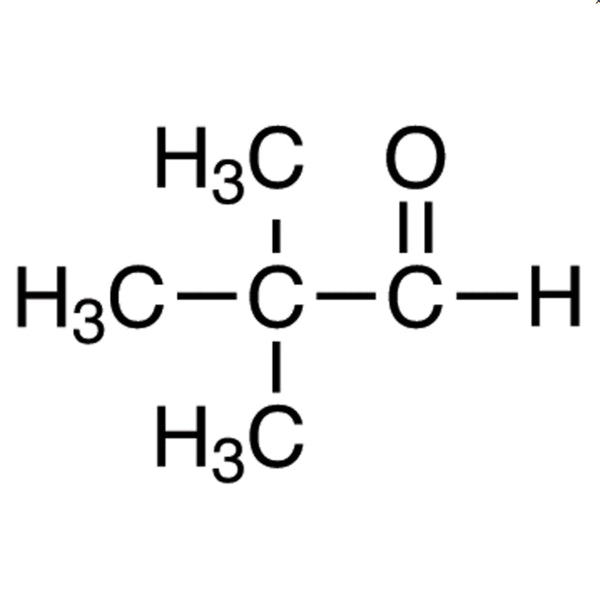
Pivalaldehyde is an organic compound widely used in chemical reactions for the synthesis of complex molecules. It serves as a versatile building block in organic chemistry, enabling various types of reactions such as reduction, oxidation, and substitution. In the laboratory, it is commonly utilized as a foundational material for creating both heterocyclic and non-heterocyclic compounds. Due to its reactivity, Pivalaldehyde is a preferred choice for organic chemistry research. Its ability to participate in multiple reaction pathways makes it an essential component in synthetic chemistry workflows.
Pivalaldehyde exhibits chemical stability under certain conditions, although it is highly sensitive to moisture and air exposure. It is a liquid with a sharp odor and is volatile in nature, requiring careful handling. Its reactivity makes it suitable for reactions that require substrates with high reactivity. The compound’s chemical properties allow it to be used in a variety of synthetic applications, making it a valuable resource for both academic and industrial research. Its availability ensures that researchers and students can access this essential material for their experiments.
In Indonesian laboratories, Pivalaldehyde is used in various chemical research projects, including the synthesis of pharmaceutical compounds and industrial chemicals. It is also commonly used in educational settings to teach organic chemistry reactions. Its presence in laboratory supply chains supports the advancement of chemical research and experimentation in Indonesia. The compound’s utility in both research and teaching makes it a key material for chemical studies in the region.
- Organic synthesis applications benefit from Pivalaldehyde’s reactivity and versatility in forming complex molecules.
- Pharmaceutical research utilizes Pivalaldehyde as a building block for synthesizing drug compounds and active pharmaceutical ingredients.
- Industrial chemical production relies on Pivalaldehyde for creating various chemical intermediates and specialty compounds.
- Educational institutions use Pivalaldehyde to demonstrate and teach fundamental organic chemistry reactions to students.
- Analytical chemistry labs incorporate Pivalaldehyde in calibration and testing processes due to its known chemical properties.
| Brand | TCI |
|---|---|
| CAS number | 630-19-3 |
| Molecular formula | — |
| Purity | — |
| Category | Chemistry > Building Blocks > Non-Heterocyclic Building Blocks |
| Pack sizes | Available in standard laboratory quantities |
| Physical form | Liquid |
| Storage | Store in a cool, dry place away from moisture and air exposure |
Pivalaldehyde should be stored in a cool, dry environment to prevent degradation due to moisture and air exposure. It is recommended to use airtight containers made of glass or stainless steel to minimize vapor loss and contamination. Due to its volatility and sharp odor, it should be handled in a well-ventilated area or fume hood. Laboratory personnel should wear appropriate personal protective equipment, including gloves and safety goggles, when handling this compound. Avoid direct skin contact and inhalation to ensure safe usage. Proper storage and handling practices are essential to maintain the compound’s stability and ensure the safety of laboratory staff.
—
Produk Terkait
-
IsophthalaldehydicAcid TCI I0851
Regular price From Rp 1.326.150,00Regular price -
TerephthalaldehydeMono(diethylAcetal) TCI T1401
Regular price Rp 3.578.400,00Regular price -
2-Bromoisophthalaldehyde TCI B3568
Regular price From Rp 1.220.100,00Regular price -
MethylTerephthalaldehydate TCI T0012
Regular price From Rp 1.829.100,00Regular price -
TerephthalaldehydicAcid TCI T0011
Regular price From Rp 1.326.150,00Regular price -
Terephthalaldehyde TCI T0010
Regular price From Rp 980.700,00Regular price -
PhthalaldehydicAcid TCI P0281
Regular price From Rp 1.378.650,00Regular price -
Isophthalaldehyde TCI I0153
Regular price From Rp 1.298.850,00Regular price