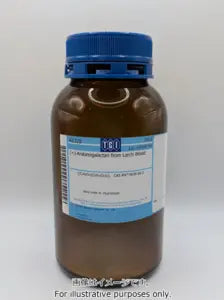
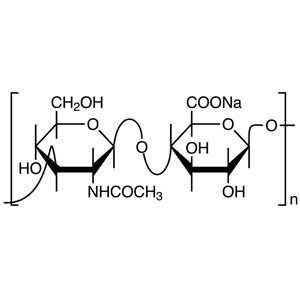
Pullulan from TCI is a natural polysaccharide produced by the fungus *Aureobasidium pullulans*. Its structure is built from maltotriose units joined by α-1,6-glycosidic linkages, which gives it a distinctive linear chain. Within glycoscience and chemical biology, pullulan is used as an enzyme substrate, a film-forming material, a biomaterial matrix, and a model compound for carbohydrate studies. It is used in biochemistry, microbiology, food technology, and pharmaceutical laboratories, where researchers need a well-defined natural polysaccharide for both basic and applied work.
Researchers choose pullulan because it dissolves readily in water and forms clear solutions. These solutions can be cast into thin films that are transparent, flexible, and good at blocking oxygen. Its alternating glycosidic linkages make pullulan a specific substrate for the enzyme pullulanase, which is useful for enzyme characterization work. Pullulan is also non-toxic, biodegradable, and easy to modify chemically. Together, these properties make it a useful platform for drug delivery and tissue engineering research, where biocompatibility and the ability to modify the polymer both matter.
In Indonesia, research on eco-friendly packaging materials, edible films, and pharmaceutical excipients based on natural polymers continues to grow at universities and research institutions. Pullulan fits well into this work. It is a reference polysaccharide for food technology groups developing biodegradable films, for pharmacy faculties studying polymer-based excipients and delivery systems, and for biochemistry and microbiology laboratories running carbohydrate-active enzyme assays. Its clear solutions and film-forming behaviour make it practical for both teaching laboratories and advanced research projects.
TCI brochures (PDF)
- Polysaccharides 2025-02-13 · p. 2
- Drug Delivery System (DDS) Research Reagents 2025-01-29 · p. 1
- Reagents for Glyco Chemistry & Biology 5th Edition · p. 120
- Biomaterials Research Reagents 2025-02-19 · p. 4
- Reagents for Biological Research 2025-03-11 · p. 54
- Pullulanase enzyme assays: the alternating α-1,6 and α-1,4 glycosidic linkages make pullulan a specific substrate for measuring and characterizing pullulanase activity.
- Edible and biodegradable film development: pullulan's clear aqueous solutions cast into transparent, flexible films with good oxygen barrier properties, which suits packaging research.
- Drug delivery research: pullulan is non-toxic, biodegradable, and easy to modify chemically, so it works well as a base polymer for designing carriers and delivery systems.
- Tissue engineering and biomaterial matrices: pullulan is biocompatible and can be modified chemically, which makes it a flexible starting material for building scaffolds and hydrogel-type matrices.
- Carbohydrate model studies: pullulan's well-defined linear maltotriose-based structure makes it a dependable model compound for studying polysaccharide structure, behaviour, and enzymatic degradation.
| Brand | TCI |
|---|---|
| CAS number | 9057-02-7 |
| Molecular formula | — |
| Purity | — |
| Category | Chemistry > Chemical Biology > Glycoscience |
| Pack sizes | as listed on the product page |
| Physical form | solid polysaccharide; see the product label and Safety Data Sheet for the recommended storage conditions |
| Storage | — |
- Product code: P0978
Store pullulan in its original, tightly closed container in a cool, dry place away from direct sunlight and moisture. As a water-soluble polysaccharide, it can absorb humidity, so reseal the container promptly after each use. Avoid contamination by using clean, dry spatulas and glassware. Follow standard laboratory practice: wear gloves, safety glasses, and a lab coat, avoid creating or breathing in dust, and handle the material in a well-ventilated area. Always check the supplier's Safety Data Sheet and label for specific storage temperatures and handling instructions before use.
—
Product Categories
Produk Terkait
-
XylanfromCornCore TCI X0078
Regular price From Rp 1.458.450,00Regular priceRp 1.035.300,00Sale price From Rp 1.458.450,00 -
(+)-ArabinogalactanfromLarchWood TCI A1328
Regular price From Rp 1.246.350,00Regular priceRp 887.250,00Sale price From Rp 1.246.350,00 -
PectinfromCitrus TCI P0024
Regular price From Rp 637.350,00Regular priceRp 460.950,00Sale price From Rp 637.350,00 -
PotassiumHyaluronatefromCockscomb TCI H0652
Regular price Rp 9.459.450,00Regular priceRp 6.630.750,00Sale price Rp 9.459.450,00 -
SodiumHyaluronatefromCockscomb TCI H0603
Regular price From Rp 2.411.850,00Regular priceRp 1.702.050,00Sale price From Rp 2.411.850,00 -
GuarGum TCI G0478
Regular price From Rp 662.550,00Regular priceRp 478.800,00Sale price From Rp 662.550,00 -
Dextrin TCI D4657
Regular price From Rp 743.400,00Regular priceRp 519.750,00Sale price From Rp 743.400,00 -
DermatanSulfateSodiumSalt TCI D3672
Regular price From Rp 2.544.150,00Regular priceRp 1.794.450,00Sale price From Rp 2.544.150,00