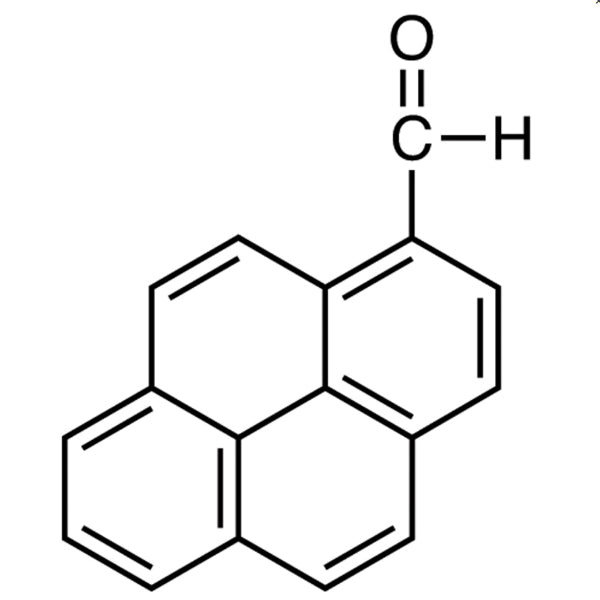
1-Pyrenecarboxaldehyde from TCI is a pyrene derivative. Pyrene is a polycyclic aromatic hydrocarbon made of four fused benzene rings, and this compound carries a single aldehyde group at the 1-position. It pairs a strongly fluorescent pyrene core with a reactive aldehyde group, which makes it a versatile building block. In the laboratory, chemists use it to attach a pyrene unit to other molecules through Schiff base formation, reductive amination, or condensation reactions, so the target molecule takes on pyrene's fluorescence.
Several properties make this compound a common choice. Pyrene is well known for its strong fluorescence and its ability to form excimers, a characteristic emission that appears when two pyrene units come close to each other. This behaviour is very useful for detecting changes in distance, aggregation, or molecular interactions. The aldehyde group offers a convenient attachment point that reacts with amines, hydrazines, or ylides. The extended π-system of pyrene can also interact non-covalently with graphitic surfaces such as graphene and carbon nanotubes, so it is often used as an anchor to functionalise carbon materials.
In Indonesia, 1-Pyrenecarboxaldehyde is of interest to research groups working on fluorescent sensors, supramolecular chemistry, and carbon materials. University chemistry departments, materials science laboratories, and research institutes can use it to build fluorescent probes, label molecules for photophysical studies, or prepare functionalised graphene and nanotube composites. AMI Scientific supplies this TCI product to support synthesis and characterisation work in academic and industrial laboratories across the country.
TCI brochures (PDF)
- Building Blocks for Organic Semiconductor 2026-03-24 · p. 12
- Fluorescent probe synthesis: the aldehyde group lets researchers attach the strongly emitting pyrene unit to receptor molecules, giving sensors that report binding events through changes in fluorescence.
- Schiff base and imine chemistry: the aldehyde condenses readily with primary amines and hydrazines, so it is a straightforward way to make pyrene-labelled imines, hydrazones, and related ligands.
- Reductive amination for molecular labelling: after the imine is reduced, the pyrene unit stays attached through a stable amine linkage, which suits durable fluorescent tagging of target molecules.
- Excimer-based studies of proximity and aggregation: pyrene's characteristic excimer emission lets researchers follow changes in distance, aggregation, or interactions between molecules in solution and in assemblies.
- Non-covalent functionalisation of carbon materials: the extended π-system of pyrene binds to graphene and carbon nanotube surfaces, so the compound acts as an anchor for adding further chemical functionality.
| Brand | TCI (product code P1448) |
|---|---|
| CAS number | 3029-19-4 |
| Molecular formula | — |
| Purity | — |
| Category | Chemistry > Building Blocks > Non-Heterocyclic Building Blocks |
| Pack sizes | available in the pack sizes listed for this product; please check the current product listing |
| Physical form | please refer to the TCI product documentation |
| Storage | follow the storage conditions on the TCI label and Safety Data Sheet |
Keep 1-Pyrenecarboxaldehyde in its original, tightly closed container in a cool, dry, well-ventilated place, away from direct light and from strong oxidising agents. Like many aromatic aldehydes, it can slowly oxidise in air, so close the container promptly after use, and storing it under an inert atmosphere may help preserve its quality. Handle it in a fume hood or another well-ventilated area, and wear suitable gloves, safety glasses, and a laboratory coat. Avoid breathing in dust or vapours and avoid contact with skin and eyes. Always check the Safety Data Sheet supplied with the product for specific hazard, storage, and disposal information, and dispose of waste according to local regulations.
—
Produk Terkait
-
1-PyrenecarboxylicAcid TCI P1687
Regular price From Rp 1.618.050,00Regular price -
Cyclohexanecarboxaldehyde TCI C0880
Regular price From Rp 1.988.700,00Regular price -
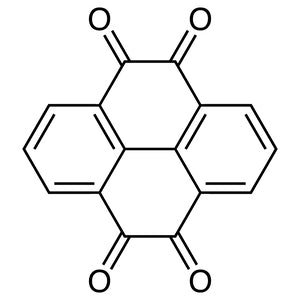
Pyrene-4,5,9,10-tetraone TCI P2947
Regular price Rp 4.743.900,00Regular price -
2-Fluorenecarboxaldehyde TCI F0333
Regular price Rp 3.021.900,00Regular price -
9-Anthracenecarboxaldehyde TCI A0779
Regular price From Rp 1.326.150,00Regular price -
3-Perylenecarboxaldehyde TCI P2110
Regular price From Rp 3.763.200,00Regular price -
1-FluorenecarboxylicAcid TCI F0541
Regular price From Rp 1.696.800,00Regular price -
9-FluorenecarboxylicAcid TCI F0022
Regular price From Rp 980.700,00Regular price