9-Phenylcarbazole from TCI is a carbazole derivative with a phenyl group bonded to the nitrogen atom. Carbazole is an electron-rich, tricyclic aromatic heterocycle and one of the most important frameworks in organic electronics. In the laboratory, 9-phenylcarbazole is used as a heterocyclic building block for hole transport materials, host materials for phosphorescent OLEDs, and a range of photoactive molecules. It is also a simple model compound for studying the optical and electrochemical behaviour of carbazole systems.
Researchers choose this compound because its carbazole framework is rigid, conjugated, and thermally and electrochemically stable, which organic semiconductor materials require. The phenyl group on the nitrogen removes the reactive N-H bond, so the molecule is more stable and easier to process. The 3 and 6 positions of the carbazole ring react readily in electrophilic substitution, such as bromination. Chemists can therefore functionalise the compound and then join it through Suzuki or Buchwald-Hartwig coupling reactions to make more complex molecules or oligomers.
In Indonesia, research on OLED materials, perovskite solar cells, and organic photocatalysts is growing steadily. University chemistry and materials science laboratories, and research institutes, use 9-phenylcarbazole as a starting material when synthesising new carbazole-based hole transport and host compounds. It is also used in teaching and research projects that cover heterocyclic functionalisation, cross-coupling methods, and the characterisation of optoelectronic materials by spectroscopy and electrochemistry.
TCI brochures (PDF)
- Carbazoles 2025-06-27 · p. 4
Related TCI products
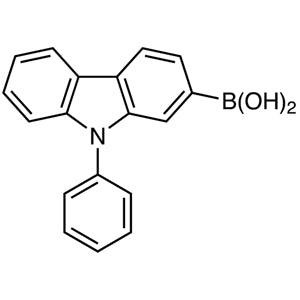
- TCI P2169 1001911-63-2 9-Phenylcarbazole-2-boronic Acid (contains varying amounts of Anhydride)
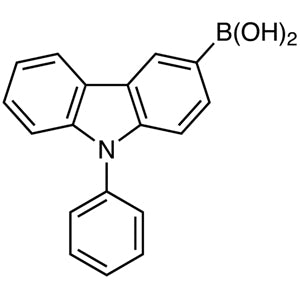
- TCI P2001 854952-58-2 9-Phenylcarbazole-3-boronic Acid (contains varying amounts of Anhydride)
- TCI D4433 56525-79-2 3,6-Diphenylcarbazole
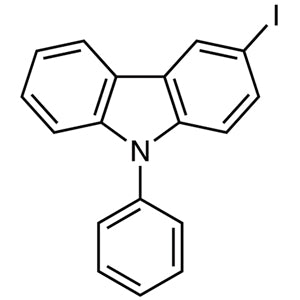
- TCI I0913 502161-03-7 3-Iodo-9-phenylcarbazole
- TCI B4795 1160294-85-8 3-Bromo-6,9-diphenylcarbazole
- TCI B4452 1028647-93-9 3-(4-Bromophenyl)-9-phenylcarbazole
- Hole transport material synthesis: the electron-rich carbazole core carries positive charge well, so 9-phenylcarbazole is a dependable starting framework for building hole transport molecules for organic devices.
- Phosphorescent OLED host materials: the rigid framework is thermally and electrochemically stable, which makes it a good base for host molecules that must stay stable during device operation.
- Electrophilic functionalisation studies: the reactive 3 and 6 positions allow selective bromination and similar substitutions, giving intermediates that can be built into larger structures.
- Suzuki and Buchwald-Hartwig coupling: once functionalised, the compound joins efficiently with other building blocks, so researchers can assemble complex conjugated molecules and oligomers for materials research.
- Model studies of carbazole photophysics: as a simple, N-protected carbazole, it is a useful reference compound for studying the optical and electrochemical properties of carbazole systems.
| Brand | TCI (product code P1492) |
|---|---|
| CAS number | 1150-62-5 |
| Molecular formula | — |
| Purity | — |
| Category | Chemistry > Building Blocks > Heterocyclic Building Blocks |
| Pack sizes | see the available options on the product page |
| Physical form | see the TCI product label and certificate of analysis |
| Storage | keep in a tightly closed container in a cool, dry place |
Store 9-phenylcarbazole in its original tightly closed container in a cool, dry, well-ventilated place, away from direct sunlight, heat sources, and strong oxidising agents. Glass or other chemically compatible containers with secure caps are suitable if the material is repacked. Handle it in line with standard laboratory practice: wear safety glasses, gloves, and a lab coat, avoid creating dust, and work in a fume hood when possible. Always read the TCI Safety Data Sheet before use, label all containers clearly, and dispose of waste according to institutional and local regulations.
—
Produk Terkait
-
9-Phenylcarbazole-2-boronicAcid(containsvaryingamountsofAnhydride) TCI P2169
Regular price From Rp 477.750,00Regular price -
9-Phenylcarbazole-3-boronicAcid(containsvaryingamountsofAnhydride) TCI P2001
Regular price From Rp 1.670.550,00Regular price -
3,6-Diphenylcarbazole TCI D4433
Regular price Rp 2.199.750,00Regular price -
3-Iodo-9-phenylcarbazole TCI I0913
Regular price From Rp 955.500,00Regular price -
3-Bromo-6,9-diphenylcarbazole TCI B4795
Regular price From Rp 689.850,00Regular price -
3-(4-Bromophenyl)-9-phenylcarbazole TCI B4452
Regular price From Rp 477.750,00Regular price -
2-Bromo-9-phenylcarbazole TCI B4439
Regular price From Rp 1.961.400,00Regular price -
3-Bromo-9-phenylcarbazole TCI B3908
Regular price From Rp 980.700,00Regular price