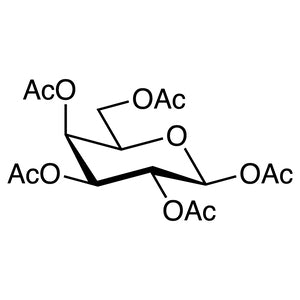
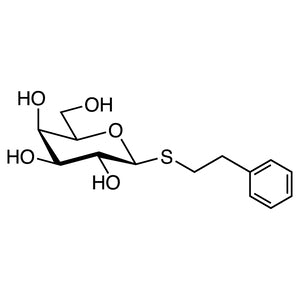
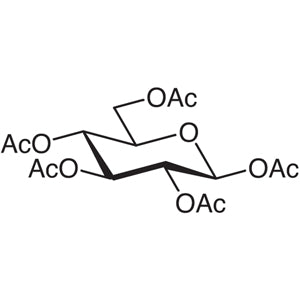
1,2,3,4,6-Penta-O-acetyl-alpha-D-galactopyranose from TCI (product code P3253) is a galactose derivative in which every hydroxyl group has been acetylated, with an alpha configuration at the anomeric carbon. It is one of the most common starting materials in carbohydrate chemistry and glycoscience. In the laboratory, protected sugars like this one serve as precursors to glycosyl donors. Researchers use them to build galactosides, oligosaccharides and glycoconjugates, which matter in studies of cell recognition, in immunology and in the development of carbohydrate-based drugs.
Its main advantage is that acetyl groups protect all of the hydroxyl positions. This makes the sugar more soluble in organic solvents and easier to purify than free galactose. The acetylated anomeric position can be activated selectively, for example by converting it into a glycosyl halide or a thioglycoside, which allows glycosidic bonds to form in a controlled way. The acetyl groups can also be removed under commonly used deacetylation conditions. Because its stereochemistry is clearly defined, the compound is a reliable starting point for stepwise synthesis, where predictable outcomes at each stage are essential.
In Indonesia, this compound is useful to researchers working in natural product chemistry, medicinal chemistry and chemical biology. University research groups, pharmaceutical research and development teams, and institutional laboratories can use it as a dependable building block for carbohydrate synthesis projects. These include glycoside preparation, oligosaccharide assembly and glycoconjugate studies. Sourcing it through AMI Scientific gives local laboratories access to a recognised TCI reagent for both teaching-oriented synthesis and advanced glycoscience research programmes.
Related TCI products
- TCI T2110 50615-66-2 2,3,4,6-Tetra-O-acetyl-1-thio-beta-D-galactopyranose
- TCI G0247 4163-60-4 Penta-O-acetyl-beta-D-galactopyranose
- TCI P2921 63407-54-5 2-Phenylethyl 1-Thio-beta-D-galactopyranoside
- TCI P2078 183875-28-7 Phenyl 2-O-Acetyl-3,4,6-tri-O-benzyl-1-thio-beta-D-galactopyranoside
- TCI I0328 367-93-1 Isopropyl 1-Thio-beta-D-galactopyranoside
- TCI P0028 604-69-3 Penta-O-acetyl-beta-D-glucopyranose
- Glycosyl donor preparation: the acetylated anomeric position can be selectively converted into glycosyl halides or thioglycosides, giving activated donors for controlled glycosylation reactions.
- Galactoside synthesis: the fully protected galactose framework and defined alpha stereochemistry give a reliable starting point for building galactoside targets step by step.
- Oligosaccharide assembly: as a protected galactose unit, it helps researchers build longer sugar chains while keeping the remaining hydroxyl groups masked until deprotection is needed.
- Glycoconjugate research: it supports the preparation of galactose-containing conjugates used in studies of cell recognition, immunology and carbohydrate-mediated biological interactions.
- Carbohydrate-based drug development: it suits medicinal chemistry programmes that need a well-defined, protected sugar precursor which handles easily in organic solvents and purifies readily.
| Brand | TCI (product code P3253) |
|---|---|
| CAS number | 4163-59-1 |
| Molecular formula | — |
| Purity | — |
| Category | Chemistry > Chemical Biology > Glycoscience |
| Pack sizes | please check the available pack options on the product page |
| Physical form | — |
| Storage | follow the storage conditions on the TCI label and the Safety Data Sheet |
- Chemical description: fully acetylated D-galactopyranose with alpha anomeric configuration
Keep the product tightly sealed in its original TCI container. Store it in a cool, dry and well-ventilated area, away from moisture, heat sources and incompatible substances such as strong acids, strong bases and strong oxidising agents. Always follow the specific storage temperature shown on the product label and in the Safety Data Sheet. Handle the material in a fume hood or a well-ventilated area, and wear standard personal protective equipment, including safety glasses, gloves and a laboratory coat. Avoid creating or breathing in dust, and avoid contact with skin and eyes. Close the container promptly after each use to limit exposure to air and humidity. Dispose of waste in line with local regulations and your institution's chemical waste procedures.
—
Product Categories
Produk Terkait
-
2,3,4,6-Tetra-O-acetyl-1-thio-beta-D-galactopyranose TCI T2110
Regular price Rp 2.835.000,00Regular priceRp 1.998.150,00Sale price Rp 2.835.000,00 -
Penta-O-acetyl-beta-D-galactopyranose TCI G0247
Regular price From Rp 2.730.000,00Regular priceRp 1.924.650,00Sale price From Rp 2.730.000,00 -
2-Phenylethyl1-Thio-beta-D-galactopyranoside TCI P2921
Regular price Rp 7.526.400,00Regular priceRp 5.278.350,00Sale price Rp 7.526.400,00 -
Phenyl2-O-Acetyl-3,4,6-tri-O-benzyl-1-thio-beta-D-galactopyranoside TCI P2078
Regular price Rp 10.281.600,00Regular priceRp 7.205.100,00Sale price Rp 10.281.600,00 -
Isopropyl1-Thio-beta-D-galactopyranoside TCI I0328
Regular price From Rp 769.650,00Regular priceRp 553.350,00Sale price From Rp 769.650,00 -
Penta-O-acetyl-beta-D-glucopyranose TCI P0028
Regular price From Rp 1.696.800,00Regular priceRp 1.202.250,00Sale price From Rp 1.696.800,00 -
Penta-O-acetyl-alpha-D-glucopyranose TCI G0225
Regular price From Rp 1.087.800,00Regular priceRp 775.950,00Sale price From Rp 1.087.800,00 -
1,2:3,4-Di-O-isopropylidene-alpha-D-galactopyranose TCI D2555
Regular price From Rp 1.670.550,00Regular priceRp 1.183.350,00Sale price From Rp 1.670.550,00