

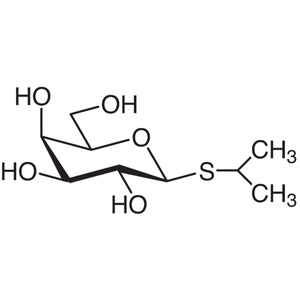
Isopropyl 1-Thio-beta-D-galactopyranoside (IPTG) is a chemical compound widely used in biotechnology and biochemistry laboratories. It serves as an inducer for the activation of genes containing the lac operon promoter in *Escherichia coli*. This compound is essential for the expression of genetically engineered proteins, making it a critical reagent in molecular biology research. Its stability and solubility in water allow it to be easily incorporated into various experimental protocols, supporting both basic and applied research.
IPTG is chemically stable and does not readily decompose under normal laboratory conditions, ensuring consistent performance across experiments. Its high water solubility simplifies preparation and use in aqueous solutions, which is crucial for many biochemical applications. Additionally, IPTG is non-toxic, making it a safe and practical choice for laboratory use. These properties contribute to its widespread adoption in both academic and industrial research settings.
In Indonesian laboratories, IPTG is commonly used in biotechnology research, particularly in vaccine development, therapeutic protein production, and biosensor applications. It is a fundamental component in genetic and biochemical experiments conducted by research institutions and universities. Its availability and cost-effectiveness make it a preferred choice for researchers working on a variety of biological projects.
- Genetic expression studies benefit from IPTG as it reliably induces gene expression in *E. coli*, facilitating protein production for research and industrial applications.
- Biosensor development utilizes IPTG to trigger specific responses in engineered systems, enhancing the sensitivity and accuracy of detection methods.
- Vaccine research employs IPTG to control the expression of antigens in recombinant systems, supporting the development of novel immunological products.
- Protein purification protocols incorporate IPTG to activate expression vectors, ensuring the production of target proteins in sufficient quantities.
- Biomedical research relies on IPTG to study gene regulation mechanisms, contributing to advancements in molecular biology and therapeutic strategies.
| Brand | TCI |
|---|---|
| CAS number | 367-93-1 |
| Molecular formula | — |
| Purity | — |
| Category | Chemistry > Chemical Biology > Glycoscience |
| Pack sizes | Available in various sizes to meet different research needs |
| Physical form | Solid powder |
| Storage | Store in a cool, dry place away from light |
IPTG should be stored in a cool, dry place, away from direct light to maintain its chemical stability. It is recommended to use airtight containers to prevent moisture absorption, which could affect its solubility and purity. Due to its non-toxic nature, standard laboratory safety practices are sufficient for handling IPTG. It is important to ensure that the compound is kept in a secure location, away from incompatible substances. Proper labeling of containers is essential to avoid confusion and ensure safe usage in laboratory settings.
—
Produk Terkait
-
Phenyl2-O-Acetyl-3,4,6-tri-O-benzyl-1-thio-beta-D-galactopyranoside TCI P2078
Regular price Rp 10.229.100,00Regular price -
Penta-O-acetyl-beta-D-galactopyranose TCI G0247
Regular price From Rp 2.677.500,00Regular price -
5-Bromo-3-indolylbeta-D-Galactopyranoside[forBiochemicalResearch] TCI B3470
Regular price From Rp 743.400,00Regular price -
5-Bromo-4-chloro-3-indolylbeta-D-Galactopyranoside[forBiochemicalResearch] TCI B3201
Regular price From Rp 1.326.150,00Regular price -
Phenylbeta-D-Galactopyranoside TCI P1326
Regular price From Rp 3.207.750,00Regular price -
4-Nitrophenylbeta-D-Galactopyranoside[Substrateforbeta-Galactosidase] TCI N0616
Regular price From Rp 1.961.400,00Regular price -
4-Nitrophenylalpha-D-Galactopyranoside[Substrateforalpha-D-Galactosidase] TCI N0492
Regular price Rp 1.298.850,00Regular price -
2-Nitrophenylbeta-D-Galactopyranoside[Substrateforbeta-D-Galactosidase] TCI N0418
Regular price From Rp 848.400,00Regular price

![97753-82-7 5-Bromo-3-indolyl beta-D-Galactopyranoside [for Biochemical Research] - AMI Scientific](http://amiscientific.com/cdn/shop/files/TCI2510B3470.jpg?v=1768193597&width=533)
![7240-90-6 5-Bromo-4-chloro-3-indolyl beta-D-Galactopyranoside [for Biochemical Research] - AMI Scientific](http://amiscientific.com/cdn/shop/files/TCI2510B3201.jpg?v=1768193511&width=533)

![3150-24-1 4-Nitrophenyl beta-D-Galactopyranoside [Substrate for beta-Galactosidase] - AMI Scientific](http://amiscientific.com/cdn/shop/files/TCI2510N0616.jpg?v=1767130131&width=533)
![7493-95-0 4-Nitrophenyl alpha-D-Galactopyranoside [Substrate for alpha-D-Galactosidase] - AMI Scientific](http://amiscientific.com/cdn/shop/files/TCI2510N0492.jpg?v=1767129934&width=533)
![369-07-3 2-Nitrophenyl beta-D-Galactopyranoside [Substrate for beta-D-Galactosidase] - AMI Scientific](http://amiscientific.com/cdn/shop/files/TCI2510N0418.jpg?v=1767129806&width=533)