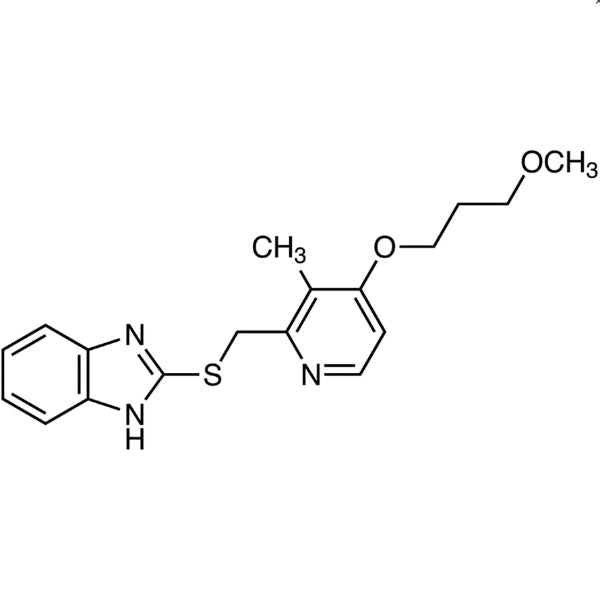
Rabeprazole Sulfide is a chemical compound widely used in pharmaceutical research and biochemical studies. It serves as a key reagent in experimental settings, particularly in the investigation of pharmacological effects and mechanisms of action of various compounds. This compound plays a vital role in drug development and pharmacological research, especially in the field of gastroenterology and digestive system disorders. Its application extends to both preclinical and clinical research, making it an essential component for laboratories focused on drug discovery and therapeutic innovation.
The compound is valued for its chemical stability and controlled reactivity, which are critical for maintaining the integrity of experimental results. Its ability to dissolve in organic solvents and its availability in solid form make it highly versatile for a range of experimental protocols. These properties ensure that it can be reliably used in various laboratory conditions without compromising the accuracy of the research. Its molecular structure allows for precise chemical interactions, making it suitable for experiments requiring high levels of precision and reproducibility.
In Indonesian laboratories, Rabeprazole Sulfide is commonly used in pharmacological and biochemical research. It is frequently found in pharmaceutical research labs, academic institutions, and research organizations dedicated to the development of new drugs. Its stability and reliability make it a preferred choice for studies involving drug mechanisms, bioavailability, and therapeutic effects. This compound supports a wide range of experimental applications, contributing to the advancement of scientific knowledge in the field of medicine.
TCI brochures (PDF)
- Pharmaceutical Ingredients for Research and Experimental Use 2026-03-09 · p. 47
- Pharmacological research in gastroenterology due to its role in studying proton pump inhibitors and digestive system disorders.
- Biochemical experiments requiring stable and reactive compounds for drug mechanism analysis.
- Drug development studies where precise chemical interactions are essential for testing new therapeutic agents.
- Clinical research applications involving the evaluation of drug efficacy and pharmacokinetics in experimental models.
- Academic and industrial research settings focused on the synthesis and testing of pharmaceutical compounds.
| Brand | TCI |
|---|---|
| CAS number | 117977-21-6 |
| Molecular formula | — |
| Purity | — |
| Category | Life Science > Biochemicals and Reagents > Pharmaceutical Research Reagents |
| Pack sizes | Available in standard laboratory quantities |
| Physical form | Solid |
| Storage | Store in a cool, dry place away from moisture and direct light |
Rabeprazole Sulfide should be stored in a cool, dry environment to maintain its chemical stability. It is recommended to keep the compound in airtight containers to prevent exposure to moisture and air, which could affect its integrity. Proper labeling of storage containers is essential for safety and traceability. Laboratory personnel should handle the compound with care, using appropriate personal protective equipment when necessary. It is important to ensure that storage conditions are consistent with standard laboratory safety protocols to prevent degradation or contamination. Regular inspection of storage areas is advised to maintain optimal conditions for the compound's use in research.
—
Product Categories
Produk Terkait
-
RabeprazoleSodiumSalt TCI R0115
Regular price Rp 2.199.750,00Regular priceRp 1.554.000,00Sale price Rp 2.199.750,00 -
OmeprazoleSulfide TCI O0437
Regular price Rp 1.351.350,00Regular priceRp 960.750,00Sale price Rp 1.351.350,00 -
Tin(IV)Sulfide TCI T4244
Regular price Rp 1.193.850,00Regular priceRp 834.750,00Sale price Rp 1.193.850,00 -
Antimony(V)Sulfide TCI A3628
Regular price Rp 1.035.300,00Regular priceRp 723.450,00Sale price Rp 1.035.300,00 -
TrimethyleneSulfide TCI T0474
Regular price Rp 3.180.450,00Regular priceRp 2.239.650,00Sale price Rp 3.180.450,00 -
PropyleneSulfide(stabilizedwithButylMercaptan) TCI P0321
Regular price Rp 1.272.600,00Regular priceRp 905.100,00Sale price Rp 1.272.600,00 -
PentamethyleneSulfide TCI P0044
Regular price Rp 1.776.600,00Regular priceRp 1.257.900,00Sale price Rp 1.776.600,00