


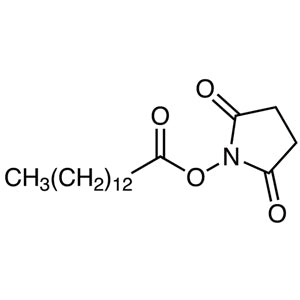
N-Succinimidyl Tetradecanoate is a chemical compound widely used in bioconjugation applications within laboratory settings. It serves as an activation reagent that facilitates the covalent bonding of biological molecules such as proteins, peptides, and nucleic acids to various substrates. This compound plays a crucial role in enabling the formation of stable and specific molecular linkages, which are essential in many biochemical and biotechnological processes. Its utility spans across multiple research areas, making it a versatile tool for scientists working in chemical biology and related fields.
The compound's effectiveness is largely due to its highly specific chemical properties. It is capable of reacting with amino groups on target molecules, allowing for precise and controlled conjugation reactions. This specificity ensures that the resulting conjugates maintain their structural and functional integrity, which is vital for applications requiring high accuracy. Additionally, its chemical stability under standard laboratory conditions contributes to its reliability and ease of use, making it a preferred choice for researchers.
In Indonesian laboratories, N-Succinimidyl Tetradecanoate is commonly used in biomedical research, organic chemistry, and biotechnology. It is a key component in various experimental protocols, including protein immobilization and the synthesis of bioconjugates. Its high quality and consistent performance make it a trusted reagent among research institutions and academic laboratories in Indonesia.
TCI brochures (PDF)
- Human-Serum-Albumin Binding Agents for Improvement of Pharmacokinetics 2019-02-22 · p. 1
Related TCI products
- TCI F1143 1128181-23-6 Nalpha-[(9H-Fluoren-9-ylmethoxy)carbonyl]-Nepsilon-tetradecanoyl-L-lysine
- TCI S0814 38862-24-7 N-Succinimidyl Acrylate
- TCI S0812 38862-25-8 N-Succinimidyl Methacrylate
- TCI S0491 35013-72-0 N-Succinimidyl D-Biotinate
- TCI D4019 23024-29-5 Di(N-succinimidyl) Sebacate
- TCI D3895 68528-80-3 Di(N-succinimidyl) Suberate
- Bioconjugation Research - This item is ideal for creating stable covalent bonds between biomolecules, enabling precise molecular modifications in biochemical experiments.
- Protein Immobilization - Its ability to react with amino groups makes it suitable for attaching proteins to solid surfaces, which is essential in biosensor development.
- Peptide Conjugation - The compound facilitates the attachment of peptides to various substrates, supporting applications in drug development and molecular biology.
- Nucleic Acid Modification - It enables the conjugation of nucleic acids to other molecules, which is useful in genetic engineering and molecular diagnostics.
- Surface Functionalization - Its reactivity with amino groups allows for the modification of surfaces in lab-based applications such as microarray fabrication.
From the TCI brochure
- Myristoylation reagent; fatty acid derivative shown among those reported to bind albumin
| Brand | TCI |
|---|---|
| CAS number | 69888-86-4 |
| Molecular formula | — |
| Purity | — |
| Category | Chemistry > Chemical Biology > Bioconjugation |
| Pack sizes | Available in various quantities as per standard laboratory reagent packaging |
| Physical form | Solid or liquid depending on the specific formulation |
| Storage | Store in a cool, dry place away from direct light and moisture |
N-Succinimidyl Tetradecanoate should be stored in a cool, dry environment, away from direct sunlight and moisture to maintain its chemical stability. It is recommended to keep the compound in a tightly sealed container to prevent exposure to air and humidity, which could affect its reactivity. In laboratory settings, it should be handled with appropriate personal protective equipment, such as gloves and safety goggles, to ensure safe usage. Due to its chemical nature, it should be stored separately from incompatible substances to avoid any potential reactions. Proper labeling of storage containers is essential for safe handling and to prevent accidental exposure. Regular monitoring of storage conditions is advised to ensure the compound remains in optimal condition for use in research applications.
References cited in the TCI brochure
- P Kurtzhals. Albumin binding of insulins acylated with fatty acids: characterization of the ligand-protein interaction and correlation between binding affinity and timing of the insulin effect in vivo Biochemical Journal, 1995. doi:10.1042/bj3120725
- Batya Plotkin. Insulin Mimetic Action of Synthetic Phosphorylated Peptide Inhibitors of Glycogen Synthase Kinase-3 The Journal of Pharmacology and Experimental Therapeutics, 2003. doi:10.1124/jpet.102.047381
- Ib Jonassen. Design of the Novel Protraction Mechanism of Insulin Degludec, an Ultra-long-Acting Basal Insulin Pharmaceutical Research, 2012. doi:10.1007/s11095-012-0739-z
- Yuanyan Tan. Myristic acid-modified thymopentin for enhanced plasma stability and immune-modulating activity International Immunopharmacology, 2017. doi:10.1016/j.intimp.2017.03.025
Product Categories
- Biochemicals and ReagentsAlbumin Binding AgentsAlbumin Binding Modification Reagents
- Biochemicals and ReagentsBioconjugationAlbumin Binding Modification Reagents
- Pharmaceutical Development and Drug Discovery ResearchAlbumin Binding AgentsAlbumin Binding Modification Reagents
- Pharmaceutical Development and Drug Discovery ResearchBioconjugationAlbumin Binding Modification Reagents
Produk Terkait
-
Nalpha-[(9H-Fluoren-9-ylmethoxy)carbonyl]-Nepsilon-tetradecanoyl-L-lysine TCI F1143
Regular price From Rp 4.611.600,00Regular priceRp 3.240.300,00Sale price From Rp 4.611.600,00 -
N-SuccinimidylAcrylate TCI S0814
Regular price From Rp 3.207.750,00Regular priceRp 2.258.550,00Sale price From Rp 3.207.750,00 -
N-SuccinimidylMethacrylate TCI S0812
Regular price From Rp 2.650.200,00Regular priceRp 1.869.000,00Sale price From Rp 2.650.200,00 -
N-SuccinimidylD-Biotinate TCI S0491
Regular price From Rp 2.013.900,00Regular priceRp 1.423.800,00Sale price From Rp 2.013.900,00 -
Di(N-succinimidyl)Sebacate TCI D4019
Regular price From Rp 1.670.550,00Regular priceRp 1.183.350,00Sale price From Rp 1.670.550,00 -
Di(N-succinimidyl)Suberate TCI D3895
Regular price From Rp 2.809.800,00Regular priceRp 1.980.300,00Sale price From Rp 2.809.800,00 -
Di(N-succinimidyl)Carbonate TCI D1662
Regular price From Rp 1.934.100,00Regular priceRp 1.368.150,00Sale price From Rp 1.934.100,00 -
2-OctyldodecylTetradecanoate TCI O0701
Regular price Rp 2.121.000,00Regular priceRp 1.498.350,00Sale price Rp 2.121.000,00


