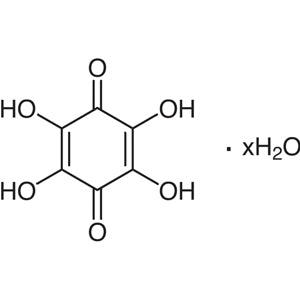
TCI T0122 Tetrahydroxy-1,4-benzoquinone Disodium Salt is the sodium salt of tetrahydroxy-1,4-benzoquinone. Its molecule has a quinone ring with four functional oxygen groups around it. In the laboratory it is classed as a non-heterocyclic building block. It is redox-active and can act as a bridging ligand for metal ions. This makes it useful for synthesis in coordination chemistry, for research on functional materials, and for electrochemical studies of organic compounds that can store and release electrons.
Researchers choose this compound mainly because its quinone-enolate system can undergo stepwise, reversible redox reactions. That behaviour matters in research on organic electrode materials. The oxygen groups are arranged symmetrically, so the molecule can bridge two metal centres and build coordination polymers or higher-dimensional metal-organic frameworks. As a sodium salt, it is easier to handle and dissolves more readily in aqueous media than the acid form. This gives researchers more practical control when preparing solutions and running reactions in the lab.
The compound is usually a dark-coloured solid that is sensitive to air oxidation and moisture, so it needs careful handling during routine work. Interest in energy storage research keeps growing in Indonesia, including work on battery development. University research groups, materials science laboratories and electrochemistry teams can use this building block to explore redox-active organic systems and to synthesise new coordination compounds. It also suits research on functional materials and teaching projects in synthetic and coordination chemistry.
Related TCI products
- TCI T1090 123334-16-7 Tetrahydroxy-1,4-benzoquinone Hydrate
- TCI B1984 3602-55-9 2-tert-Butyl-1,4-benzoquinone
- TCI T0672 527-17-3 Tetramethyl-1,4-benzoquinone
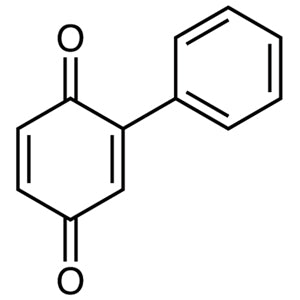
- TCI P2674 363-03-1 2-Phenyl-1,4-benzoquinone
- TCI D2706 530-55-2 2,6-Dimethoxy-1,4-benzoquinone
- TCI D2430 3383-21-9 3,5-Di-tert-butyl-1,2-benzoquinone
- Coordination chemistry synthesis: the symmetrically arranged oxygen groups can bridge two metal centres, so the compound is a useful ligand for building new metal complexes and coordination polymers.
- Metal-organic framework research: because it bridges metal ions, the molecule can help form higher-dimensional frameworks, which suits studies on the design of porous and functional materials.
- Organic electrode material studies: its quinone-enolate system undergoes stepwise, reversible redox reactions, so it is relevant to research on organic materials for energy storage electrodes.
- Electrochemistry of organic compounds: the redox-active quinone core can store and release electrons, which makes it a good model compound for electrochemical studies of electron-transfer behaviour.
- Aqueous-phase reactions and solution preparation: as a sodium salt it dissolves more readily in aqueous media than the acid form, so it is practical for reactions and analyses that need water-based solutions.
| Brand | TCI (product code T0122) |
|---|---|
| CAS number | 1887-02-1 |
| Molecular formula | — |
| Purity | — |
| Category | Chemistry > Building Blocks > Non-Heterocyclic Building Blocks |
| Pack sizes | available in the pack sizes TCI supplies for this product code |
| Physical form | usually a dark-coloured solid |
| Storage | sensitive to air oxidation and moisture; keep tightly sealed and protected |
This compound is sensitive to air oxidation and moisture. Keep it in a tightly sealed container, ideally the original supplier packaging, in a cool, dry place away from direct light and incompatible substances. After opening, reduce exposure to air by closing the container right after use. Where possible, store it under an inert atmosphere or in a desiccator. Handle the material in a well-ventilated area or a fume hood, and wear suitable personal protective equipment such as gloves, safety glasses and a lab coat. Avoid creating dust, and do not let the material touch skin or eyes. Always read the supplier's Safety Data Sheet before use, and follow local regulations for disposing of chemical waste.
—
Produk Terkait
-
Tetrahydroxy-1,4-benzoquinoneHydrate TCI T1090
Regular price Rp 1.618.050,00Regular priceRp 1.146.600,00Sale price Rp 1.618.050,00 -
2-tert-Butyl-1,4-benzoquinone TCI B1984
Regular price Rp 1.167.600,00Regular priceRp 831.600,00Sale price Rp 1.167.600,00 -
Tetramethyl-1,4-benzoquinone TCI T0672
Regular price From Rp 1.538.250,00Regular priceRp 1.090.950,00Sale price From Rp 1.538.250,00 -
2-Phenyl-1,4-benzoquinone TCI P2674
Regular price From Rp 689.850,00Regular priceRp 497.700,00Sale price From Rp 689.850,00 -
2,6-Dimethoxy-1,4-benzoquinone TCI D2706
Regular price Rp 2.332.050,00Regular priceRp 1.646.400,00Sale price Rp 2.332.050,00 -
3,5-Di-tert-butyl-1,2-benzoquinone TCI D2430
Regular price From Rp 3.551.100,00Regular priceRp 2.499.000,00Sale price From Rp 3.551.100,00 -
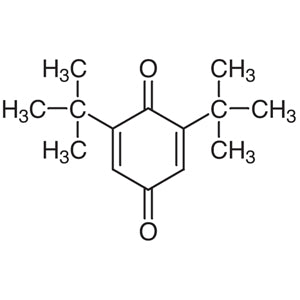
2,6-Di-tert-butyl-1,4-benzoquinone TCI D2256
Regular price From Rp 2.359.350,00Regular priceRp 1.665.300,00Sale price From Rp 2.359.350,00 -
2,6-Dimethyl-1,4-benzoquinone TCI D2234
Regular price From Rp 1.220.100,00Regular priceRp 868.350,00Sale price From Rp 1.220.100,00