

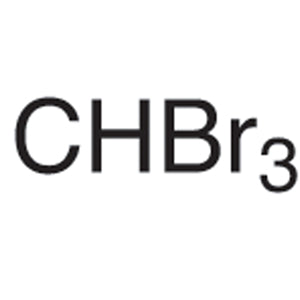
Bromoform, with the chemical formula CHBr₃, is an organic halogen compound widely used in various chemical reactions. As a key building block in organic chemistry, it plays a crucial role in the synthesis of complex organic molecules. Its unique reactivity makes it a valuable reagent in substitution reactions and radical processes. Bromoform is commonly used in laboratory settings for its ability to participate in a wide range of chemical transformations. Its stability when stabilized with ethanol enhances its usability and safety in experimental environments.
This compound is known for its chemical stability and high reactivity under specific conditions. The stabilization with ethanol not only improves its shelf life but also reduces volatility, making it safer to handle. Its characteristic dark brown color and distinct odor aid in visual identification, which is essential in a laboratory setting. The combination of stability and reactivity makes bromoform a preferred choice for researchers requiring both reliable performance and controlled chemical behavior.
In Indonesian laboratories, bromoform is frequently utilized in organic chemistry research and halogen compound analysis. It is a staple in academic and research institutions where high reactivity and stability are required for experimental success. Its presence in the lab supports the development of new compounds and the study of chemical mechanisms, making it an essential tool for scientific inquiry in Indonesia.
Related TCI products
- Organic synthesis reactions benefit from bromoform’s reactivity and role as a halogen source, enabling the formation of complex organic compounds.
- Halogen compound analysis uses bromoform as a reference standard due to its well-defined chemical properties and stability.
- Radical substitution reactions rely on bromoform’s ability to generate reactive intermediates, enhancing the efficiency of synthetic pathways.
- Laboratory safety protocols utilize bromoform’s stabilized form to reduce volatility and ensure safer handling during experiments.
- Research in environmental chemistry employs bromoform to study halogenated compounds and their impact on chemical processes.
| Brand | TCI |
|---|---|
| CAS number | 75-25-2 |
| Molecular formula | — |
| Purity | — |
| Category | Chemistry > Building Blocks > Non-Heterocyclic Building Blocks |
| Pack sizes | Available in standard laboratory quantities as per supplier specifications |
| Physical form | Liquid |
| Storage | Store in a cool, dark place away from heat and direct sunlight |
Bromoform should be stored in a cool, dark environment to maintain its stability and prevent degradation. It is recommended to use airtight containers made of glass or high-density polyethylene to minimize exposure to air and moisture. Due to its volatility, the container should be sealed tightly to prevent evaporation. In laboratory settings, bromoform should be handled in a well-ventilated area to avoid inhalation of vapors. Proper personal protective equipment, such as gloves and safety goggles, should always be worn when handling this compound. Regular monitoring of storage conditions is essential to ensure the compound remains safe and effective for use in experiments.
—
Produk Terkait
-
Bromoform(stabilizedwith2-Methyl-2-butene)[forSpectrophotometry] TCI B0806
Regular price Rp 6.333.600,00Regular price -
2-(Benzyloxy)ethanol TCI B0426
Regular price From Rp 557.550,00Regular price -
1-(2-Nitrophenyl)ethanol TCI N1132
Regular price From Rp 1.881.600,00Regular price -
1-(2-Naphthyl)ethanol TCI N0788
Regular price From Rp 1.936.200,00Regular price -
2-(1-Naphthyl)ethanol TCI N0575
Regular price From Rp 1.326.150,00Regular price -
2-(4-Nitrophenyl)ethanol TCI N0569
Regular price From Rp 1.353.450,00Regular price -
trans-2-Nonenal(containstrans-2-NonenalDiethylAcetal)(ca.10%inEthanol,ca.0.57mol/L) TCI N0430
Regular price Rp 1.405.950,00Regular price -
1-(1-Naphthyl)ethanol TCI N0395
Regular price From Rp 2.016.000,00Regular price
![75-25-2 Bromoform (stabilized with 2-Methyl-2-butene) [for Spectrophotometry] - AMI Scientific](http://amiscientific.com/cdn/shop/files/TCI2510B0806.jpg?v=1767086115&width=533)


